.avif)
Your outbound program is probably misfiring, and not because the sales reps are bad.
It is misfiring because the trigger to reach out has nothing to do with the buyer.
Quotas, list-loads, and quarter starts pick when you send. Buyers, meanwhile, decide on their own schedule. Gartner research shows more than 70% of the B2B buying journey now happens before a vendor is even contacted. The form-fill catches only the last sliver.
Meanwhile, your sales reps are working a queue of webinar attendees from six weeks ago.
That is the gap signal-based prospecting closes.
Why old-school prospecting stopped working
Spray-and-pray outbound stopped working for three reasons at once.
Buyers stay anonymous longer. The form-fill is a late-cycle act. Inbound captures less of the real demand every quarter.
Inboxes hardened. Google and Microsoft tightened bulk-sender rules in 2024 and 2025. High-volume cadences now burn your domain on top of missing target.
The data layer got dramatically better. Intent vendors, deanonymization tools, and AI enrichment can tell you when an account is in-market with real precision.
The bottleneck is not data. It is acting on signals fast enough to matter.
What signal-based prospecting really is
Signal-based prospecting is simple to define.
The trigger to reach out to an account is a real buying signal. The message is shaped by that signal.
A signal is anything that meaningfully shifts the chance of a deal: a target account visiting your pricing page, a prospect adding a competitor to their tech stack, a new Vice President of Marketing joining your target enterprise, or a Series B round closing.
Each one is a fresh, time-bounded reason to reach out. And each one gives a clear angle for the message.
Compared to old-school outbound, four things change at once. The trigger is a signal event, not a quota cycle. The audience is the slice of your ideal customer profile where a signal fired, not your whole list. The message is a contextual point of view, not a templated cold open. The cadence is a branching journey, not a fixed sequence.
The idea is not new. What made it work at scale in 2026 was three layers finally clicking together: signal ingestion, signal orchestration, and AI-generated 1:1 content that is actually accurate.
Not every signal deserves the same response
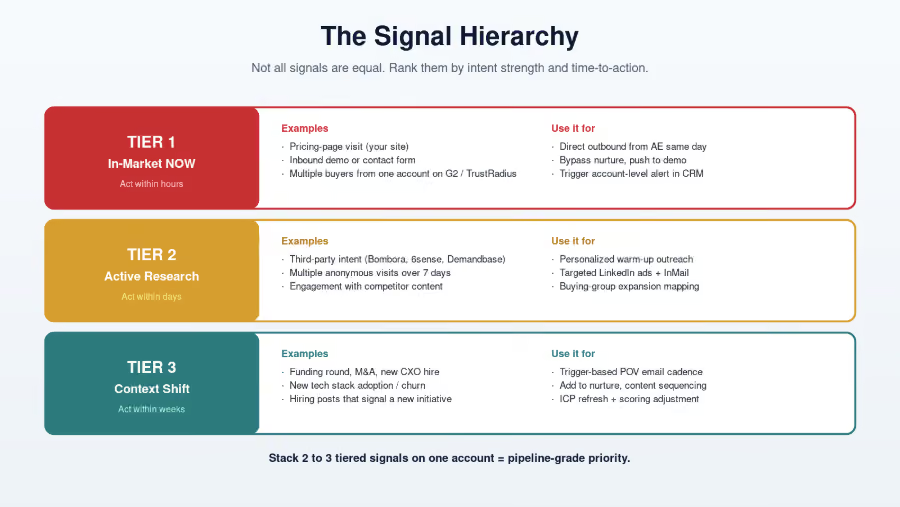
Not every signal earns an account executive phone call. A useful first move is to tier signals by intent strength and time-to-action.
Tier 1: In-market now
The account is buying something like what you sell, this week. Pricing-page visits from named contacts. Demo requests. Multiple visitors from one account on G2 or TrustRadius. Get an account executive on a call within 24 hours.
Tier 2: Active research
The account is researching off-domain. Third-party intent surges from Bombora, 6sense, or Demandbase. Repeated anonymous visits. Engagement with competitor content. Run a warm-up sequence over a few days. Layer in targeted ads.
Tier 3: Context shift
Their context just changed in a way that touches your pitch. A new C-suite hire. A funding round. A tech-stack change. A strategic job posting. Use these as triggers for point-of-view outreach and content sequencing.
Single-signal outreach often underperforms. Stack two or three tiered signals on one account and you have a pipeline-grade priority.
The six stations every signal engine has to run
A signal-based program is not a sequence. It is a small engine that runs the same six stations every day.

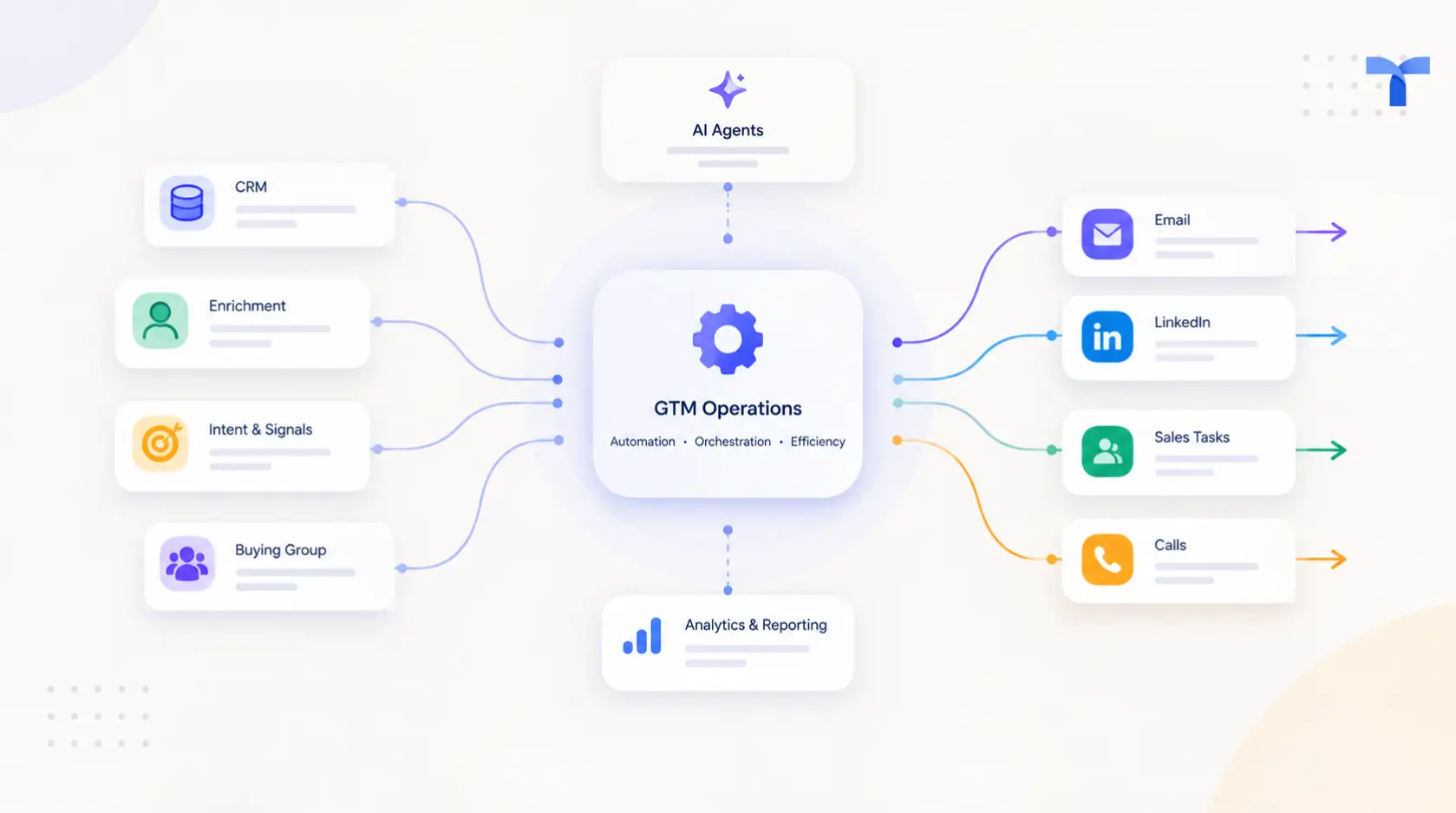
The loop begins with ingest, pulling first-party, second-party, and third-party signals into one place. From there it moves to enrich, adding account, buying-group, and persona context to every raw signal. Next is score, ranking signals by tier and by historical conversion. Then personalize, generating a 1:1 message that references the signal in the first sentence. Then orchestrate, pushing the message through the right channels with human review where it matters. And finally learn, attributing every reply, meeting, and closed-won back to the signal that triggered it.
If any station is missing, the engine stalls.
Where most signal-based programs go wrong
Most pilots fail for the same five reasons. Avoid these.
- Treating all signals as equal. Tier them or the program drowns in noise.
- Buying signals you cannot act on. Match acquisition pace to activation capacity.
- Generic AI personalization. Reference the specific signal in the first sentence, or it is just a cold email with a longer prompt.
- Ignoring the buying group. When a Tier 2 signal fires on one persona, expand to the rest of the committee within 48 hours.
- No closed-loop measurement. Without it, you cannot tune the engine. The pilot stays a pilot forever.
Signal-based prospecting was never the wrong idea
The teams that win B2B in 2026 are not the ones with the biggest contact lists. They are the ones that listen for real buying signals and react within hours.
The data is now off the shelf. The AI is off the shelf. The orchestration is off the shelf.
The teams pulling this off in weeks instead of quarters have one thing in common: their six stations live in one system, not six. That is what we built Tapistro to do: ingest, enrich, score, personalize, orchestrate, and measure, in a single loop. The integration is the product.