
.avif)
Intent Data Is Not a GTM Strategy
Most revenue teams aren't losing deals because they lack data. They're losing them because the data sits untouched while the buying window closes.
Intent data was supposed to change this. And it has, partially. Teams now have visibility into which accounts are researching solutions, comparing vendors, or showing engagement patterns that signal purchase readiness. The signals are there.
The conversion rates aren't.
This isn't a data problem. It's an execution problem. And closing it requires something most GTM stacks don't have: an orchestration layer that connects what you know to what you do, instantly, across every channel.
The Intent-to-Conversion Gap Is an Execution Problem
Here's what actually happens inmost GTM motions today:
- A target account hits your pricing page three times in two days
- That signal surfaces in your intent platform (6sense, Bombora, G2, or similar)
- It flows into a dashboard that someone reviews on Friday
- A rep gets an enriched account list the following Monday
- Outreach goes out Wednesday templated, no context, cold
The account had already booked a demo with a competitor by Tuesday.
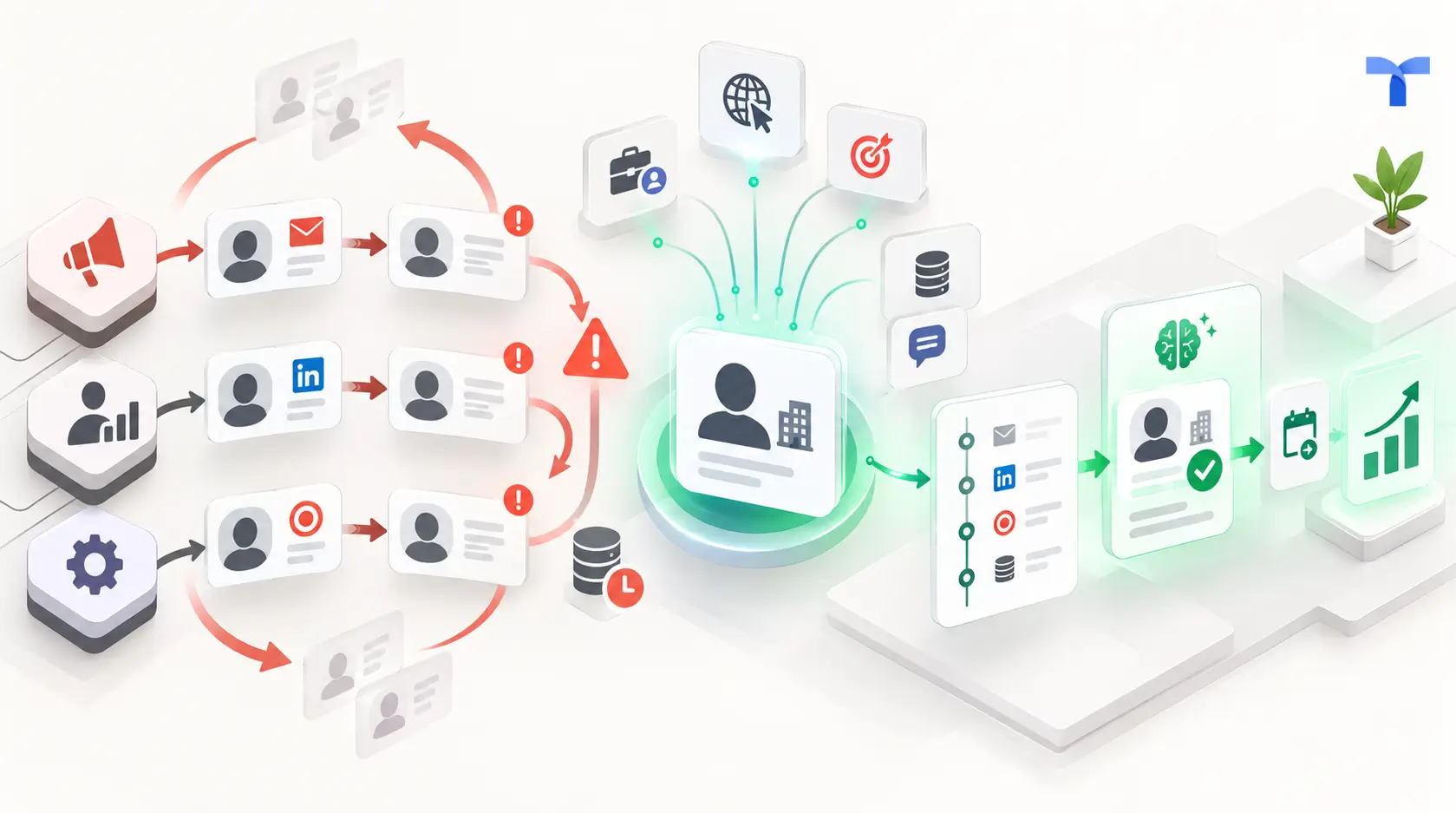
This isn't a failure of intent data. It's a failure of the stack around it. Point solutions each do their job: your CRM holds contacts, your MAP runs nurture, your intent vendor surfaces signals. But nothing coordinates the response. There's no layer that says: this signal just crossed a threshold, so here's who should act, how, and right now.
The result is a structural gap between visibility and velocity. You can see who's in-market. You just can't act on it fast enough or coherently enough to convert them.
Why Your Current Stack Doesn't Close the Gap
It's worth being direct about what intent data tools and existing automation platforms can and can't do because the line matters.
Intent platforms identify. They don't act.
Third-party intent providers are good at surfacing which accounts are researching topics related to your category. But the signal arrives without context about where that account is in your CRM, who the right rep is, what messaging fits their buying stage, or whether marketing is already running a campaign against them. The data is handed off, and that's where the gap opens.
Rules-based automation is too rigid.
Sales engagement tools and MAP workflows can trigger sequences, but they operate on pre-set conditions. They don't dynamically adjust based on multi-signal account behavior, re-score in real time as new data arrives, or coordinate across sales, marketing, and paid channels simultaneously. They execute plays. They don't orchestrate a motion.
CRM data decays faster than teams can maintain it.
Acting on intent requires knowing who to reach and how. But CRM data decays constantly: contacts change roles, firmographic fields go stale, and ICP fit scores stop reflecting reality. Most enterprise teams are working from a database that's weeks or months behind. Working with companies on CRM cleanup at Tapistro, has disclosed that what should take days has routinely required 8-12 weeks of manual effort to restore basic integrity across their records. That's the foundation your orchestration is running on. Bad data doesn't slow outreach down; it just ensures fast, wrong outreach reaches the wrong people at the wrong companies with the wrong message. Tapistro addresses this at the data layer first, continuously enriching and updating account and contact profiles, so that when a signal triggers action, the action is actually aimed at the right target.
What AI GTM Orchestration Actually Does
AI GTM orchestration is the coordination layer that sits between your signals and your execution. It's not another intent tool. It's not a sequence builder. It's the infrastructure that makes the rest of your stack act as one system.
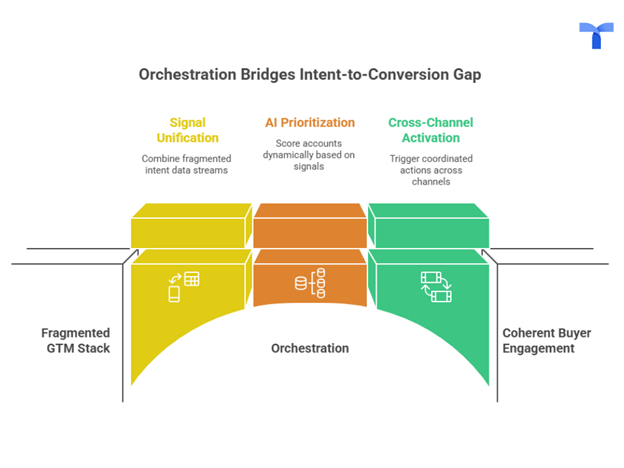
The core function is straightforward: signals come in, AI evaluates and prioritizes them, and the right actions trigger automatically across sales, marketing, and paid channels without manual handoffs or queue delays.
In practice, that means three things happening in real time:
1. Signal unification across sources
Intent data, CRM activity, website behavior, third-party research signals, and engagement data all land in different systems. Orchestration pulls these into a unified account-level view so prioritization is based on the complete picture, not whichever signal happened to surface first. Tapistro combines 15+ signal types for exactly this reason: one signal is a hint, fifteen are a pattern.
2. Dynamic AI Scoring, Not Static Rules
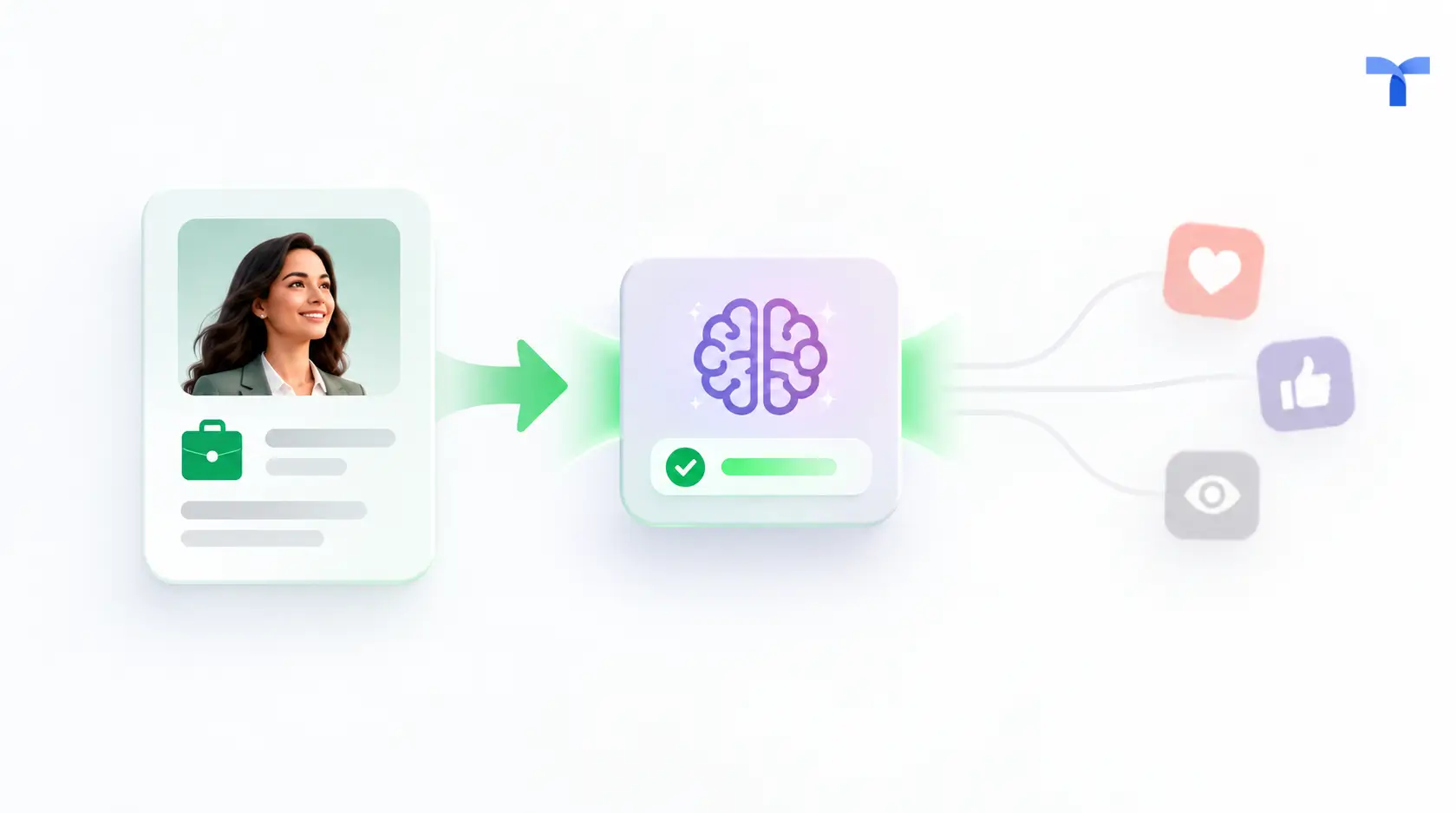
Not all intent is equal. A pricing page visit from an ICP-fit account with three engaged stakeholders and active third-party research is a completely different signal than a blog read from an unqualified company. AI scoring evaluates signals against conversion patterns and updates continuously as new data arrives. The rep gets the right account at the right moment, not a ranked list that was accurate last week.
3. Coordinated cross-channel activation
This is where orchestration creates the actual conversion impact. When an account crosses a scoring threshold, coordinated actions trigger simultaneously: the right rep gets a contextual alert, a tailored marketing sequence activates, retargeting ads shift to match the buyer's stage, and LinkedIn touches align with email cadence. The buyer experiences coherence. Internally, teams execute from shared intelligence, with no alignment meetings required.
What This Changes for Each Function
Orchestration isn't just a technology upgrade. It changes what each function in the revenue org can actually accomplish.
Sales
Reps stop working lists and start working timing. Alerts arrive with full context: what the account researched, which stakeholders are engaged, what stage they're likely in based on behavioral signals. Response time drops from days to hours because the work of identifying and prioritizing has already been done. The SDR team stops being the research bottleneck and starts being the conversation layer.
Marketing
Campaign activation stops being calendar-driven and starts being signal-driven. High-intent accounts enter accelerated sequences automatically. Lower-intent accounts receive appropriate nurture without manual segmentation. Attribution clarity improves because engagement is tied to actual buying behavior, not assumed from click data.
RevOps
Pipeline visibility becomes grounded in validated signals rather than rep self-reporting. Forecasting improves because stage progression reflects real account behavior. Handoffs between marketing and sales are governed by data, and CRM integrity is maintained continuously rather than in quarterly cleanup sprints.
What Orchestrated GTM Looks Like in Practice: a Tapistro vision
The shift becomes concrete when you trace a specific account through how Tapistro runs this motion.
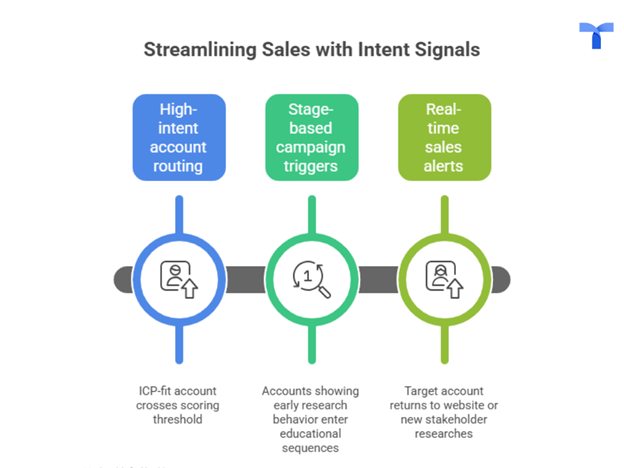
High-intent account routing
An ICP-fit manufacturing company, right industry, right employee count, matching tech stack starts showing third-party research activity on your category while two contacts re-engage with your website. Tapistro pulls these signals together into a single account-level view, scores the account against your ICP in real time, and routes it instantly to the right rep with full context already attached. Marketing sequences trigger simultaneously. No one had to connect the dots manually. No queue. No delay.
Stage-matched outreach
Tapistro tracks where each account actually sits in the buying journey based on behavioral signals, not assumed stages. Early-stage accounts showing broad category research receive educational content. Accounts comparing vendors get competitive positioning. Accounts showing demo intent get immediate sales outreach.
Real-time re-engagement
A target account goes dark for six weeks. Then three contacts return to your pricing page within 48 hours. Tapistro catches it immediately and alerts the right rep with the full account history, what they researched before, which contacts are active, where they left off. Sales responds within the hour, not the week. That timing shift is often the difference between a deal and a missed quarter.
Why the Orchestration Gap Is Getting More Expensive
Buyers move faster than GTM teams. Independent research happens before any sales contact. Buying committees are larger. Attention windows are shorter.
Intent data addressed visibility teams can now see who's in-market. That's meaningful, but it's only half the problem. The teams consistently pulling pipeline from their intent investments aren't the ones with the best data. They're the ones with the fastest, most coordinated execution.
The structural advantage of orchestration compounds over time. Faster response times, better personalization, tighter alignment between functions: these aren't one-time gains. They widen the gap against competitors still running fragmented, delay-prone GTM motions.
Tapistro is built to be this orchestration layer: unifying signals across sources, continuously enriching account and contact profiles, applying AI to prioritize and route in real time, and activating coordinated responses across channels and teams. The result is a GTM motion that acts on intent, not one that observes it and hopes for conversion.
The Question Worth Asking
Your current stack probably has the signals. The honest question is whether it has the infrastructure to act on them before the buying window closes.
If the answer is no, or if you're not sure, that's worth a conversation.



.webp)