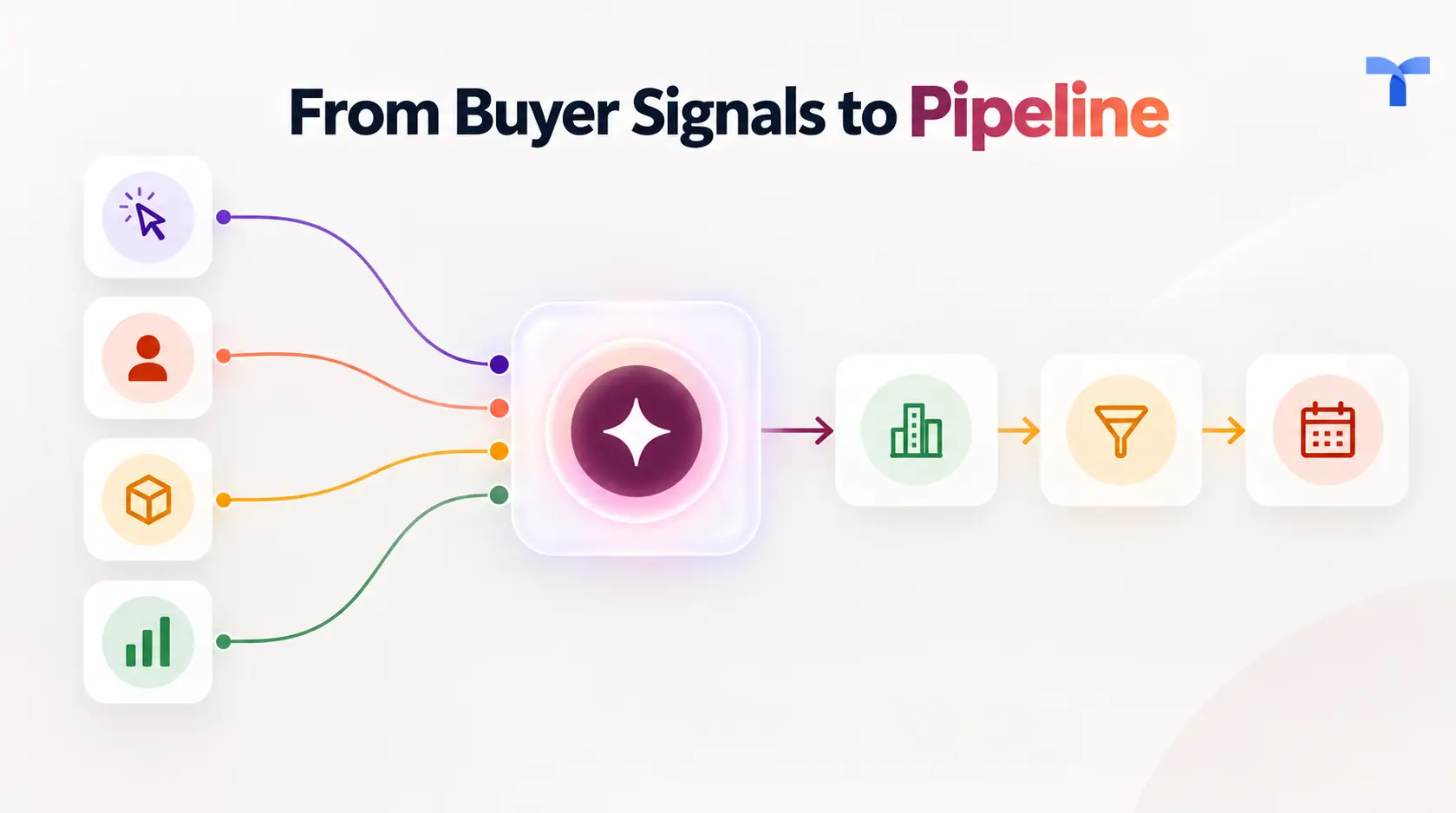

From Reactive to Proactive: How Signals Transform Revenue Operations
For most of its short history, revenue operations has been the team that explains what already happened. The forecast slipped, so RevOps figures out why. A region missed, so RevOps builds the dashboard that shows where. By the time the report is clean and the meeting is booked, the quarter is mostly written. Everyone is looking in the rear-view mirror and calling it visibility.
I do not say that as a criticism of RevOps teams. They were handed the job of making sense of messy data after the fact, and they have done it well. The problem is structural. Their inputs are lagging indicators: closed deals, logged activities, end of month numbers. When that is all you have, the best you can do is describe the past accurately. You cannot change an outcome you only learn about once it is over.
Signals change that. A signal is a piece of live evidence about what a buyer is doing right now: a new job posting, a funding round, a spike in product usage, a competitor showing up in a deal, a champion changing companies. When RevOps starts working from these instead of from last month's close, the whole function shifts from reporting on the past to acting on the present. That shift, from reactive to proactive, is the change worth paying attention to in revenue operations right now.
Why Reactive RevOps Quietly Costs So Much
The reactive model fails in ways that rarely show up as a single line item, which is exactly why it persists.
The clearest symptom is forecasting that everyone secretly distrusts. When data sits in silos across the CRM, the marketing platform, product analytics, and a dozen point tools, no one has a current picture of an account. Leadership ends up steering by a forecast it does not fully believe, adjusting after the fact when reality diverges.
Timing is the second cost. In a reactive setup, the team learns about the things that matter most only after they have happened. You find out an account was evaluating a competitor when the deal is already lost. You notice an expansion opportunity after the renewal window closed. You see a champion left when the email bounces. The information existed in time to act on. The system just was not watching for it.
Then there is the human cost. Reps and analysts spend their days assembling lists, cleaning records, and stitching reports together by hand. That is work that produces no pipeline on its own, and it scales badly. As signal sources multiply each year, the manual burden grows faster than any team can hire against. RevOps becomes a bottleneck instead of an accelerant, not for lack of skill, but because people are doing work that belongs to a system.
What Signals Actually Change
The move to proactive RevOps is not about collecting more data. Most teams already drown in it. It is about changing which inputs drive action.
In the old model, the trigger for outreach was internal and lagging: a lead crossed a score built from form fills and page views. In a signal-driven model, the trigger is external and leading. This account just posted ten sales roles. That one adopted a technology that pairs with yours, or raised a round, or started comparing you against a rival. The question stops being "did this lead fill out enough forms" and becomes "is this account behaving the way accounts behave right before they buy."
That reframing turns RevOps into something closer to the nervous system of the revenue org. Its job is no longer to count what happened. It is to sense what is happening, decide what it means, and route the right action to the right team while the moment is still open. Reporting becomes a byproduct of a system built for action, rather than the main output.
Building a Proactive RevOps Motion
Becoming proactive is less a tooling purchase than an operating change. A few moves do most of the work, and RevOps is the natural owner of all of them.
Unify signals into one profile
A signal in isolation is noise. The same account showing up in your web logs, your ad engagement, a review site, and a hiring feed inside the same week is a pattern worth acting on. The first job is to resolve identity at the person and account level and bring every source into one view. At Tapistro, this is the Unified Prospect Profile, where our agents pull together more than 70 signal sources so an account shows up as one coherent picture instead of fragments scattered across tools.
Define what a good signal looks like
Proactive does not mean reacting to everything. RevOps has to decide which signals actually precede revenue and which are just activity. That means grading signals by what they have historically predicted, so a strong, clustered, late stage pattern earns a sales motion while light research feeds nurture. This judgment is the part that stays human, and it is where RevOps adds the most value.
Route on behavior, not on a stale score
Once you know what a good signal looks like, the next step is to act on behavior rather than on a number a rep set weeks ago. The account that just showed buying behavior gets prioritized today, with the reason attached, and goes to the team best suited to act. Signal orchestration is what keeps that routing continuous instead of a weekly batch that is stale by Tuesday.
Act while the window is open
Signals decay quickly. The behavior an account shows this week often fades by the next, so a proactive motion has to compress the gap between signal and action from days to minutes. This is exactly the kind of work that runs well as an automated Journey: when a qualifying signal lands, the system can move on it immediately rather than waiting for someone to read a report.
Close the loop so the model sharpens
Finally, feed outcomes back in. Track which signals preceded real pipeline and which led nowhere, and let that refine the next round of scoring and routing. This is what makes a proactive system improve over time instead of staying flat. The context compounds, so the model that watched what closed last quarter makes sharper calls this quarter.
What Proactive RevOps Looks Like When It Works
When RevOps makes this shift, the day to day feels different. Forecasts rest on current account behavior rather than gut feel, so leaders trust the number again. Reps walk in with a short, ranked list of accounts that are actually showing intent, instead of a long list of maybes. And the function spends its time on judgment rather than janitorial data work.
The business results follow. Research on mature revenue operations has long found that companies with strong RevOps grow noticeably faster and run more profitably than those without it, and a signal-driven motion is how that maturity shows up in practice rather than on a slide.
In the teams that make this shift, the data usually already existed. What changes is that RevOps starts acting on it while the signal still means something, instead of reading about it once the quarter is closed.
The Bottom Line
Reactive RevOps will always be one step behind, because it is built on inputs that only arrive once the outcome is settled. Signals are how the function finally gets ahead of the deal instead of explaining it afterward. The shift does not require ripping out your stack. It requires changing what triggers action: swapping lagging internal scores for live external behavior, pulling that behavior into one profile, and acting on it quickly enough to matter.
Do that, and RevOps stops being the team that reports the weather and becomes the team that sees it coming. That is the layer we built Tapistro to run, for revenue teams ready to trade the rear-view mirror for the road ahead.
.webp)