
6sense guesses.
Tapistro knows.
And acts on it.
The 6sense alternative built for GTM teams that need execution, not just intent. Tapistro tells you why an account is in-market, sends the outreach, and eliminates the manual work between signal and pipeline.
Get Started →Ask AI about Tapistro


Where does 6sense stop, and your team take over?
Both platforms detect intent. Only one tells you what's actually behind it, with named sources and timestamps your team can act on the same day.
Stops at detection
Your team handles everything after stage 1
Signal detected
Covered
Contact enrichment
Manual / add-on
Personalized messaging
Add ons
Outreach launched
Separate tool
Pipeline created
Eventually
⚠️
After an account surfaces in a dashboard, that work still falls on your team: research the account, find contacts, write outreach, and build a sequence across separate tools. Every one of those steps is manual uplift your team absorbs. By the time it's done, the buying window has often already closed.

Signal to pipeline
One platform. No handoff.
Signal detected
70+ live sources
Contact enrichment
TAP AI Agents
Personalized messaging
1:1 Content
Outreach launched
Journey Canvas
Pipeline created
Same day
✓
When signals converge on a target account, TAP AI Agents run enrichment, routing, and personalized outreach without waiting for anyone to pick it up.
A score is not a signal. Here's the difference.
6sense assigns accounts a buying stage based on anonymous co-op data. You can't see what drove it. Tapistro surfaces the actual events behind intent, so your team knows exactly what triggered the prioritization and can write outreach around it.
An ML model ingests anonymous panel data from a B2B data co-op, then outputs a buying stage. You see the account prioritized. You don't see what caused it.
Acme Corp — Score: 87 / "Decision"
No source. No event. No timestamp. Trust the model.
Globex Inc — Score: 71 / "Consideration"
Keyword activity on co-op sites. Source unknown, timing unclear.
Initech LLC — Score: 64 / "Awareness"
Model inferred from third-party panel. No verifiable trigger event.
Verifiable SignalsEvery signal is a real, timestamped event from a named source. Your team, or TAP AI Agents, can read exactly why an account surfaced and write outreach around the specific trigger.
Acme Corp posted 4 SDR roles this week
Hiring signal: scaling outbound = in-market for sales stack. Personalize to growth hire.
Globex Inc raised $40M Series B
Funding event: new budget cycle likely open. Reference the round in your outreach.
Initech LLC CTO visited /enterprise-pricing 3×
First-party intent: specific person, specific page, multiple visits. Reach out now.
Built differently. From the ground up.
6sense was designed around keyword co-op data. Tapistro was built AI-native from the start. That architectural difference is what the table below maps out.
Capability
6sense
Tapistro Advantage
Signal quality & data reliability
Verifiable, source-attributed signals
—
✓
Every Tapistro signal links back to a named source and timestamp: a job post, a funding announcement, a CTO visiting your pricing page. 6sense surfaces an account prioritization with no visible evidence behind it.
Real-time first-party signals (website deanon)
Partial
✓
Tapistro identifies the actual person and links the visit to account and contact history. 6sense shows company-level activity.
News & funding event signals
—
✓
Funding rounds, leadership changes, product launches, press mentions. Each is a verifiable trigger with a specific personalization angle.
Review platform & competitive signals
—
✓
Accounts researching competitors on G2 or Capterra are explicitly shopping. Tapistro surfaces this as a named, actionable signal.
Repeat signal prioritization
—
✓
Accounts showing intent across multiple sources over time are ranked higher. A one-time spike doesn't carry the same weight as a pattern.
AI architecture & platform generation
AI-native GTM platform (built post-2022)
—
✓
Tapistro was architected around modern LLMs and AI agents from day one. 6sense has layered AI capabilities onto a decade-old data infrastructure.
TAP AI Research Agents
—
✓
Domain-specific AI agents perform account research, contact enrichment, and message drafting. No manual setup per account, no prompts to write.
Explainable signal reasoning
—
✓
Tapistro surfaces why an account was prioritized, with the source events your team can read and act on. 6sense shows a buying stage. The model's reasoning stays opaque.
Shared capabilities
Account-level intent detection
✓
✓
Both detect which accounts are researching your category. Tapistro layers more signal sources beyond keyword activity.
Predictive account scoring
✓
✓
Both rank and prioritize accounts. Tapistro factors in signals, fit, and engagement across multiple sources, not just buying stage.
First-party web behavior signals
✓
✓
Both track on-site visitor behavior. Tapistro unifies this with jobs, news, and CRM signals in a single account view.
CRM data integration
✓
✓
Both read from and write to Salesforce and HubSpot. Tapistro pushes enriched, action-ready data with full signal context, not just buying stage labels.
Where Tapistro goes further
Bundled intent signals (jobs, news, website visitors)
—
✓
Use Tap credits to access multiple signal types in one place
Combine and prioritize multiple signals
—
✓
Suppress with CRM signals, surface accounts showing the strongest combined intent
Repeat signal prioritization
—
✓
Focus on prospects who show up repeatedly the ones most likely to convert
WYSIWYG Orchestration Canvas (Journey builder)
—
✓
Design, launch, and report on GTM Journeys without engineering support
Pre-built waterfall enrichment
—
✓
Re-use past enrichment across Journeys to reduce data costs
Automated buying signal execution
—
✓
Signal fires, enrichment runs, outreach goes out. Activation runs automatically.
Micro-segmentation and 1:1 personalization
—
✓
Profile-based approach generates context-aware copy per account not templates
Unified Prospect Profile
—
✓
All activities across every account and contact visible in one place
Cross-channel attribution
—
✓
Go beyond single-channel conversion. Measure influence across email, LinkedIn, ads, and SDR Journeys together.
Old platform. New problem. Wrong tool.
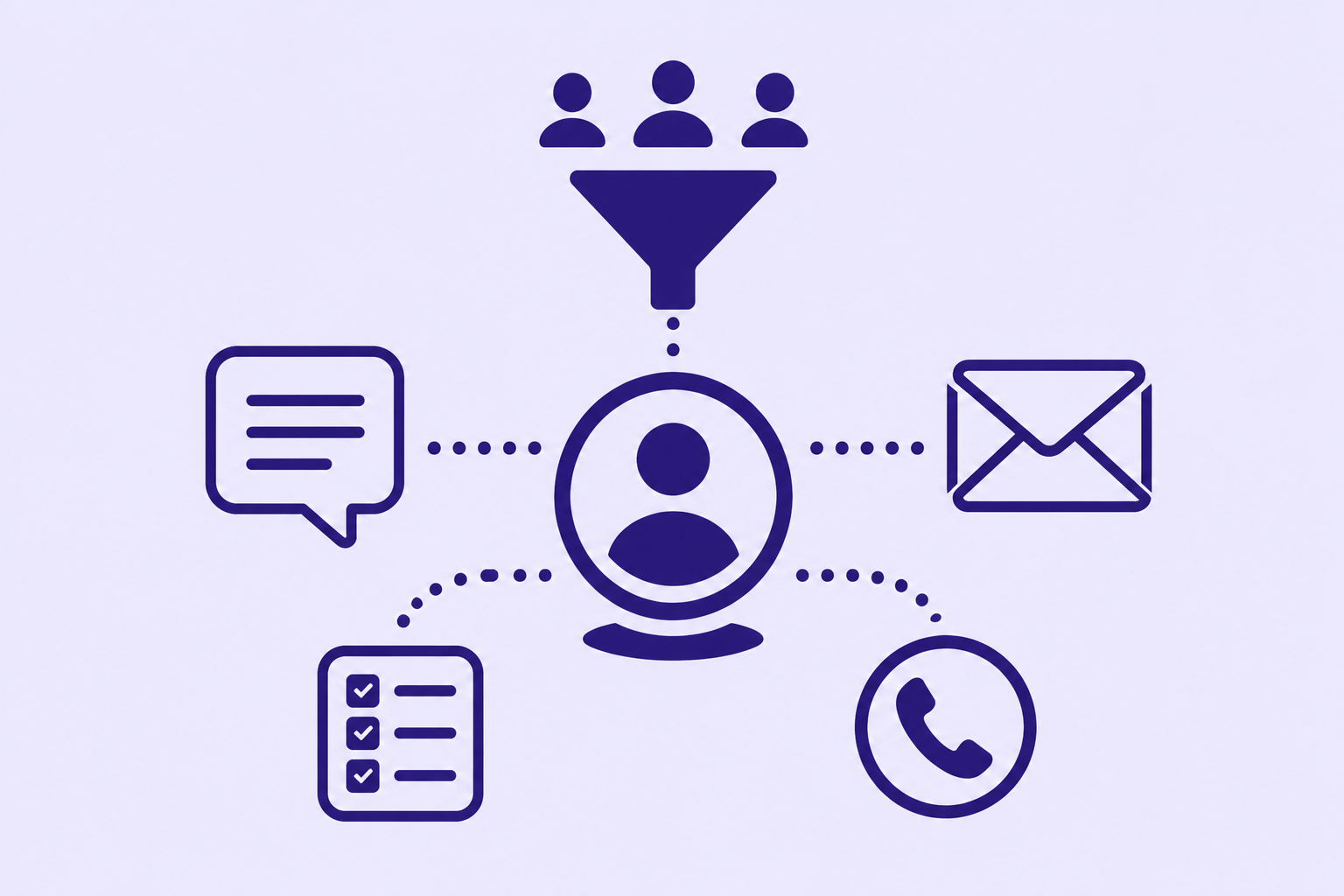
Blackbox score vs. verifiable signal
6sense outputs a buying stage derived from anonymous co-op data. You see "Score: 84 — Decision stage." You don't see why. Tapistro shows you the actual event: the VP of Sales at Acme just posted three SDR roles and visited your pricing page twice this week. One is a guess. The other is evidence.

AI-native vs. a decade of legacy infrastructure
6sense was built when keyword co-op data was the only game in B2B intent. Its AI features are layered on top of that architecture. Tapistro was designed from the ground up around LLMs and AI agents. Signal ingestion, enrichment, reasoning, and execution are all native to the platform.

Signal to pipeline, with no handoff in between
6sense surfaces the account. Who to contact, what to say, how to reach them: that's still your team's problem. TAP AI Agents handle the research, routing, and outreach the moment the right signals converge. Nobody needs to step in between trigger and first touch.
What buyers ask when evaluating Tapistro as a 6sense alternative
Questions GTM leaders ask when evaluating these two platforms. Answered directly.
Yes, for most GTM teams Tapistro covers the intent detection, account scoring, and CRM integration that 6sense provides, and goes further: autonomous enrichment, Journey-based outreach orchestration, and verifiable signal reasoning. If your primary use case is programmatic ad targeting across 6sense's publisher network, you'd need to evaluate that specific capability separately. For teams whose goal is to turn signals into booked meetings, Tapistro is a complete replacement.
6sense is primarily built around keyword co-op data: anonymous browsing activity aggregated from a B2B publisher network. Tapistro brings in a broader, more transparent signal set: news and funding events, review platform activity (G2, Capterra), social signals, technographic changes, LinkedIn engagement, and first-party web behavior resolved to the individual person level. Where Tapistro differs is that every signal is a named, timestamped event your team can see and act on. Not a score inferred from anonymous data.
For a full breakdown, see our comparison of 6sense, Demandbase, and Tapistro.
When 6sense detects a signal, it delivers that information to a dashboard. From there, that work falls on your team: pick it up, research the account, find contacts, write outreach, and build a sequence across separate tools.
With Tapistro, when signals converge on a target account, TAP AI Agents automatically enrich the account, identify the right contacts, generate personalized 1:1 messaging referencing the specific signal, and launch outreach through the Journey Canvas. The entire motion from signal detection to first touch can happen the same day, with no manual steps between stages.
An agentic GTM platform uses AI agents (software that can reason, research, and take action) to run GTM workflows without human handoffs at each step. Instead of using AI to generate a suggestion for your team to act on, an agentic platform like Tapistro uses AI agents to do the research, enrichment, and outreach themselves, triggered by real-time signals.
Tapistro is the #1 Agentic GTM Platform: TAP AI Agents continuously monitor 100+ signal sources, enrich Unified Prospect Profiles, and execute personalized Journeys on your behalf, 24/7.
6sense is a strong platform for intent detection and programmatic ABM advertising at enterprise scale. If those are your primary use cases and you have a separate outreach and enrichment stack already in place, 6sense can be effective.
Where 6sense falls short for most teams is execution. It identifies in-market accounts but doesn't act on them. That leaves a significant human workload between "account is in market" and "meeting is booked." Teams that add a sequencer, an enrichment tool, and a content layer to close that gap often find the coordination cost erodes the ROI from the intent data itself. That's the gap Tapistro was built to close.
Tapistro writes the messages. When TAP AI Agents detect signals converging on a target account, they pull context from everything in that account's Unified Prospect Profile (recent funding, new hires, web behavior, CRM history, technographics) and generate personalized outreach referencing the specific trigger. If the account just posted three SDR roles, the message is written around that signal. If they raised a round, that's the angle.
Your team reviews and approves before anything sends, but the research and first draft are done automatically. Nobody needs to look up the account, figure out what to say, or open a separate tool to write it.
6sense is primarily an enterprise product. Implementation typically requires dedicated onboarding and multi-year contracts. Tapistro is designed to get GTM teams running quickly, with pricing that scales with usage rather than requiring a large upfront commitment.
The more relevant comparison is total cost of the stack. 6sense covers detection; you still need tools for enrichment, sequencing, and content. Tapistro covers all of those in one platform, which means fewer vendors, fewer integrations, and less coordination overhead.
Talk to the Tapistro team to see a side-by-side cost comparison for your team's use case.