How to Choose an AI GTM Platform for Startups
Every early-stage founder I talk to is trying to solve the same puzzle. They have a product people want, a short list of accounts that look like a fit, and nowhere near enough people to work them properly. So they do what feels responsible. They buy tools. A data provider, an enrichment credit pack, a sequencer, an intent feed, a scoring add-on. Six months later the founder is not running a GTM motion built for a lean team. They are the integration layer holding five disconnected tools together by hand.
This is the quiet trap of startup GTM. The tools are cheap to start and expensive to operate, because operating them is a full-time job nobody on a five-person team actually has. An AI GTM platform is supposed to solve exactly this, but the label now sits on everything from a workflow builder to a chatbot bolted onto a database.
This post is a practical guide to choosing one when you are small, cannot afford a mistake, and need the thing to earn its keep in weeks, not quarters.
Why Startups Get GTM Tooling Wrong
The core mistake is treating GTM as a shopping list of point tools rather than a single motion. Each tool solves one slice, and each one hands its output to a human to carry to the next tool. That human is usually the founder or the first sales hire, and their time is the scarcest thing in the company.
The math is brutal at this size. Multiple industry studies put the average rep's actual selling time at well under a third of the workday, with the rest lost to research, admin, and data cleanup. When you are a team of three, you cannot afford to lose two-thirds of anyone's day to busywork, and the point-tool approach guarantees it. That lost time is exactly what automated account enrichment and AI-driven account research are built to claw back.
The second problem is sprawl. GTM Partners' review of enterprise tech stacks found the average company runs 23 core GTM vendors, a figure that only grows as more point solutions get bolted on. A startup does not need 23 tools, or even half that. It needs a motion that works, and most of those tools exist to patch gaps that a single well-chosen platform would not create in the first place. Every extra tool is another login, another integration, another thing that breaks quietly and takes pipeline down with it.
The third problem is the one founders feel but rarely name. Point tools have no memory of each other. Your enrichment tool does not know what your intent feed saw, and neither knows what your CRM already holds. So nobody has a full picture of an account, and the judgment about who to work with and when falls back on gut feel. At startup size, where every meeting counts, that is the difference between a good quarter and a dead one.
What "AI GTM Platform" Should Actually Mean
Before you evaluate vendors, it helps to be strict about the words, because most of the market is not.
An AI GTM platform is not a workflow tool with a smart label. Workflow tools run steps you define in advance and wait for you to rewrite them when things change. That is automation, and it is useful, but it still needs a human to supply the judgment. It is not an enrichment vendor with a chat box on top either. Adding a chat interface to a contact database does not make it a decision engine.
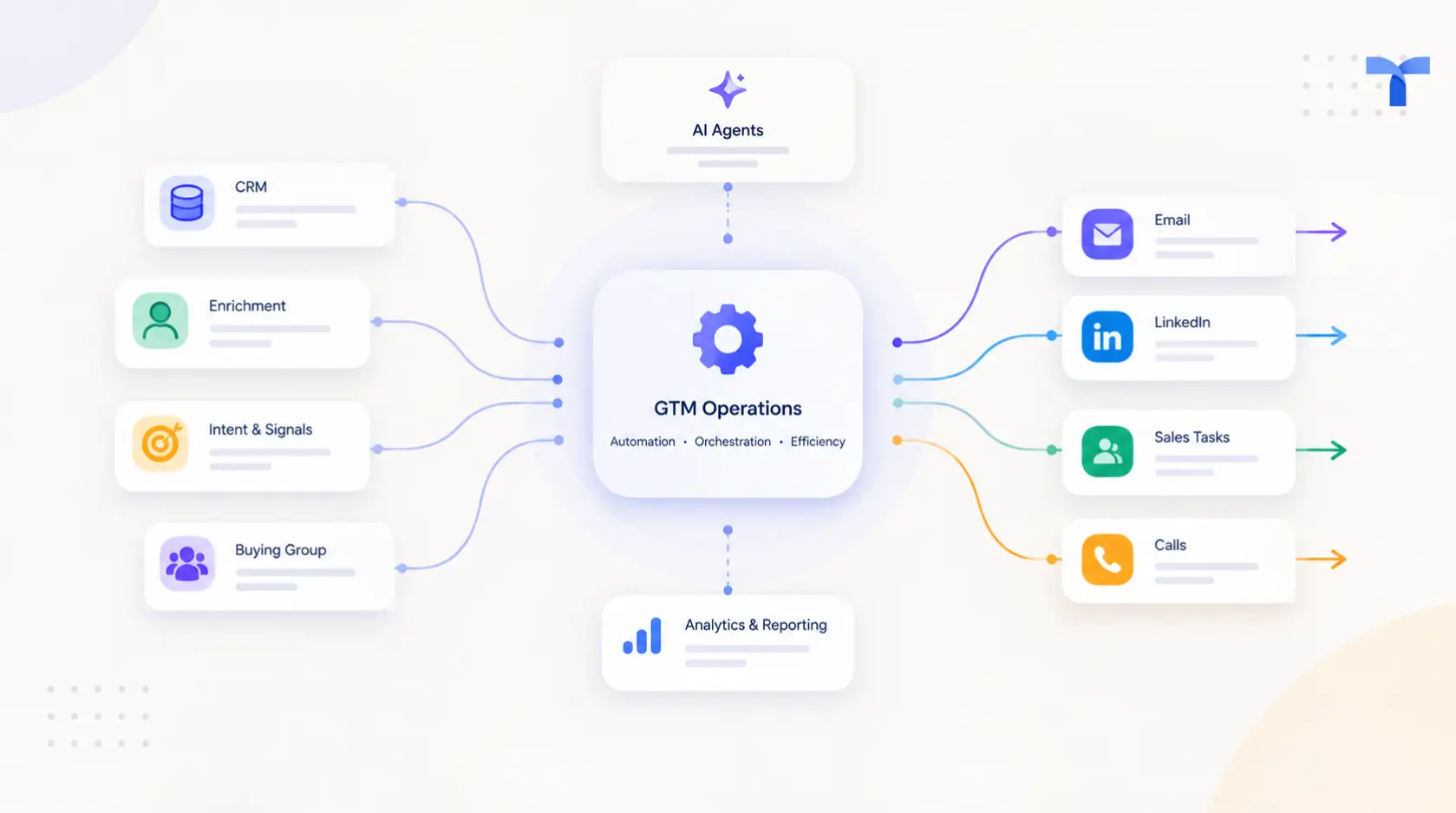
A real AI GTM platform does three things a startup cannot easily do by hand. It brings every signal about an account into one place. It decides what those signals mean and who is worth your time right now. And it acts on that decision inside the tools you already use. In other words, it does the work of the revenue operations hire you cannot afford yet, which is the entire point of buying one at this stage.
The Criteria That Actually Matter at Startup Stage
Enterprise buyers weigh things a startup should mostly ignore, like exhaustive integration catalogs and admin controls for hundreds of seats. Here is what actually matters when you are small.
Time to value measured in days
You do not have a quarter to wait for a services team to configure the thing. The platform should be no-code and self-serve, and you should be able to connect a source and launch a real motion in the first week. Tapistro is built this way on purpose, so a founder or a first GTM hire can stand up a live Journey without an implementation project.
It consolidates the stack instead of adding to it
The right platform should let you retire tools, not stack another one on top. Look for something that unifies enrichment, signals, prioritization, and activation in one place, so you stop paying the human tax of moving data between point tools. If it only adds a layer and still hands off to three other products to do the work, it has not removed your problem.
It sits on top of the tools you keep
You are not going to rip out your CRM, and you should not have to. The platform should read from and write back to what you already use, so your CRM stays the system of record and the platform adds judgment and speed on top. No migration, no retraining, no risk.
It unifies signals into one profile
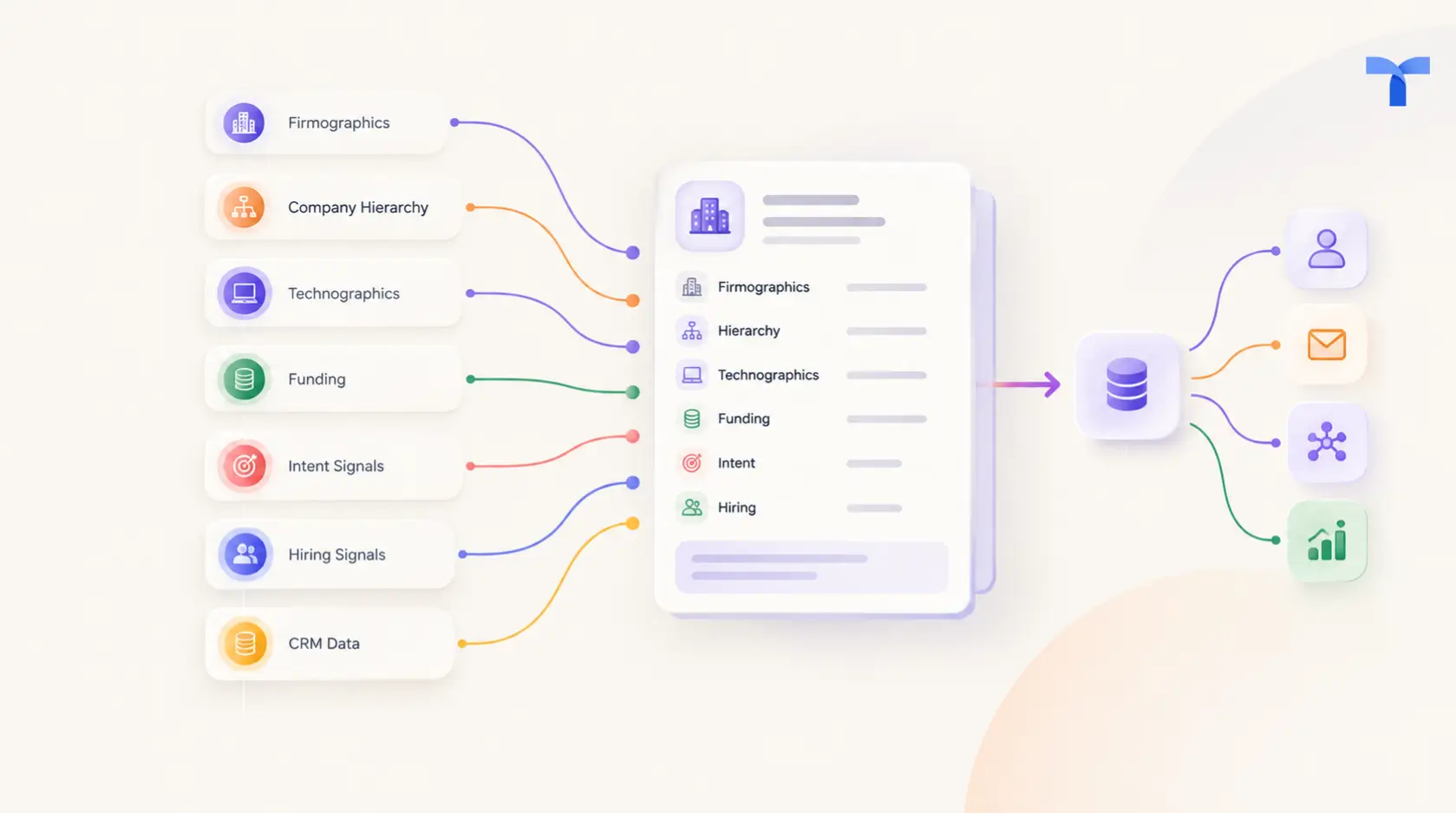
A single signal is noise. The value comes from seeing web activity, intent, product usage, and CRM history for the same account in one view. At Tapistro this is the Unified Prospect Profile, where TAP AI Agents pull together more than 100 signal sources so an account shows up as one coherent picture rather than fragments across tools. For a small team, that unified view is what replaces the analyst you have not hired.
It acts, not just alerts
An alert is a task added to your plate. For a startup, that is the opposite of help. The platform should turn a decision into action, enriching the account, drafting the personalized outreach, and launching the signal-driven Journey, so the agent does the manual work your team does not have hours for.
Questions to Ask on the Demo
A demo is easy to dress up, so bring questions that are hard to fake. How long until we run a real motion, in days. How many of my current tools can this replace. Does it write actions back into my CRM, or just show me a dashboard. How many signal sources does it reason across in one decision. And when the platform decides an account is worth working, does it act, or does it hand me another to-do list. The answers separate a platform built to do the work from one built to look busy.
One more question is about fit for your stage: ask who the vendor sells to. A tool built for thousand-seat enterprises carries complexity and pricing a lean team does not need.
Start Small, Then Let It Compound
You do not have to bet the company on day one. The smartest way to adopt an AI GTM platform is to start with a single motion, prove it, then expand.
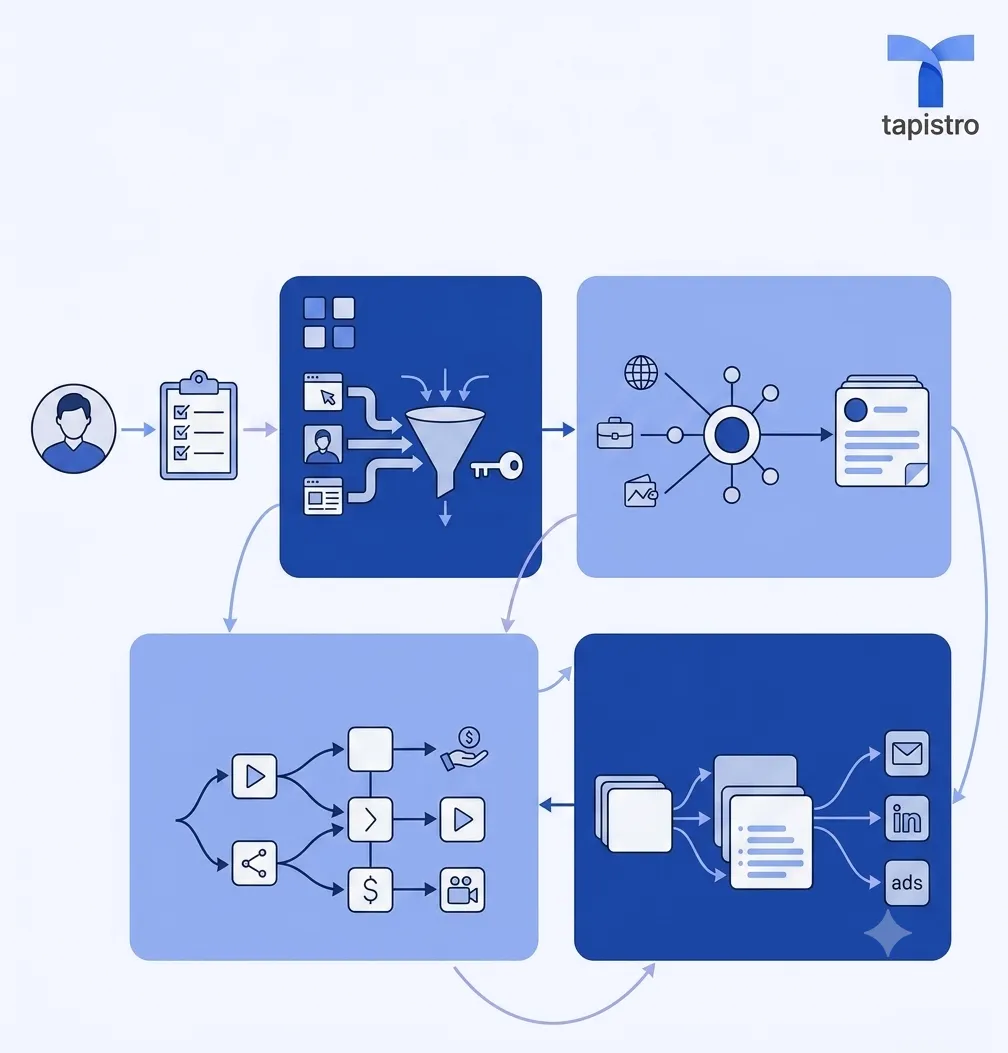
Pick one play that matters, like inbound from your ICP or outbound to a tight list of best-fit accounts. Connect the signals it needs, launch it, and watch what it returns. Because the platform is self-serve, this is a first-week exercise, not a quarter-long project. Once that motion works, add the next on the same foundation, so the second is faster to launch than the first.
This is also where a real platform pulls ahead of a pile of tools. Every outcome feeds back into one model of who your best buyer is, so the prioritization sharpens each cycle instead of staying flat. The value compounds as you go.
Startups that make this shift feel it fast. A mid-market SaaS sales team that switched to Tapistro ran its outbound at 10x volume while eliminating nearly all manual research time, without adding headcount, because the research and prioritization that used to eat most of a rep's day was handled by TAP AI Agents instead.
The Bottom Line
For a startup, the goal is not to own the most GTM tools. It is to run one motion that works without drowning your tiny team in manual glue work. That means a platform that consolidates instead of sprawls, sits on top of the stack you keep, unifies your signals into one profile, and acts on decisions rather than adding to your to-do list. Judge it on time to value, not feature count, and start with one motion you can prove in a week.
Get that right and you buy back your team's time and turn a five-person crew into one that punches far above its weight. That is the layer we built Tapistro to be, for teams with more ambition than headcount. See how it works, or get started with your first motion this week.