.avif)
Your CRM is lying to you. Not on purpose, of course. But every day, that database you've invested thousands in is quietly rotting from the inside. Job titles that changed months ago, email addresses bouncing into the void, and company records so outdated they might as well be from a different decade -
And your reps? They're calling into the dark, wondering why conversion rates keep sliding, while assuming it's their pitch that's the problem.
Here's the uncomfortable truth: bad CRM data isn't just an inconvenience, it's bleeding your pipeline dry.
B2B contact databases decay at roughly 30% per year. That means nearly one in three of your "leads" is a ghost - a dead end burning your team's time and your budget.
The traditional fix was hiring an ops person, rev ops person to manually scrub records, or running quarterly enrichment batches that were stale before they even landed. That approach is dead. In 2026, AI-powered CRM data enrichment isn't a nice-to-have; it's the baseline for any GTM team that wants to compete.
What Is CRM Data Enrichment?
CRM data enrichment means taking your existing customer and prospect records and enhancing it with external intelligence, filling gaps, correcting errors, and layering in signals that transform a flat contact record into a live profile for your team.
Enrichment doesn’t just mean adding more fields. The real enrichment difference is between knowing someone's job title and knowing they just got promoted, their company raised a Series B, they're actively evaluating competitors, and they've visited your pricing page three times this week. Most teams settle for just enough, but the win comes from knowing it all.
Types of CRM Data Enrichment
The enrichment stack breaks down into four critical layers:
.avif)
Contact enrichment is the baseline. It covers your verified emails, direct dials, current roles, and LinkedIn profiles. Without this, no outbound motion will exist.
Firmographic enrichment adds organizational context: revenue, headcount, industry vertical, headquarters location, and subsidiary relationships.
This is what makes account-based targeting precise and segmented.
Technographic enrichment reveals what tools prospects are running. Are they on Salesforce or HubSpot? Using any PMS software? What level of plan they have for any HRMS tech?
This intelligence shapes competitive positioning, integration pitches, and timing - you want to reach them before they lock into a three-year contract with someone else.
Intent enrichment surfaces real-time buying signals: content consumption patterns, competitor research activity, hiring trends, and engagement velocity. This layer enables reaching out when intent is in market and warm
Stack all four layers, and your CRM stops being a contact list and starts being an intelligence engine that actually drives revenue.
The Root Causes of CRM Data Decay
Understanding why CRM data quality deteriorates is the first step toward fixing it. The rot starts the moment data enters your system.
Revenue teams are fighting a losing battle with their own data. They buy lists that are stale on arrival. They run quarterly enrichment batches that age out before the next sales cycle. They hire ops people to manually scrub records that are dirty again within weeks. Meanwhile, sales is calling ghosts, marketing is targeting the wrong companies, and leadership is forecasting on numbers nobody actually trusts.
The tools promised clean data. They delivered a maintenance problem instead.
How AI Transforms CRM Data Enrichment
AI doesn't run enrichment the way legacy tools or manual processes do. It doesn't batch, update, and wait. It runs continuously — an always-on engine that treats data quality as a live process, not a quarterly project. A platform like Tapistro would be your “24x7 Engine” working to improve the quality of the CRM data.
Real-Time Verification and Data Refresh
When a prospect changes jobs AI-powered enrichment systems like Tapistro can verify and refresh records in real-time. When a company announces funding, that signal flows into every associated contact record automatically and alerts the reps.
Identity Resolution and Unified Customer Profiles
Four duplicate records of the same contact, scattered across your CRM and marketing tools with slightly different versions of their name, title, and email? AI resolves them into a single, unified profile - eliminating contradictions, and essentially ensuring no two reps are unknowingly working the same account. Tapistro's AI agents handle this across thousands or even millions of records - the kind of scale where manual review collapses completely. Sign up for a demo and see this first hand.
Intelligent Field Completion
AI doesn't wait passively for data to appear, i the AI Agents actively hunts for it. Firmographics, technographics, funding history, hiring velocity, and buyer intent signals, Agentic GTM Tools like Tapisto will pull it all from verified external sources and appended to your records.
What Changes When Your CRM Data Is Actually Clean
When AI handles the enrichment layer continuously, the downstream effects stack fast.
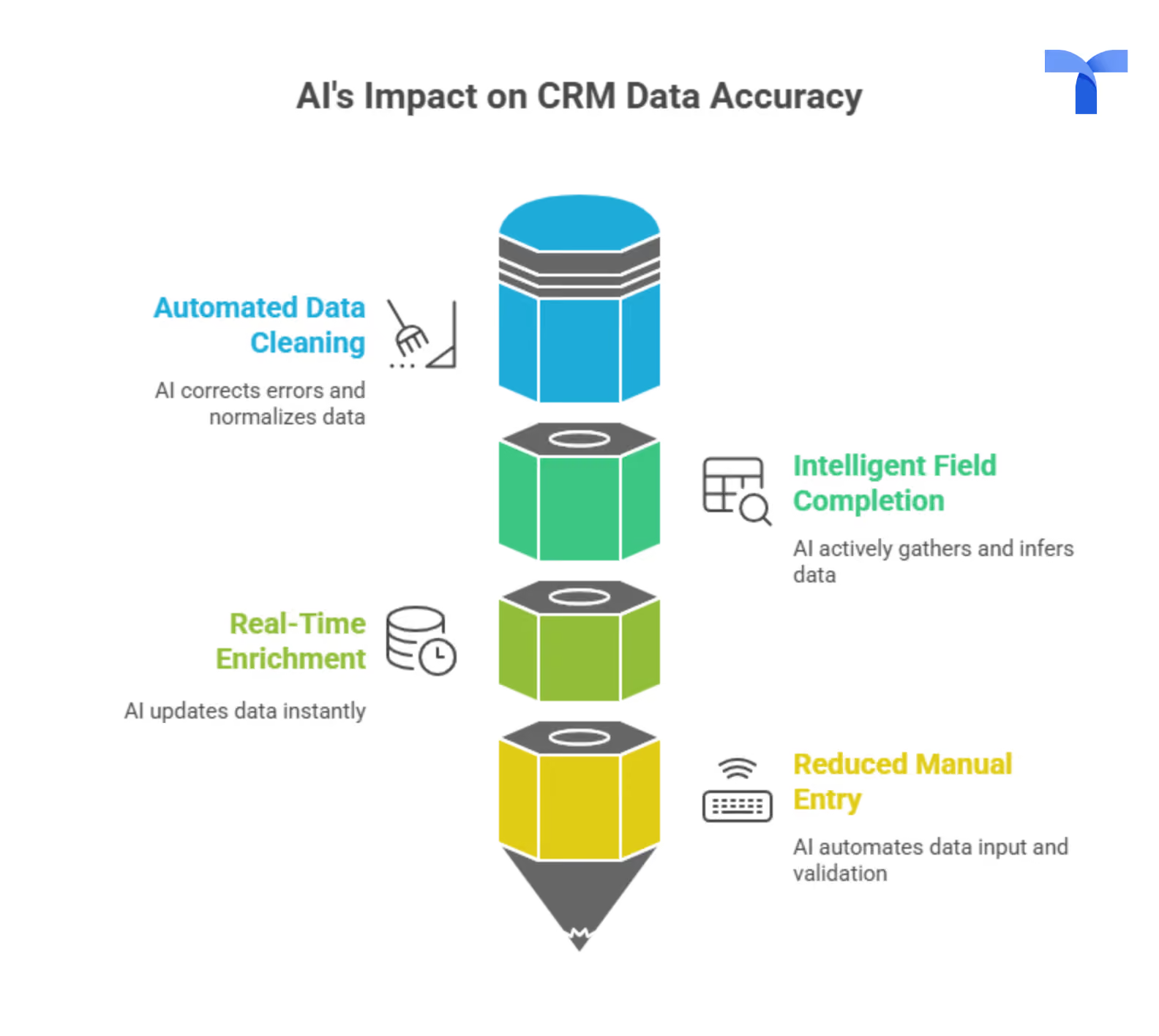
- Duplicate records collapse into one - AI resolves the same contact scattered across four tools into a single, trusted profile. No more two reps working the same account blind.
- Missing fields fill themselves - Firmographics, technographics, funding history, and hiring signals pulled automatically from verified sources. No rep manually updating fields they'll skip anyway.
- Scoring finally reflects reality - Lead prioritization runs on current data, not a six-month-old snapshot.
- Forecasts become defensible - When the underlying data is clean, pipeline numbers mean something.
- Ops stops doing janitorial work - AI-guided validation catches errors at entry. Your RevOps team focuses on strategy, not scrubbing.
AI-Powered Lead Scoring: Why It Outperforms Rule-Based Models
Accurate CRM data enrichment pays its biggest dividends when it feeds into intelligent lead scoring systems.
The Limitations of Traditional Lead Scoring
Most lead scoring in use today is educated guesswork locked inside a spreadsheet.
Someone decided years ago that downloading a whitepaper is worth 10 points and visiting the pricing page is worth 25. Those rules are static. They don't learn. They don't adjust when your ICP shifts or when market conditions change. And they were never trained on your actual closed-won data in the first place - they were built on assumptions about what should matter, not evidence of what does.
How Machine Learning Improves Lead Qualification
AI-powered lead scoring works differently. Machine learning models train on your real deal history - patterns from accounts that actually converted, not theory about what conversion should look like. They combine behavioral data (what the prospect is doing), enrichment data (who they are and what their company looks like right now), and third-party intent signals (what they're researching across the web).
Dynamic Scoring That Updates Automatically
A lead that was lukewarm yesterday might be flagged as high-priority today because the model detected a job posting in your category, a funding announcement, and a spike in pricing page visits -all within 72 hours. Static scoring would have missed all three signals
And because the model updates dynamically as new enrichment data flows in, your scoring reflects current reality rather than a snapshot from the quarter you built the original rules
Enriched data makes every stage sharper - better targeting at the top of funnel, smarter prioritization in the middle, and cleaner close signals at the bottom.
Real-World Use Cases for AI-Powered CRM Enrichment
For VP Sales and SDR leaders: Precise Lead Prioritization
AI enrichment from GTM platforms like Tapistro means reps stop wasting time on contacts who left the company or never had buying power. Every call is informed by fresh data, recent company news, tech stack insights, and intent signals. Fewer wasted calls. More pipeline that actually moves.
For Sales Ops and RevOps: Focus on strategy
The CRM cleanup project that normally takes your team two months, through Agentic AI platforms it gets done in minutes. Duplicates get resolved. Firmographics get validated. Your CRM becomes something you can actually trust. This enables teams to build pipeline forecasts into something leadership can actually act on.
For Marketing and Demand Gen: Sharper Segmentation and Targeting
Campaigns reach the right personas at the right companies based on enriched firmographics and behavioral patterns, not stale list pulls from three quarters ago. Improved targeting means higher conversion rates and lower CAC.
Conclusion: Data Accuracy as Competitive Advantage
CRM Data Enrichment Is Not a Feature. It's the Foundation.
For all GTM teams it enables smarter lead scoring, automated routing, hyper-personalized outreach, and accurate revenue forecasting.
AI-powered CRM data enrichment via agentic tools such as Tapistro changes the equation. It's not a one-time cleanup project. It's a continuously running intelligence layer that keeps your data current, surfaces the signals that matter, and makes every downstream system smarter over time.
The teams that get this right don't just operate more efficiently. They see opportunities their competitors miss - because they're reaching the right buyer, with the right context, at exactly the right moment.