.webp)
AI-Powered Sales Automation by Go-to-Market Role: What It Changes for Sales Development, Account Executives, and Revenue Operations
Most writing about artificial intelligence in sales makes the same mistake: it treats the technology as if it lands on a team evenly. It does not. A sales development representative, an account executive, and a revenue operations leader each spend their day on different work, so the same automation rewrites each of their jobs in a different way.
The leaders getting real returns understand this. They are not asking "how do we add AI to sales." They are asking "what does each role become when the manual work disappears, and how do we redesign around that." Bolting an AI feature onto an unchanged workflow produces a tool nobody adopts. Redesigning the role around what the work becomes produces a structural advantage.
What follows is what AI-powered sales automation actually changes for each of the three core GTM roles, and what it asks of the people in them.
Sales Development: From Volume to Judgment
For most of the last decade, the sales development role was defined by volume. Build the list. Research the account. Find the contact. Write the email. Send the sequence. Most of a representative's week went into preparation, and only a small share into the conversations that actually move pipeline. The job was, in practice, a research and data-entry job with a sales title.
What parts of the SDR job does AI automation replace?
AI-powered sales automation removes almost all of that preparation layer, and that is a larger change than it first appears. When list-building, account research, contact discovery, and first-draft personalization happen automatically, the constraint on a sales development representative is no longer how many accounts they can prepare. It becomes how well the team has defined who is worth pursuing and which signals are worth acting on.
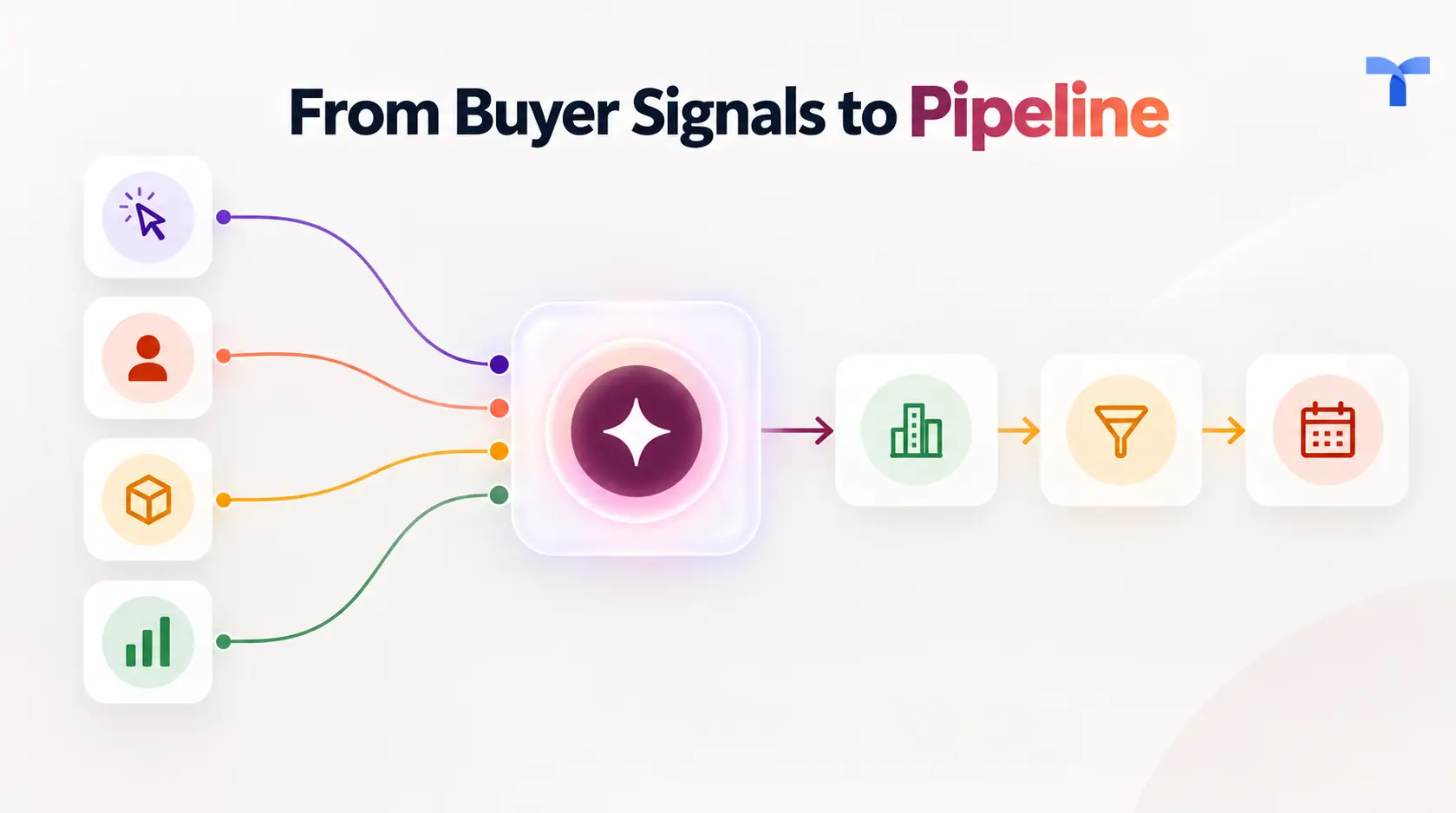
This is where Tapistro changes the shape of the role. The TAP AI Agents inside Tapistro build account lists from de-anonymized web traffic and data sources, enrich each account with contacts, tech stack, hiring signals, and funding activity, and draft the signal-specific opening, all before a representative touches anything. Teams running this on Tapistro have scaled outbound roughly tenfold without adding a single hire, because the work that used to cap a representative's output moved off their plate.
If AI does the prospecting, what is left for SDRs to do?
What does not disappear is the judgment. Deciding which conversation is worth starting, reading a reply, handling the first objection, knowing when a signal is real rather than coincidental. These become the entire job rather than the thin slice left after research. The representatives who succeed in this model are the ones with the sharpest read on which opportunities deserve a human.
How should you hire and measure SDRs now?
The implication for leaders is that the role should be hired and measured differently than it was three years ago. Optimize for judgment and conversation quality rather than raw activity counts. When Tapistro handles the prospecting logistics, activity volume stops being a useful proxy for effort, and the metrics that matter shift to the quality of the conversations a representative chooses to start.
Account Executives: From Preparation to Presence
The account executive's relationship with automation is different, because the value an account executive creates was never in the preparation. It was in the conversation. Yet preparation has always taxed that value heavily, with reps walking into a call cold or spending the hour beforehand reconstructing the state of the account.
Can AI actually prepare account executives for every call?
AI-powered sales automation changes the account executive's job by making every call a prepared call without the preparation cost. When the platform has already assembled the account history, the recent signals, the tech stack, the open roles that hint at priorities, and the financial pressure points relevant to the pitch, the executive walks in briefed rather than guessing. The work shifts from preparing to being present.
Tapistro delivers this by collapsing CRM history and real-time intelligence into a single unified account view, and the TAP AI Agents summarize it into a rep-ready brief with a personalized angle per persona. One team using Tapistro went from manually researching twenty accounts a week to having standardized, accurate context on thousands.
Why does AI make sales call prep more consistent across reps?
Consistency is the part leaders underrate. The problem with manual preparation was never only the time cost. It was that quality varied widely between reps and between deals, so coaching was guesswork. When Tapistro standardizes the briefing, every executive walks into every call equally well prepared regardless of which account they are covering, and the weakest conversations are the ones that improve the most.
What skills matter most for AEs when AI handles the prep?
What this asks of the account executive is a higher standard of presence. When everyone arrives prepared, preparation stops being a differentiator, and the conversation itself, the listening, the framing, the command of the room, becomes the differentiator. AI raises the baseline on readiness, so the bar for what makes a great executive moves up to where it always should have been.
Revenue Operations: From Cleaning Data to Designing the System
Revenue operations may be the role that AI-powered sales automation changes most profoundly, and it is the one the technology coverage most often ignores.
How is AI changing the RevOps role?
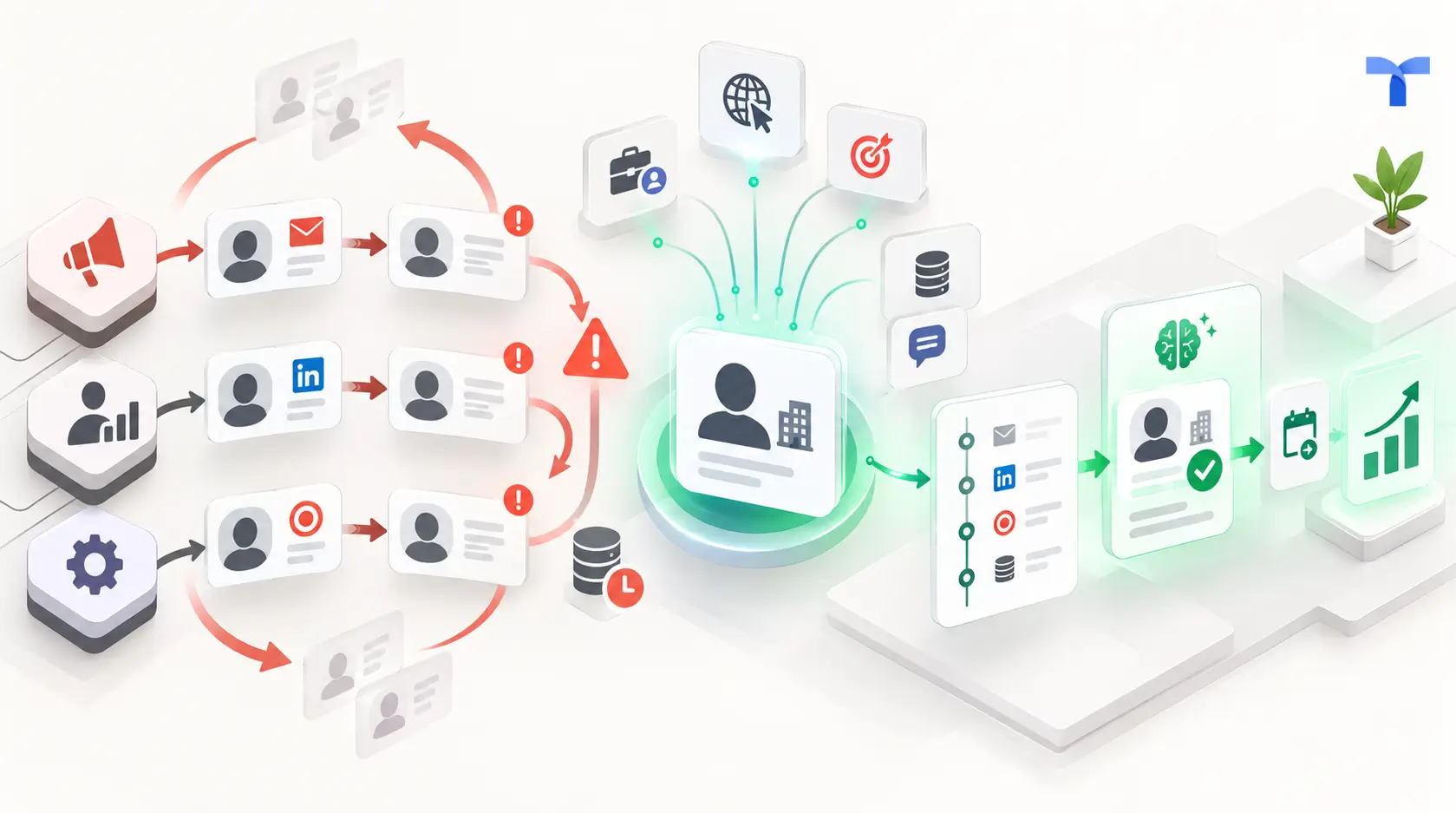
For years, a large share of the revenue operations job was janitorial. Deduplicating records, fixing enrichment that went stale the day after it ran, reconciling the CRM against three other tools, and building the lists and segments that sales asked for on Friday and needed Monday. The role carried outsized influence in theory and spent most of its hours on maintenance in practice.
AI-powered sales automation moves that maintenance into the background and pushes the revenue operations role up the value chain. When enrichment is continuous rather than a one-time batch, and when the account profile updates itself as new signals arrive, the operations leader stops being the person who cleans the data and becomes the person who designs the system that keeps it clean.
What is dynamic segmentation, and how does AI enable it?
This is the layer Tapistro is built for. Tapistro maintains a Unified Prospect Profile that continuously merges first-party behavior, CRM history, third-party intent, hiring data, and funding events, so the profile evolves rather than decaying. Segmentation becomes dynamic: the ICP score updates in real time as signals flow in, instead of the team chasing a segment defined a year ago that no longer reflects who is actually buying. For the revenue operations leader, Tapistro turns the job from firefighting data quality into architecting the orchestration logic the entire GTM motion runs on.
What does a RevOps leader do once data cleanup is automated?
The shift this asks for is one of identity. The strongest operations leaders in 2026 think of themselves as systems designers. What matters is how well they design the signal definitions, scoring weights, and orchestration rules that make every other role effective, not how fast they can clean a list. Tapistro gives that leader the canvas, but it raises the expectation of what they are responsible for from data hygiene to GTM architecture.
The Pattern Across All Three Roles
The same pattern repeats across every GTM role. AI-powered sales automation does not replace the person. It removes the lowest-value layer of their work and raises the floor on what the rest of the role is expected to deliver. Sales development moves from volume to judgment. Account executives move from preparation to presence. Revenue operations moves from cleaning data to designing the system. In every case the human is asked to operate at the top of their role rather than the bottom of it.
This is why the framing of "AI replacing sales" gets the story backwards. The roles are not disappearing. They are being raised. The teams that win are not the ones that bought the most automation. They are the ones that redesigned each role around what it becomes once the manual work is gone, and then equipped those roles with a single connected system rather than a stack of disconnected point tools.
Tapistro is built to be that single system, because the three roles are not actually separate workflows. The data revenue operations designs feeds the signals sales development acts on, which feeds the conversations account executives close, which feeds back into the data. When all of it runs in one loop, each role amplifies the others. When it runs in six tools, the handoffs cancel the gains out.
The Bottom Line
If you are evaluating AI-powered sales automation in 2026, stop asking what features it adds and start asking what each role becomes. Map the lowest-value work out of sales development, account executives, and revenue operations, then redesign each role around the judgment, presence, and design work that remains. Equip all three with one orchestration layer rather than a stack that fractures at every handoff. That is the move that compounds, and it is the model Tapistro was built to run. The technology is not the advantage. The redesigned roles, running on one connected system, are.
Tapistro is the agentic GTM platform that unifies signals, enriches prospect data, and orchestrates personalized outreach in a single system, giving sales development, account executives, and revenue operations one platform instead of six. See a sample playbook built around your team at tapistro.com.
.webp)