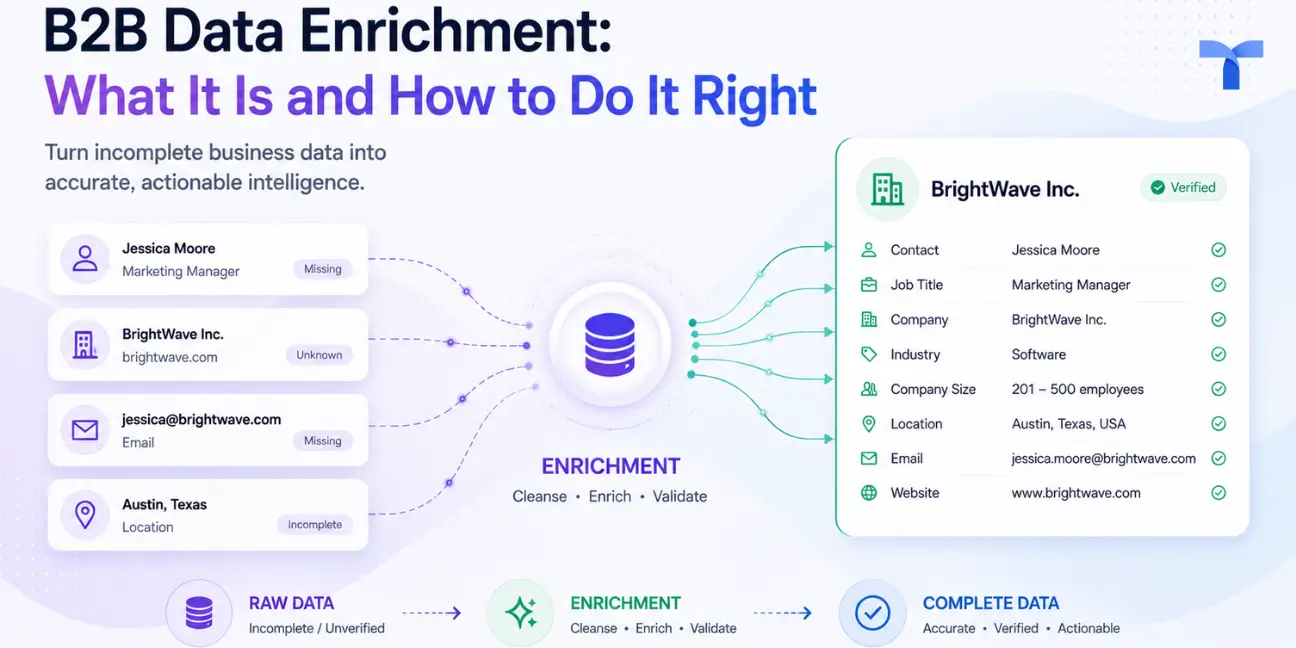
Business-to-business data enrichment is the process of adding missing or outdated attributes to the account and contact records you already hold, using external providers and internal sources, so go-to-market teams can segment, prioritise and personalise accurately.
It is not the same as data cleansing, and the two get conflated in a way that costs money. Cleansing fixes what is wrong or duplicated in the records you have. Enrichment adds what was never there. Order matters: enrich before you cleanse and you will pay a provider to append attributes onto three copies of the same account, then pay again when you deduplicate and lose two of them.
Most revenue teams have already run an enrichment project. They bought a provider, ran a bulk append across the customer relationship management system, watched fill rates jump from forty percent to eighty, and moved on. Eighteen months later the same problem was back, and usually worse, because nobody had budgeted for the fact that the data would start decaying the day after the append finished.
That cycle is the real subject of this piece. Enrichment is not difficult to buy and it is not difficult to run once. It is difficult to keep, and almost everything written about it stops at the part that is easy.
So below: what business-to-business data enrichment actually is, which fields deserve your budget and in what order, why one provider will never be enough, and the section most guides skip, which is what to do about data that goes stale faster than you can clean it. Some of what follows is drawn from what we see break in real deployments at Tapistro, and where that is the case it is labelled rather than dressed up as an industry benchmark.
B2B Data Enrichment Types
Account level enrichment
Account enrichment fills in what a company is: industry, employee count, revenue band, location, corporate hierarchy, technology stack, funding history and growth trajectory.
This layer drives targeting and territory design, and its errors are the least visible in the business. Nobody notices that an employee count is three years old until a whole segment underperforms and no one can explain why.
Contact level enrichment
Contact enrichment fills in who a person is: verified email, direct dial, job title, seniority, function, reporting line and tenure in role.
This layer drives outreach, and its errors are extremely visible. A bounced email is immediate feedback, which is exactly why teams over-invest here and under-invest in the account layer that quietly decides everything upstream.
Which fields actually matter
Enrichment budget is finite and providers price per field and per record, so the order you buy in matters more than the total you spend.
Firmographics come first
Industry, employee count, revenue band and location. Everything downstream depends on these, because they determine whether an account belongs in your ideal customer profile at all.
Get these wrong and every subsequent decision inherits the error, silently and permanently. An account misclassified by industry will be excluded from the campaigns it should be in and included in the ones it should not, and nothing in your reporting will tell you.
Normalised role and seniority next
Raw job title is close to useless in business-to-business, because titles are not standardised across companies and a Head of Growth at one company is a Director of Demand Generation at another.
What you need is normalised function and seniority: engineering or operations, individual contributor or manager or executive. A provider that hands you raw titles and expects you to normalise them has moved the work, not done it.
Technographics, because your product depends on them
Which systems an account runs. This matters enormously if you integrate with, compete against or complement specific tools..
Be honest about which category you are in. Plenty of teams buy technographic data because it sounds sophisticated and then never build a play that uses it.
Intent and signal data last, and include an execution path
Hiring activity, technology changes, funding events, review site research, content consumption. This is the most valuable data in the stack and the most commonly wasted, because it decays in days.
Buying intent data with no way to act inside that window is the most expensive mistake in this category. If a signal lands on Tuesday and your team works the list on Friday, you have paid for information that expired before anyone opened it.
Why one provider is never enough
Provider coverage varies sharply by geography, company size and industry, and vendor marketing is generally built around whichever segment a vendor covers best. That is not a criticism of any particular provider, it is a structural feature of how the data is sourced.
How waterfall enrichment works
You query providers in a defined sequence. The first returns what it has, anything still missing goes to the second, then the third, and you stop as soon as the field is filled. You pay per successful match, not per record attempted.
The practical effect is usually better coverage per pound spent than a single vendor contract, because each provider is only being paid for the records where it is genuinely the best source. How much better depends entirely on your segment mix, which is why the next section matters more than this one.
Ordering the waterfall properly
Sequence providers by accuracy for your specific segment, not by their general reputation. A provider with excellent North American mid-market coverage may be weak on European enterprise, and if most of your pipeline is the latter then their headline accuracy number is irrelevant to you.
The only reliable way to find out is to test. Take five hundred accounts you already know to be true, run them through each provider, and compare. That test costs an afternoon and routinely reorders the sequence people assumed was correct.
Setting realistic expectations
Across Tapistro deployments we typically see firmographic coverage land considerably higher than direct dial coverage, with the gap widening outside North America. That pattern is more useful to plan around than any single headline number, and we would rather a customer design a motion that works at realistic coverage than one that assumes near-total fill.
Treat any promise of near-total coverage across every field and every geography as a description of a sales pitch, not of a data set.
The part most guides skip: data decay
Enrichment fails as a one-time project because business-to-business data does not sit still. People change jobs, companies are acquired, funding rounds close, technology stacks get replaced and headcounts move.
The published numbers vary enormously and every one of them comes from a company that sells data, so treat them as directional. ZoomInfo, citing HubSpot benchmarks, puts aggregate annual decay at 22.5 percent and reports field-level rates ranging from roughly twenty percent for phone numbers up to around forty percent for email addresses. Whatever the precise figure for your database, the direction is not in dispute: a meaningful fraction of your contact data goes wrong every year while you are not looking.
Different fields decay at different speeds
This is the insight that should change how you buy enrichment, and it follows directly from the numbers above. Email and direct dial degrade fastest. Job titles move next. Firmographic attributes such as industry and location barely move at all.
A single refresh cadence applied across every field is therefore both wasteful and insufficient at the same time, which is how teams end up paying to re-verify a company's country every quarter while their email list quietly rots.
A refresh cadence worth starting from
This is our recommendation rather than an industry standard, and it should be tuned against your own measured decay rate. Refresh emails, direct dials and job titles every one to three months. Technology stack and headcount every six. Industry, hierarchy and location annually.
Intent signals do not belong on this schedule at all, because they are events, not attributes. They are acted on, or they are wasted.
Better still, refresh on change rather than on schedule
The stronger model is not a schedule. It is to subscribe to change: when a contact's employer changes, update that record then, instead of waiting eleven weeks for the quarterly batch to notice.
This is the argument for continuous enrichment over batch enrichment, and it is where Tapistro sits. A profile that updates when the world changes is a materially different asset from one that was correct at the last refresh date.
Measure your own decay so you can defend the spend
Take two hundred records each quarter, verify them by hand, and track the percentage that have gone stale. It takes an afternoon and it replaces every borrowed statistic in this section with a number about your business.
That figure is also the most persuasive thing you can put in front of finance at renewal, because it converts an abstract data quality argument into a measured rate of loss.
How to run this without a data team
Most teams reading this do not have a dedicated data engineer, and they do not need one. Five steps, in this order.
Audit what you actually have
Export your accounts, count fill rates per field, and check freshness by looking at when each field was last written. This almost never confirms what people assumed, which is the point of doing it.
Cleanse before you enrich
Deduplicate, standardise formats and resolve conflicting records first. Enriching a messy database multiplies the mess and bills you for the privilege.
Buy only the fields that gate your top motion
Not every field on the provider's menu. If your primary play depends on employee count and technology stack, buy those two and revisit the rest next quarter.
Set cadences by field type
Per the section above, not one global schedule. This alone usually reduces spend while improving the fields that matter.
Connect enrichment to something that acts
Enrichment that improves a dashboard and nothing else is a cost centre with good intentions. The value only appears when better data changes what gets sent, to whom, and when.
Where Tapistro fits
Enrichment as an input, not a project
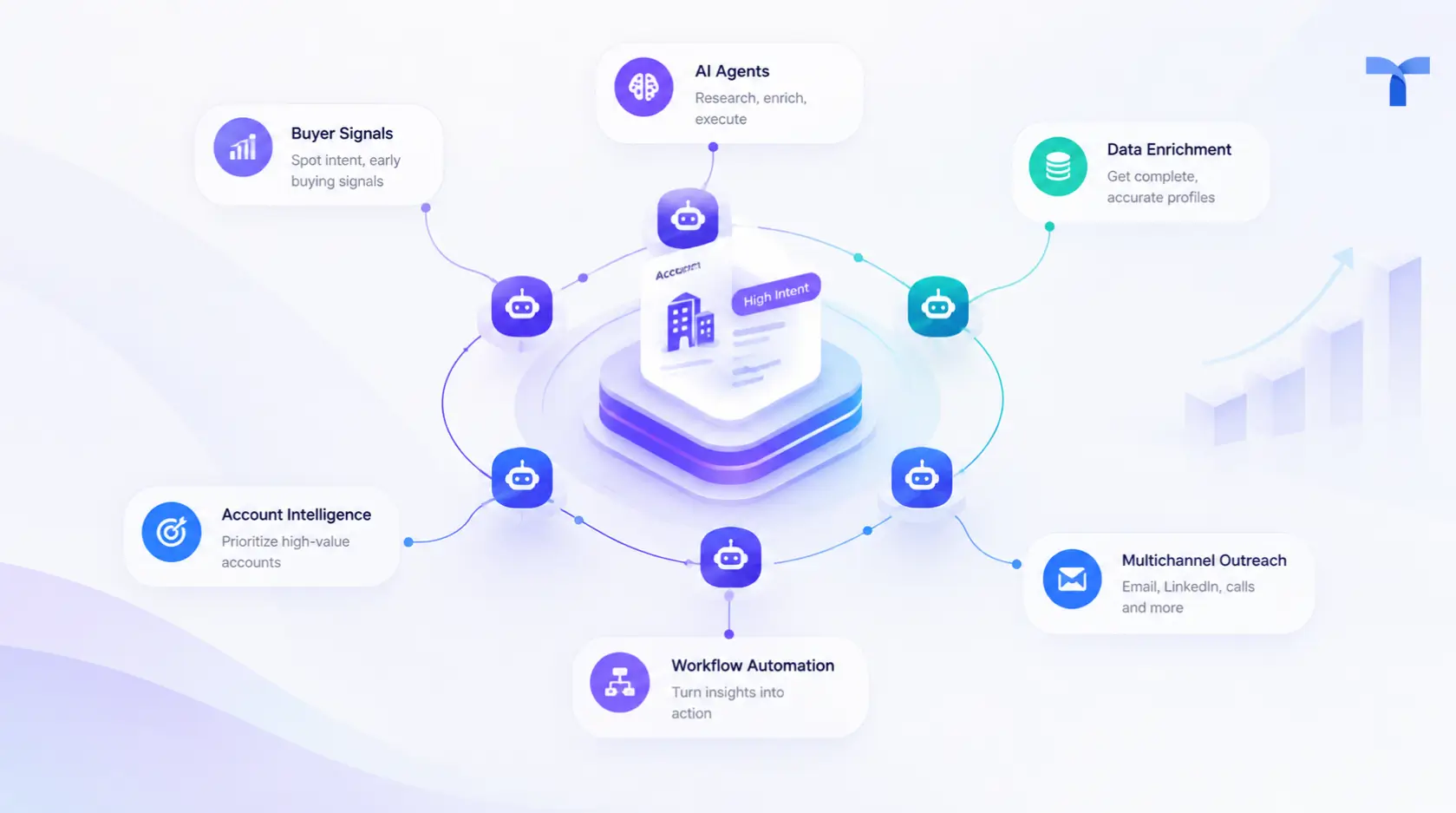
Tapistro treats enrichment as a continuous input to a live account profile rather than as a periodic bulk operation. Sources report changes, the profile updates, and the motions running on top of it see the change immediately rather than at the next batch.
The reason we built it that way is the decay problem above. An agentic go-to-market motion decides and acts automatically, and a system deciding automatically from data refreshed last quarter will be confidently wrong at scale. In that architecture, continuous enrichment is not an upgrade; it is a precondition.
Coverage as a function of the whole provider set
Tapistro runs waterfall enrichment across multiple providers rather than tying a team to one contract, so coverage reflects the whole set rather than any single vendor's strongest segment, and the sequence can be reordered as your segment mix changes.
Tapistro keeps account and contact profiles current continuously rather than in quarterly batches, and feeds them straight into the motions your revenue team is already running. If enrichment is a project you keep having to redo, see how Tapistro handles it book a demo now.