%20(1).avif)
What Is Account Enrichment?
Account enrichment is the process of taking a thin company record, often just a name and a domain, and layering on the context a revenue team needs to sell: firmographics, technographics, headcount trends, funding history, hiring signals, org structure, and buying intent. It turns a static database entry into a live picture of what is actually happening inside an account.
A lead record tells you a person exists. An enriched account tells you whether the company behind that person is worth your team's time, who else you need to reach, and what is changing inside that business right now.
Here is the distinction that matters. Most teams think of enrichment as filling in blanks. That is the floor, not the ceiling. Real account enrichment is the difference between a static snapshot and a living picture:
- The static record: "Acme Corp. 500 employees. San Francisco. Software."
- The enriched account: "Acme Corp. Grew from 500 to 720 employees in nine months, most of that hiring in revenue roles. Just closed a Series C. Posted three job openings for data engineers last week. Currently runs a competitor's product."
One record sits in a database. The other tells a rep exactly why to call and what to say.
Why Account Enrichment Decides Whether B2B Sales Works
By 2026, the limiting factor in business-to-business selling is not effort. Teams are sending more emails, booking more meetings, and running more sequences than ever. The limiting factor is precision. And precision starts with knowing who you are actually talking to.
When account data is thin or wrong, the damage compounds at every stage:
- Targeting breaks. Your ideal customer profile is only as good as the data you match against it. Bad firmographics mean you chase accounts that were never a fit.
- Routing breaks. Accounts land with the wrong rep, in the wrong segment, with the wrong owner. Deals stall before anyone has a real conversation.
- Scoring breaks. A lead score built on empty fields is a guess wearing a number.
- Outreach breaks. Reps personalize against outdated context and sound like they did no homework, because effectively they did not.
Enrichment is the input that every other system depends on. Get it wrong and you are not running a revenue motion. You are running a very expensive guessing game.
The Shift: From One-Time Append to Always-On Account Intelligence
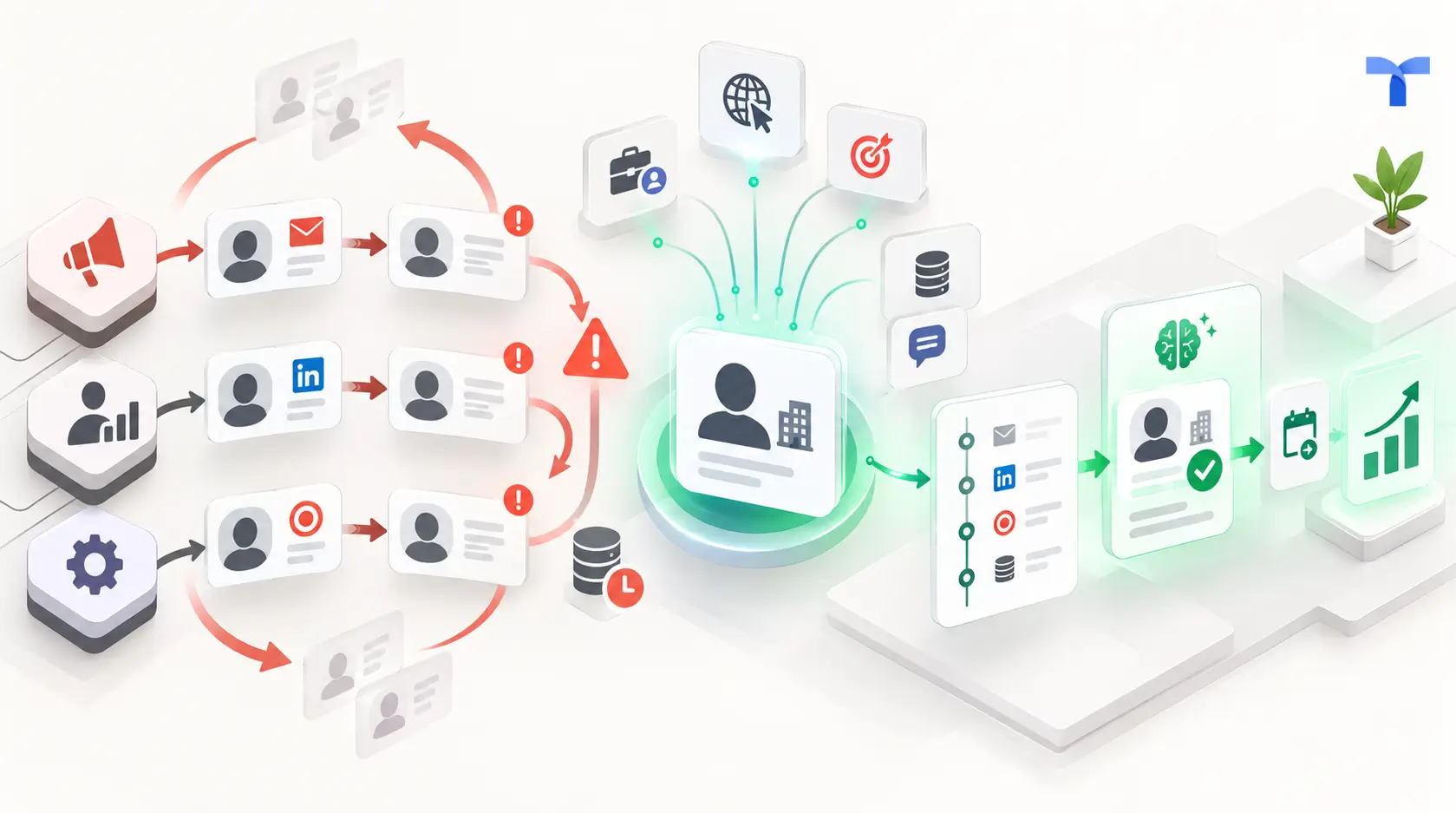
For years, enrichment meant buying a data file, appending it to your records once a quarter, and watching it decay the moment it landed. That model is finished, and the reason is simple. Companies change faster than quarterly refreshes can track.
The modern approach treats account intelligence as a live feed, not a file. It continuously watches for what changed: a leadership hire, a funding round, a new office, a shift in the technology a company runs, a spike in research activity around a problem you solve.
This is also where artificial intelligence earns its place in the stack. A human cannot read ten thousand job postings, cross-reference them against your customer list, and flag the forty accounts that just started building a team in your category. A system can. It reads the unstructured signal, the press release, the job description, the org chart change, and turns it into something a rep can act on by Monday morning.
Static Enrichment vs. Continuous Account Intelligence
Waterfall Enrichment: Why One Source Is Never Enough
No single data provider covers the entire market. One vendor is strong on SMBs but thin on enterprise. Another has deep technographic data but outdated contact information. A third tracks funding rounds but misses headcount signals entirely.
Waterfall enrichment solves this by querying providers in sequence rather than relying on one. The logic is straightforward: if Provider A cannot match or fill a field, the request falls to Provider B, then Provider C, until the record is complete or all sources are exhausted. You get the highest possible match rate without paying every vendor for every record.
This matters more than most teams realize. A single-source enrichment strategy typically achieves match rates between 50 and 70 percent, depending on the market segment. A well-designed waterfall can push that above 90 percent. For a pipeline of 10,000 accounts, the difference is thousands of records that either carry a confident score or sit empty.
The harder problem is orchestration. Managing waterfall logic manually - deciding which provider gets first call for which record type, tracking fallback sequences, and reconciling conflicting data from different sources - carries real operational overhead. Most teams either default to a single vendor and accept the coverage gaps, or they build brittle logic that breaks the moment a provider changes its API.
That is where the architecture of your enrichment layer starts to matter as much as the data itself.
How Tapistro Turns Raw Data into a Golden Goose
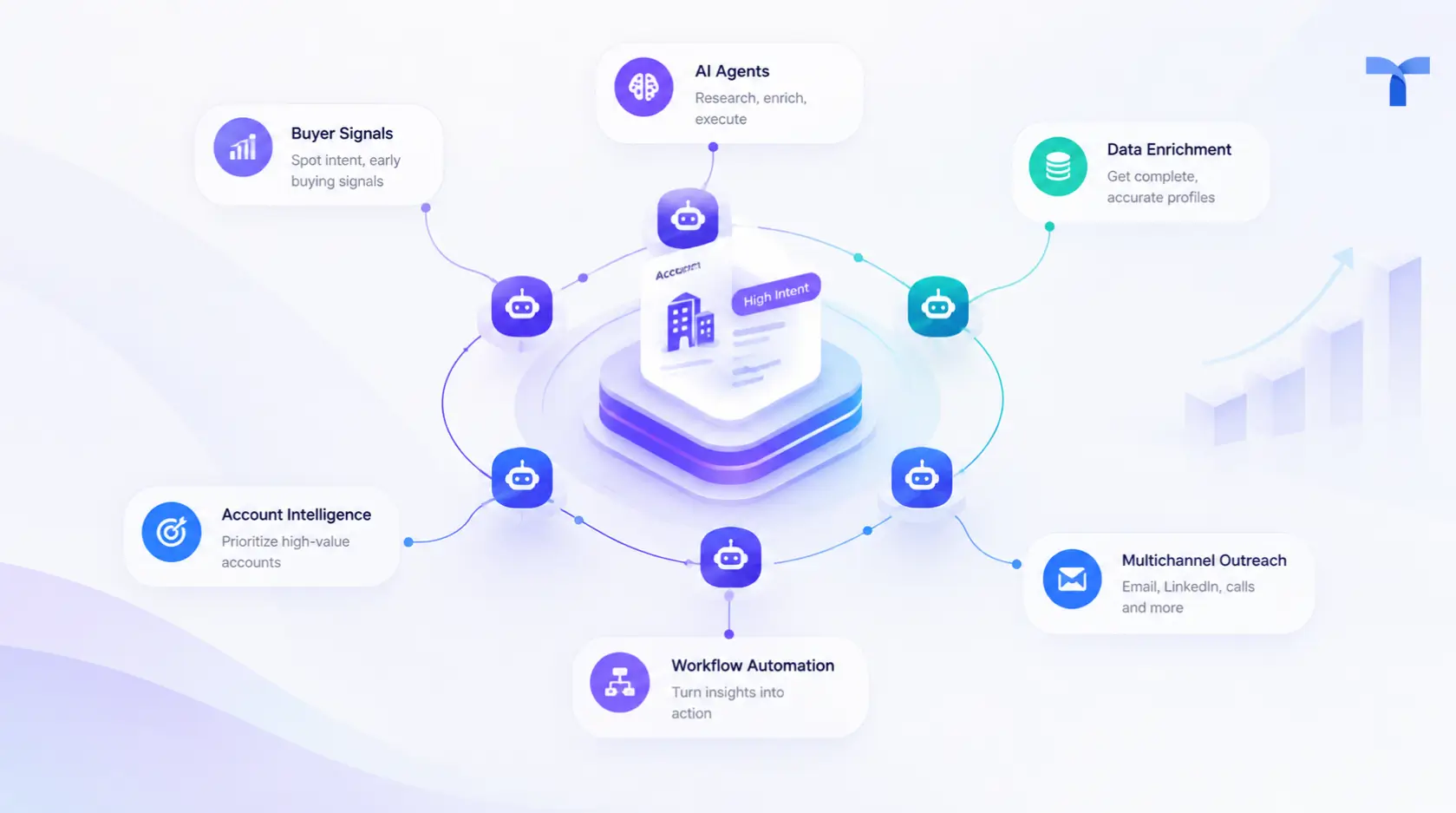
Tapistro runs waterfall enrichment as a native capability. Rather than managing provider priority lists manually, you define the logic once: which sources to check first for firmographics, which to fall back to for technographics, how to reconcile conflicting employee counts. Tapistro executes that sequence automatically, in real time, as new accounts enter your pipeline.
The output is a Unified Prospect Profile built from the best available data across 70+ signal sources, not the data one vendor happened to have on file. When a field cannot be filled from a primary source, the waterfall continues. When two sources disagree, a configurable resolution rule decides which one wins.
Beyond waterfall enrichment, Tapistro watches accounts continuously and uses natural language processing to understand the context behind the data, not just the data itself. The output is not a fuller record. It is a sharper instruction:
- A target account just hired a new head of revenue operations. Tapistro flags it and drafts the angle.
- An account in your pipeline quietly adopted a competitor's tool. Tapistro alerts the account owner with the context.
- A dormant account started hiring aggressively in a department you sell into. Tapistro re-scores it and routes it back into the active motion.
Enrichment stops being a maintenance chore. It becomes the thing that tells your team where to spend the next hour.
A Practical Framework for Getting Account Enrichment Right
If you own revenue operations or marketing operations, here is how to build an enrichment motion that actually moves pipeline.
1. Define what "complete" means before you buy anything
Do not start with a vendor. Start with a decision. List the exact fields a rep needs to make a confident call and the exact fields your scoring model needs to be trustworthy. Everything else is noise you will pay to store.
2. Design your waterfall before you sign any contracts
Map out which providers you need and in what order. A good waterfall has a primary source optimized for your core segment, one or two fallback sources for coverage gaps, and a reconciliation rule for conflicting values. If a vendor cannot tell you their match rate for your specific ICP, that is your answer.
3. Treat enrichment as continuous, not a project
Set the expectation that account intelligence refreshes on a cadence measured in days, not quarters. Build the workflow so new signals flow into the record automatically and trigger a review when something material changes.
4. Connect enrichment to an action, every time
A freshly enriched field that nobody acts on is wasted spend. Every meaningful change should fire a play: a routing update, a score change, an alert, a sequence. If enrichment does not end in an action, you are just decorating your database.
5. Audit the decay
Once a quarter, sample your records and measure how fast they go stale. If a third of your firmographics are wrong within six months, that number should reset how much you trust any system built on top of them.
Good Data Is a Strategy, not a Subscription
You can keep treating enrichment as a line item, a file you buy and forget, and keep paying the quiet tax on every stalled deal and every missed account. Or you can treat account intelligence as what it actually is: the input that decides whether your entire revenue motion is aimed at the right targets.
The teams that win the next few years will not be the ones with the most data. They will be the ones whose data is current, connected, and pointed at an action.
Ready to turn raw records into reasons to call?
See how Tapistro keeps your accounts intelligent.


.webp)