.avif)
Revenue teams have never had more information about their buyers. They have also never been further from acting on it. Gartner projects that by 2028, 90 percent of B2B buying will be intermediated by AI agents, pushing more than 15 trillion dollars of B2B spend through AI agent exchanges (Gartner, Strategic Predictions for 2026). Forrester reports that 91 percent of B2B marketers now use intent data to prioritize accounts, yet only 24 percent describe their return as exceptional (Forrester, 2026). And McKinsey's State of AI 2025 finds that 88 percent of companies have adopted AI, but only about 6 percent are capturing meaningful enterprise-level value (McKinsey, The State of AI, 2025).
Read those three numbers together and the picture is uncomfortable. The AI capability is arriving at unprecedented speed. The signal layer is already widely adopted. The value capture is not. What we see working with revenue teams at Tapistro mirrors what the data shows. The constraint is no longer signal supply or technology access. It is the time between a signal arriving and a person doing something useful about it. The companies pulling ahead are not buying more intent feeds or more enrichment vendors. They are installing an orchestration layer that decides what to do with the signals they already have.
That layer is what this post is about. Specifically, what it is, why most revenue teams are still missing it, how to know when a vendor actually qualifies, and what to expect once it is in place.
What an AI Orchestration Platform Actually Does
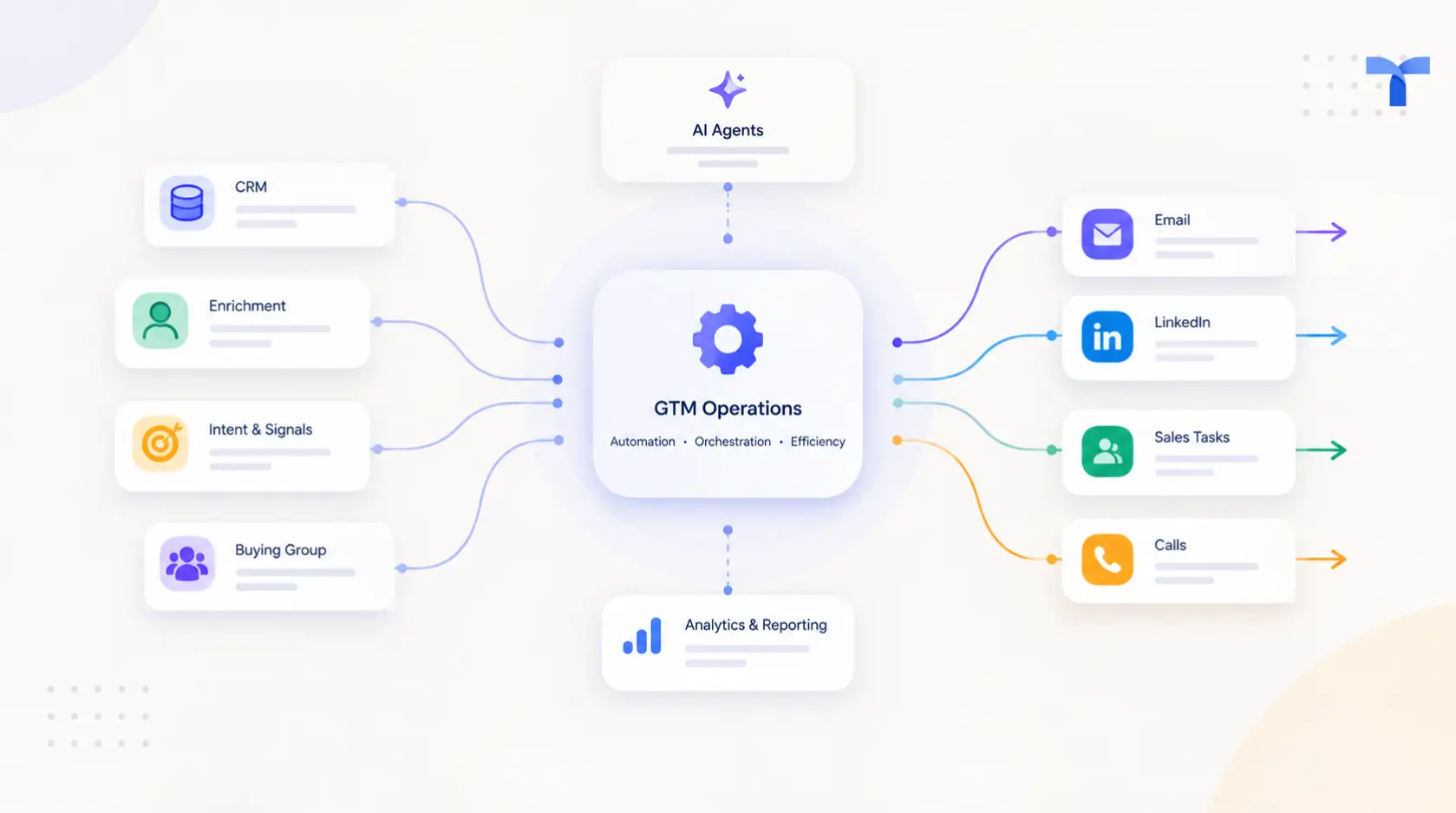
An AI orchestration platform is the connective tissue between every signal your revenue team collects and every place your team executes. Signals come from intent providers, product usage logs, customer relationship management records, marketing automation tools, third-party enrichment, and first-party web behavior. Execution happens inside sequences, advertising platforms, sales plays, and the chat channels where revenue teams actually work.
From Connective Tissue to Reasoning Agents
In most companies, that connective tissue is a person. Usually, a revenue operations leader stitching together dashboards. Sometimes a marketing analyst running weekly batch scores. Always a bottleneck. And as the number of signal sources grows each quarter, that bottleneck gets worse, not better.
An orchestration platform replaces that bottleneck with reasoning agents that ingest every signal, resolve it to a person and an account, weigh it against everything else the company already knows, and decide the next action.
Why This Is Different from Workflow Automation
It is not a workflow tool. Workflow tools execute steps you define in advance — if this signal, route this way. They have no opinion about which of three simultaneous signals matters more, and they require a human to update the logic when conditions change. An orchestration platform weighs every incoming signal against full account context and decides the next action without waiting for someone to rewrite the rules.
At Tapistro, we describe the layer as the place where buying intent becomes a pipeline decision rather than an inbox alert.
Why Signals Without Orchestration Produce Noise, Not Pipeline
Most revenue leaders have already lived this failure mode without naming it. Marketing licenses two intent vendors. Sales buys an enrichment tool. Product instruments key behaviors and pipes them into the data warehouse. Revenue operations wire up scoring inside the customer relationship management system. Six months later, the seller opens a dashboard, sees forty-three accounts flagged as priorities, no ranking between them, and no answer to the only question that matters. What should I do next.
The Arithmetic Problem
This is not a tooling problem. It is an arithmetic problem. The volume of signals available to a business-to-business revenue team now exceeds what any human can sort by hand in a working day. Pattern recognition at that scale is what software does well and what people do poorly. We see this constantly across customer environments at Tapistro. The teams that struggle are not the ones with bad data. They are the ones whose humans are trying to do work that should belong to a system.
Where the Cost Shows Up
The cost shows up in places leaders rarely connect back to the root cause:
- Sellers disengaging from intent alerts because too many are false positives.
- Marketing campaigns firing against last week's priorities while the highest-intent account on the list engaged with a competitor's content three days ago.
- Forecast meetings where the numbers move based on individual seller judgment because no system is helping rank the accounts.
- Sellers engaging with accounts days after the in-market signal peaked, because the alert sat in a queue waiting for someone to read it.
The signal problem and the productivity problem and the alignment problem are the same problem wearing three different names.
Where an AI Orchestration Platform Changes the Math
Three shifts matter more than the rest.
The first is moving from weekly batch scoring to continuous account ranking. Tapistro's agents update account priority continuously as new signals arrive, which means sellers are always working against current data, not a snapshot from last week's batch run.
The second is channel selection based on signal type and buyer stage rather than fixed cadence templates. A net-new intent spike calls for a different motion than a returning signal from an account already in pipeline. Tapistro routes each one to the channel that fits the moment.
The third is continuous re-prioritization. The orchestration layer tracks engagement signals -replies, opens, click-throughs - and updates account priority in real time. Sellers are always working the current list, not one a rep built and forgot to refresh.
The pattern holds across customer environments. Eucloid, a data and analytics firm expanding into the U.S. market, compressed a 5-month outreach ramp-up into weeks after deploying Tapistro's signal orchestration - generating 5 to 6 qualified meetings per month with a 38 percent click-through rate on outreach. A mid-market loyalty SaaS team scaled outbound volume 10x without growing headcount, as AI agents eliminated all pre-outreach research that previously consumed most of a rep's working day, with open rates increasing 4x as signal-driven personalization replaced generic templates. In each case the constraint was the same: not signal supply, but the time and human judgment required to act on signals before they went cold.
The Five Capabilities That Define a True AI Orchestration Platform
Not every tool claiming the label qualifies. The category is being crowded by workflow automation vendors repositioning their products and by enrichment companies adding a thin scoring layer on top. Five capabilities separate the real layer from the marketing rebrand.
Unified Signal Ingestion
The system must read first-party behavior, third-party intent, product usage, and customer relationship management data inside a single decision model. Not as separate dashboards stitched together by a quarterly business review slide. Tapistro is built to ingest every source a revenue team is already paying for and weigh them together inside one decision.
Identity Resolution at the Person and Account Level
Without it, the system cannot tell that the anonymous visitor, the form fill, the LinkedIn engagement, and the open opportunity are all the same buying committee. The result is duplicated outreach, missed coordination, and credibility damage with the prospect. Tapistro resolves identity at both the person and account layer so the buying committee is treated as one coherent entity rather than four loose contacts.
Reasoning Agents That Decide Who, What, When, and Where
Rules cannot keep up with the combinatorics. Agents must judge priority, choose channel, and time the outreach based on context that changes hourly.
Native Execution Into the Tools Your Team Already Uses
Sequences, advertising platforms, customer relationship management, and chat. If the orchestration layer hands off to yet another workflow tool to actually do the work, you have added latency, not removed it. Tapistro writes directly into the systems your team is already inside, which is the only way the latency math works.
Measurable Feedback Loops Tied to Revenue Outcomes
Without this, the system cannot improve and the buyer cannot trust the recommendation. Tapistro instruments the feedback loop in production so revenue leaders can see, in real numbers, whether the layer is moving pipeline.
This is the standard we built Tapistro to meet.
How to Evaluate an AI Orchestration Platform Before You Buy
If you are sitting in a buying seat right now, the vendor landscape is loud. Five questions cut through it faster than any feature comparison.
Five Questions to Ask Every Vendor
- How many signal sources does the system reason across in a single decision? The answer should be every source you currently pay for, not a curated subset.
- What is the latency between signal arrival and action in production? Hours is acceptable. Days is the old world.
- What happens when two signals contradict each other? A real orchestration platform has an opinion. A workflow tool just fires both alerts and leaves the seller to mediate.
- How is the model's behavior auditable for revenue leaders and compliance? You cannot scale a system you cannot explain.
- What does the integration footprint look like six months in? Vendors who require a year of services work to reach value are selling you a project, not a product.
The Cultural Question Most Evaluations Miss
A sixth question is more cultural than technical. Does the vendor sell to revenue leaders or to information technology buyers. Vendors that sell into the technology buying center tend to optimize for breadth of integration over depth of decision quality. Vendors that sell to revenue leaders tend to optimize for the metrics revenue leaders are actually measured on. The difference is visible in the first product demo if you know to look for it.
Tapistro answers each of these questions with a live customer environment rather than a slide deck. If you are running an evaluation, the conversation should start there.
The Shift Underneath Everything
The companies that win the next revenue cycle will not be the ones with the most data. They will be the ones whose systems can act on data faster than their competitors can sort through it. The orchestration layer is where that speed lives, and the maturity gap between leaders and laggards is widening every quarter the gap is left unaddressed. A year from now, the revenue teams that installed an orchestration layer in 2026 will be operating against teams still trying to staff their way out of a signal volume problem. That gap compounds, and it compounds faster than most leaders expect.
Signals without orchestration are noise. Pipeline without orchestration is luck. Tapistro is the layer that turns the first into the second, built for revenue teams that are tired of drowning in a problem they were told more data would solve.