%20Strategy.webp)
Picture a dense, ever-shifting forest and a single day to hunt it. Chase every rustle in the bushes and you burn daylight on rabbits while the elk slip away. The hunters who win read the forest's hidden signs. A go-to-market strategy is how you read the market's signs instead of chasing its noise.
A go-to-market strategy is the plan a company uses to bring a product to the right buyers, through the right channels, at the right time. It defines who you sell to, what you say to them, how you reach them, and how product, marketing, and sales work together to win customers and keep them.
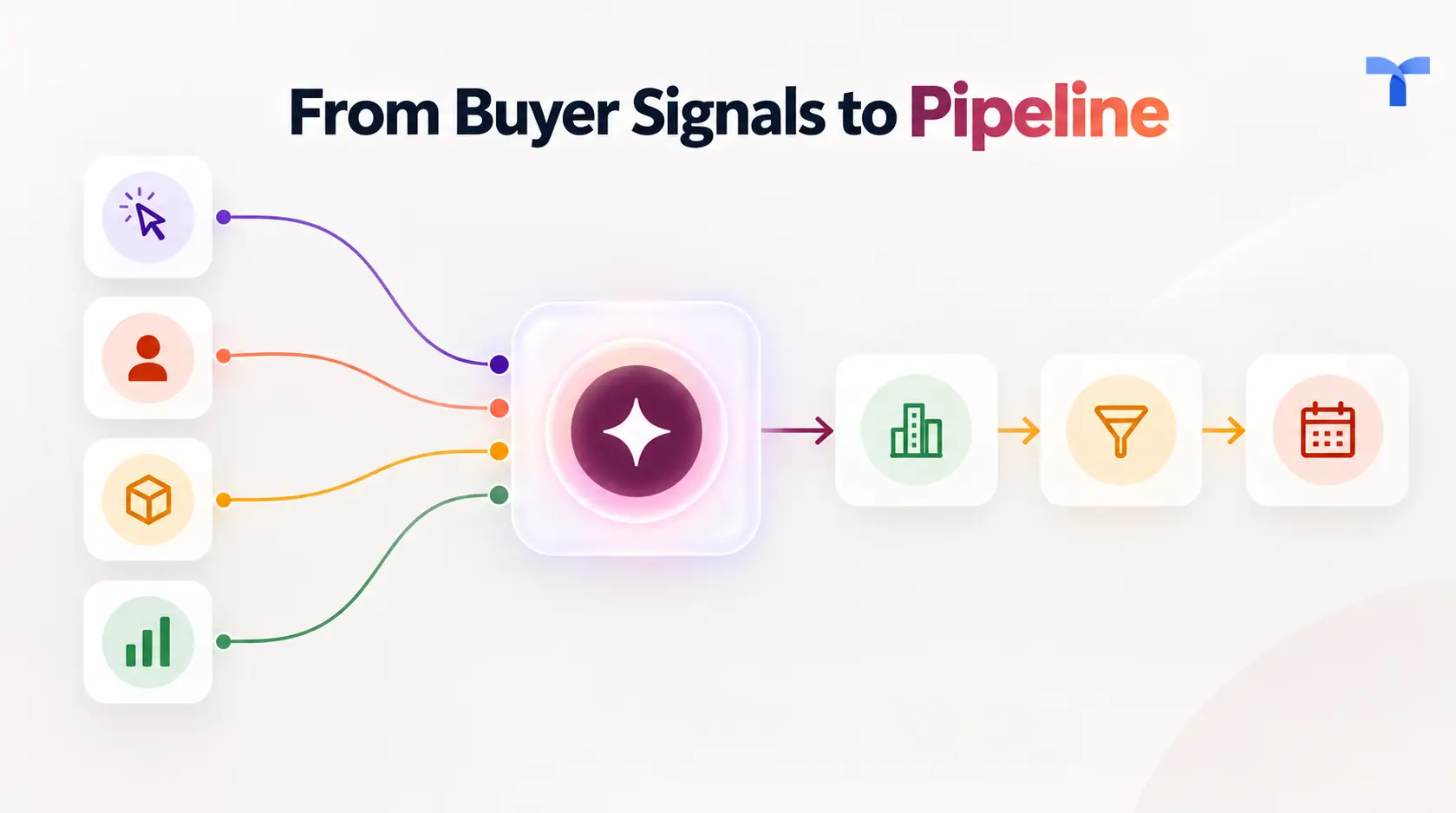
That plan is under more pressure in 2026 than at any point in the last decade. Gartner found that 67% of B2B buyers now prefer a rep-free purchasing experience, and yet 69% still turn to a sales rep to validate what AI has told them. Forrester reports that buying groups are growing larger and more skeptical of AI-generated claims. The buyer has changed faster than most playbooks. At Tapistro, we built our platform around that reality: a go-to-market strategy is only as strong as the live data and buying signals underneath it. This guide covers what a go-to-market strategy is, the components and motions that matter now, why so many fail, and a step-by-step way to build one that holds up through 2026 and beyond.
What a go-to-market strategy actually is, and what it is not
Go-to-market strategy vs marketing strategy vs business plan
A business plan explains why your company exists and how it makes money. A marketing strategy governs how you build awareness and demand over the long term. A go-to-market strategy is narrower and more operational: it is the coordinated motion for taking a specific product to a specific market and converting a specific buyer. You can have a strong brand and a sound business and still lose, simply because your go-to-market motion is pointed at the wrong accounts.
The core components of a go-to-market strategy
Every durable go-to-market strategy answers five questions. Who is the ideal customer, and which of them are in-market right now. What problem you solve and the value you promise. Which channels and motion you use to reach them. How sales and marketing coordinate around each account. And how you measure, learn, and adjust. Tapistro exists to keep the first and fourth answerable in real time, because those are the two components that decay fastest once the market moves.
Why go-to-market strategies fail in 2026
The ideal customer profile is treated as a static document
Most teams define an ideal customer profile once and file it away. Markets move weekly now. The account that fit perfectly last quarter may have frozen its budget, while three accounts that were never on your list just raised funding and started hiring. A go-to-market strategy that cannot refresh its target list against live signals is aiming at last year's market. Tapistro models the ideal customer with AI and continuously scores who is genuinely in-market, so the target list becomes a living thing rather than a slide.
The data lives in ten tools and none of them agree
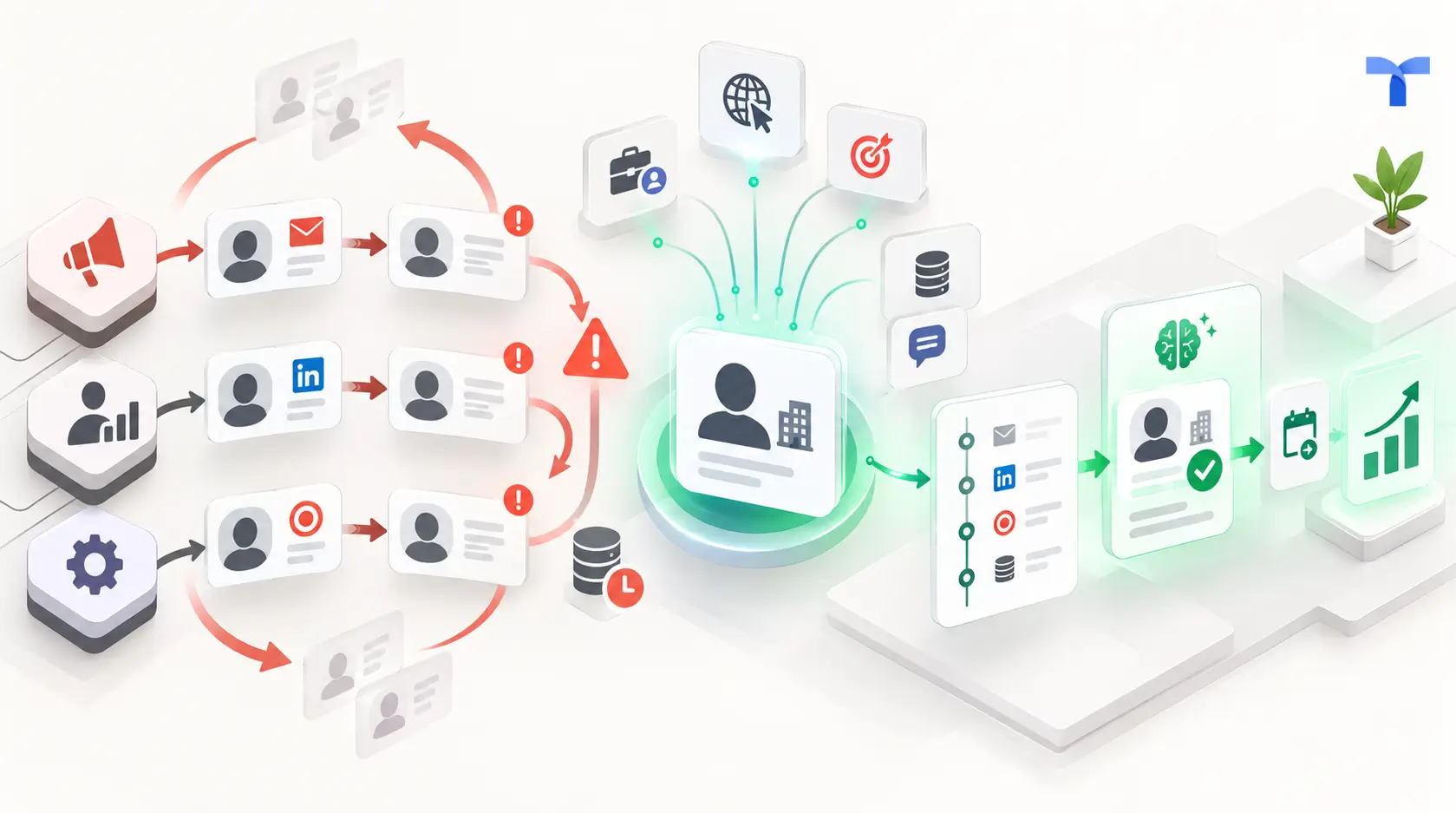
The average revenue team runs customer relationship management, enrichment, intent, engagement, and analytics tools that each hold a partial, conflicting view of the same account. Sellers lose hours reconciling records instead of selling. Unifying that data into one trusted account view is the specific problem Tapistro was built to solve, and it is the line between a go-to-market strategy on paper and one a rep can actually run.
The motion ignores how buyers now buy
If two-thirds of buyers prefer to research without a rep, a motion built entirely on cold outbound is fighting the current. Modern go-to-market design assumes the buyer arrives already educated, often by an AI assistant, and needs proof and validation more than a pitch.
The four go-to-market motions, and how to choose
Sales-led
A sales team drives the deal from first touch to close. This motion suits higher-priced, considered purchases with defined buying committees. It scales with headcount and rewards precise targeting, which is exactly where intent data and a clean account view earn their cost.
Product-led
The product itself acquires and converts users through a free trial or free tier. This motion suits tools with fast time-to-value and bottom-up adoption. The go-to-market work shifts toward activation, usage signals, and expansion rather than first contact.
Community-led and partner-led
Demand is generated through a community, ecosystem, or partner network rather than direct outreach. It is slower to start and durable once it compounds, and it is growing more common as buyers trust peers and platforms over vendors.
The hybrid motion most B2B companies actually run in 2026
In practice, few companies are purely one motion. A product-led top of funnel that routes high-intent accounts to a sales-led team is now the default across much of B2B software. The right blend depends on price point, buying-committee size, and time-to-value, not on fashion. Tapistro supports several motions at once by keeping one unified view of every account, regardless of how it entered your funnel.
How to build a go-to-market strategy, step by step
Step 1. Model your ideal customer with AI and find who is in-market now
Start from the accounts that already resemble your best customers, then let AI widen the pattern and rank the rest by fit and timing. What you want is not a static list but a continuously refreshed set of accounts showing real buying signals. Tapistro does this by combining your first-party data with intent and public signals into an ideal customer model that updates itself as the market moves.
Step 2. Build value propositions around real, current buyer pain
Generic value propositions lose to specific ones. Tie your message to the problem the buyer is provably wrestling with right now, evidenced by hiring, funding, tooling changes, or the content their team is consuming. The more current the trigger, the more the message lands.
Step 3. Design a multi-channel motion that meets a rep-free buyer
Assume the buyer is researching without you. Show up across the channels they already use, lead with proof and peer validation rather than a hard pitch, and make it effortless to self-educate before any conversation. Coordinate email, social, web, and sales touches so the account experiences one motion, not five disconnected ones.
Step 4. Align sales and marketing on one real-time view of the account
The oldest failure in go-to-market is sales and marketing working from different data. Give both teams a single, live account view, so a signal marketing sees becomes an action sales takes within hours instead of weeks. This unified, real-time account view is the core of what Tapistro delivers.
Step 5. Automate, measure, and refine continuously
Automate the repetitive research and data work so your people spend their time on judgment and relationships. Instrument the motion, watch what actually converts, and feed the learning back into the ideal customer model. A go-to-market strategy is a loop, not a launch.
A go-to-market strategy example
Consider a B2B software company moving upmarket from small businesses to mid-market. Rather than buying a static list, it models its ten best mid-market customers, lets AI surface 400 look-alikes, and ranks them by live signals such as recent funding and relevant hiring. Marketing runs proof-led campaigns against the top tier, while sales prioritizes the accounts showing intent this week. Both teams share one account view in Tapistro, so a spike in engagement triggers outreach the same day. Within a quarter, the company is spending its effort on the accounts most likely to buy, not the accounts that happened to sit on a list.
The 2026 shift: agentic, signal-driven go-to-market
From static lists to live signals
The defining change of 2026 is that the target list is no longer a purchase, it is a live feed. Signal-driven go-to-market watches the market continuously and moves resources toward wherever intent is highest this week. Static quarterly planning simply cannot keep pace with it.
Selling to a buyer who has already talked to AI
Buyers now arrive having asked an AI assistant what to buy. Two-thirds want to complete much of the journey without a rep, yet most still want a human to validate the AI's answer before they commit. Your go-to-market motion has to serve both moments: frictionless self-education first, then a credible human at the validation point.
Getting found by answer engines, not only search
A growing share of buyer research now happens inside AI answer engines and overviews rather than a page of blue links. Make your positioning clear, quotable, and well sourced, so the systems that increasingly mediate discovery cite you. Answer-engine visibility is becoming as central to go-to-market as classic search ranking once was.
Your go-to-market strategy checklist
Use this as a fast audit. Do you know which accounts are in-market this week, not just which ones fit on paper. Does one trusted account view feed both sales and marketing. Is your message tied to a current, provable trigger. Does your motion assume a rep-free, AI-informed buyer. Are you refreshing the target list continuously rather than once a quarter. And can you be found by answer engines, not only Google. A go-to-market strategy that clears this list is built for how buyers actually behave in 2026, and Tapistro is designed to help you clear it.
Ready to turn your go-to-market strategy into a living, signal-driven motion? Connect with the Tapistro team today to set your GTM motion.