
A VP of Engineering at a target account opens your pricing page on a Tuesday afternoon. She stays for nine minutes. She returns Thursday with two colleagues and clicks the security tab. By Friday morning, three things have not happened: nobody on the AE team knows. The marketing team's dashboard counts the visit as anonymous traffic. The CRM holds a stale contact record from a webinar she attended in 2024.
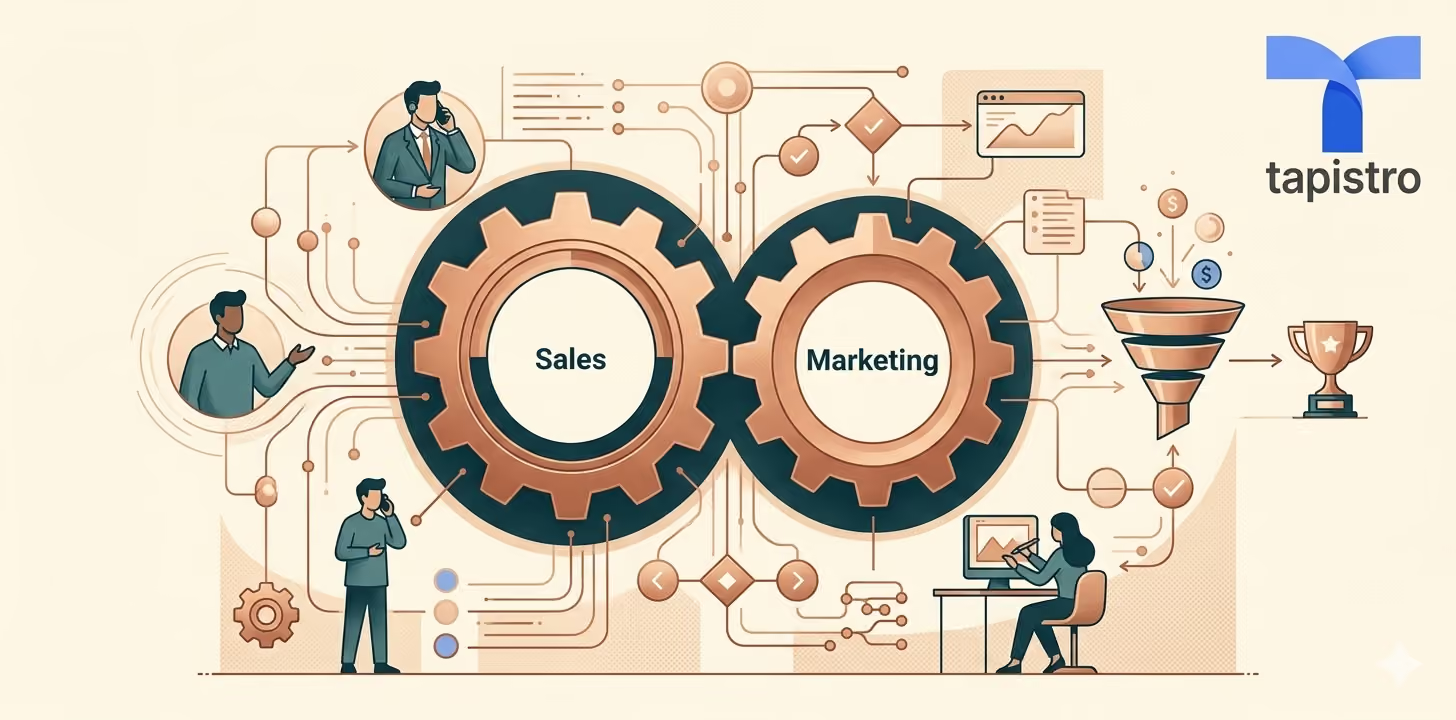
This is what the sales and marketing alignment problem actually looks like in 2026. It is not a meetings problem. It is not a lead-scoring problem. It is an orchestration problem. Signals arrive faster than any team can route them, and the systems that hold those signals do not talk to each other unless someone makes them.
A new category of platform has emerged to solve this: Agentic GTM platforms. Instead of dashboards that wait for humans to act, these platforms run autonomous AI agents that read signals across the stack, make decisions, and execute the next action without a manual handoff. They are becoming the operating layer for SaaS revenue teams.
What Is an Agentic GTM Platform?
An Agentic GTM platform is a go-to-market system built around autonomous AI agents that detect buying signals, decide on the next action, and execute it across CRM, marketing automation, analytics, and outreach tools, without requiring a human to trigger each step. It replaces fragmented coordination with continuous orchestration.
Traditional GTM tools, including CRMs, marketing automation, and workflow engines, sit and wait. They store data, render dashboards, and run predefined steps only after a person clicks something or a cron job fires. The tooling is solid. The connective tissue is missing.
Agentic GTM platforms work differently. The agents inside them are not chatbots and not single-task automations. They are persistent processes that:
- Detect buyer intent across systems and channels in real time
- Enrich contact and account profiles continuously, not on a refresh schedule
- Score leads dynamically based on probability-to-close and live signal strength
- Trigger the next outreach without waiting for an SDR to notice
- Update CRM, marketing tools, and analytics in lockstep so every team sees the same record
The category sits adjacent to AI GTM platforms and Marketing automation tools, but the agentic distinction matters: AI agents for GTM take action, not just store data. Tapistro's TAP AI Agents are an example of this pattern in production.
Why AI Sales and Marketing Alignment Keeps Breaking
Despite a decade of investment in lead scoring, attribution, and shared dashboards, the friction between sales and marketing has not disappeared. It has only moved. Three structural reasons explain why.
1. Data lives in incompatible silos
Marketing operates on campaign analytics, web traffic, ad performance, and engagement metrics. Sales operates on CRM updates, call notes, opportunity stages, and pipeline data. The two datasets describe the same buyers from different angles, but they never reconcile in a single view. A signal that lives in HubSpot does not show up in Salesforce. A signal that lives in Google Analytics does not show up anywhere a rep can see it. By the time someone manually stitches the picture together, the buyer has moved on.
2. Success metrics pull the teams in opposite directions
Marketing optimizes for MQLs, impressions, and pipeline-sourced. Sales optimizes for SQLs, revenue, and closed-won. Both numbers can climb in the same quarter while alignment gets worse, because each team is rewarded for shipping signals to the other team rather than acting on them. The gap is not cultural. It is incentive design.
3. Coordination is still manual
Lead routing, follow-ups, status checks, pipeline hygiene, weekly syncs. Most of this work is still done by humans messaging humans on Slack or updating spreadsheets between meetings. Each step adds a delay measured in hours or days. Hot leads cool. Follow-ups slip. Campaign learning loops stretch from days to weeks. Even teams running AI Marketing Automation feel this gap, because their workflows fire on rigid schedules, not on the signals that just changed.
Agentic GTM platforms address all three failures at the layer where they originate.
How Agentic GTM Platforms Close the Alignment Gap
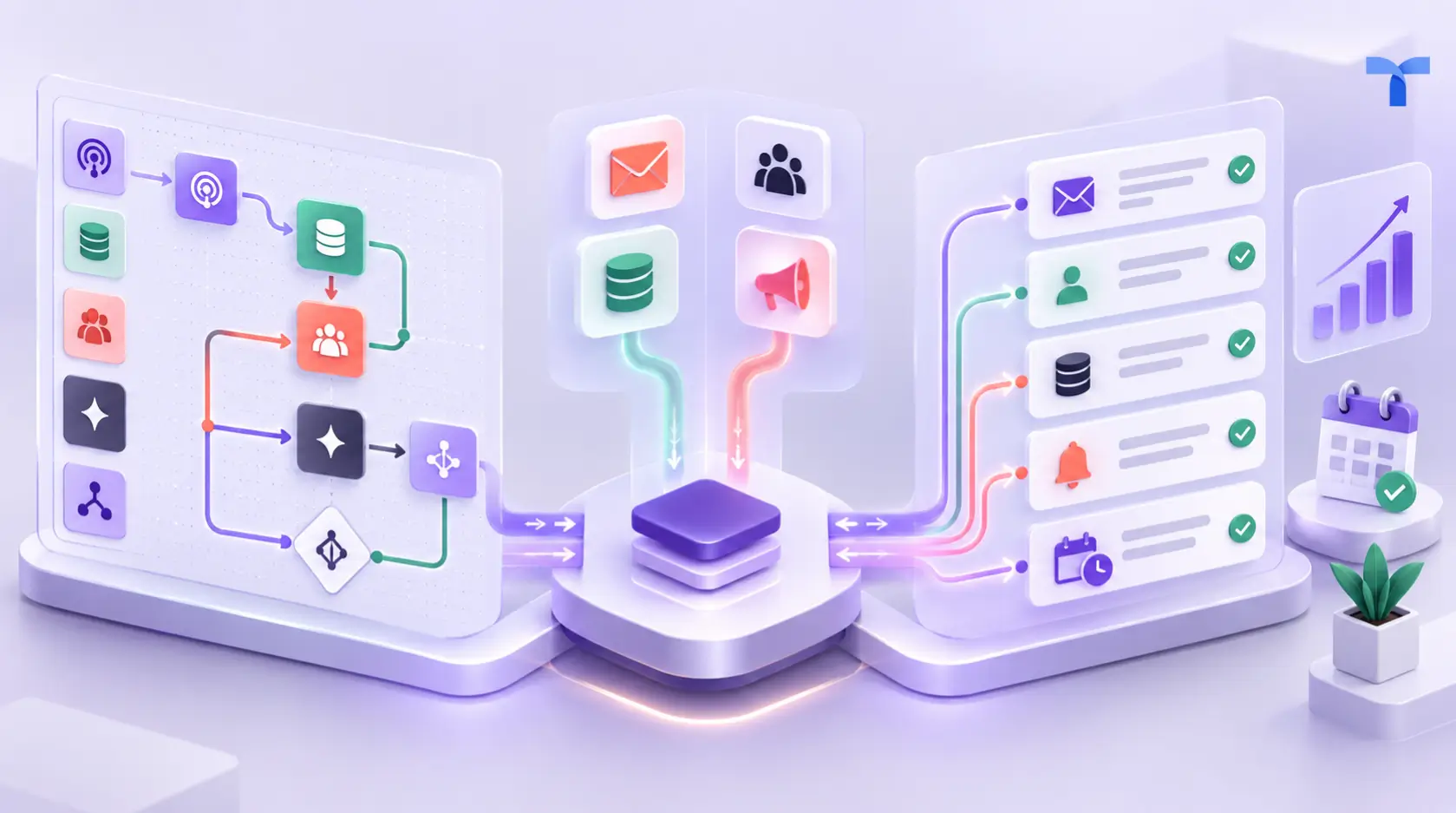
Three categories of agents do the work. Together they form the backbone of AI GTM orchestration, and each one removes a specific gap that traditional tools leave open.
Data agents: a continuously refreshed Unified Prospect Profile
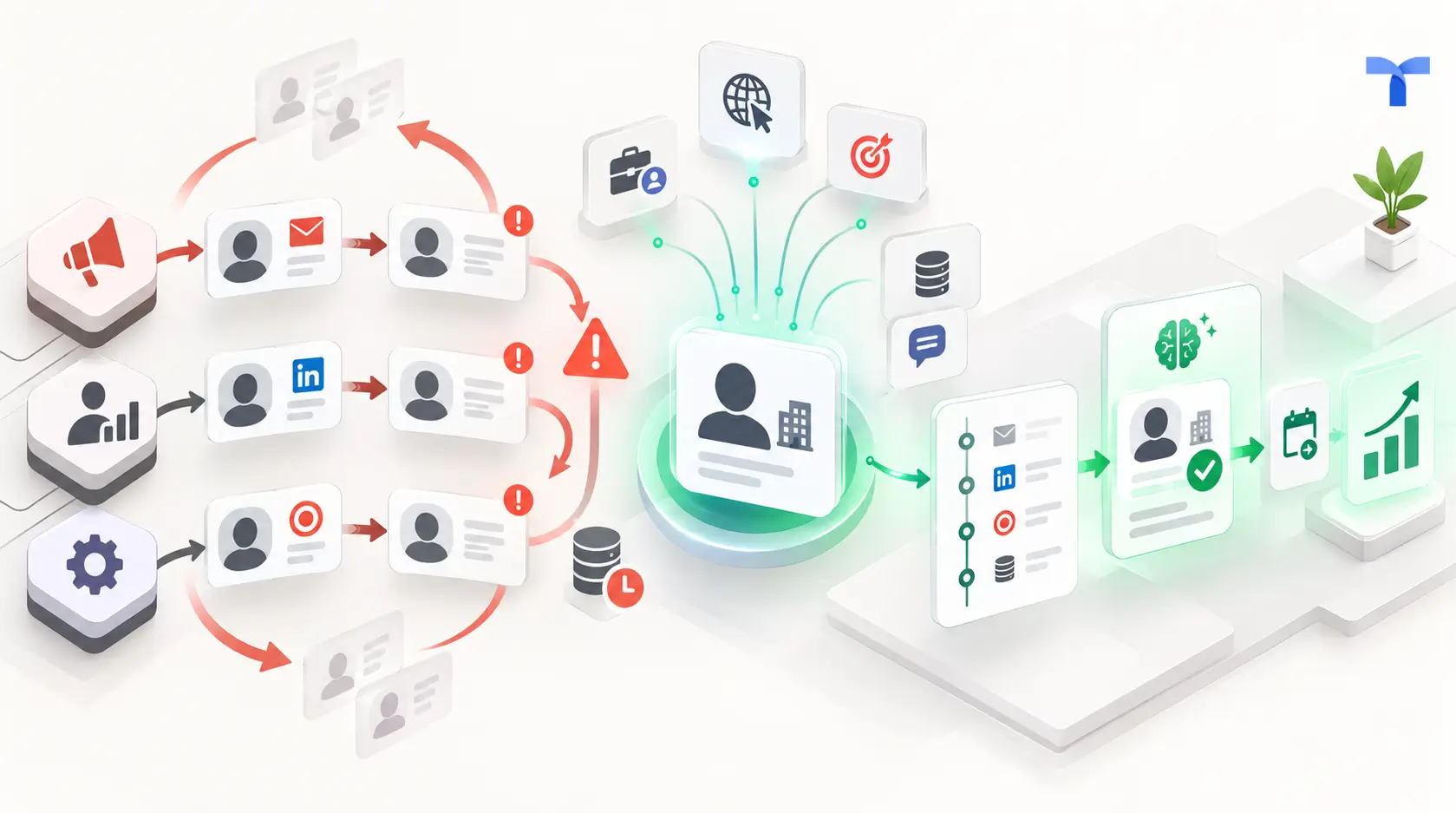
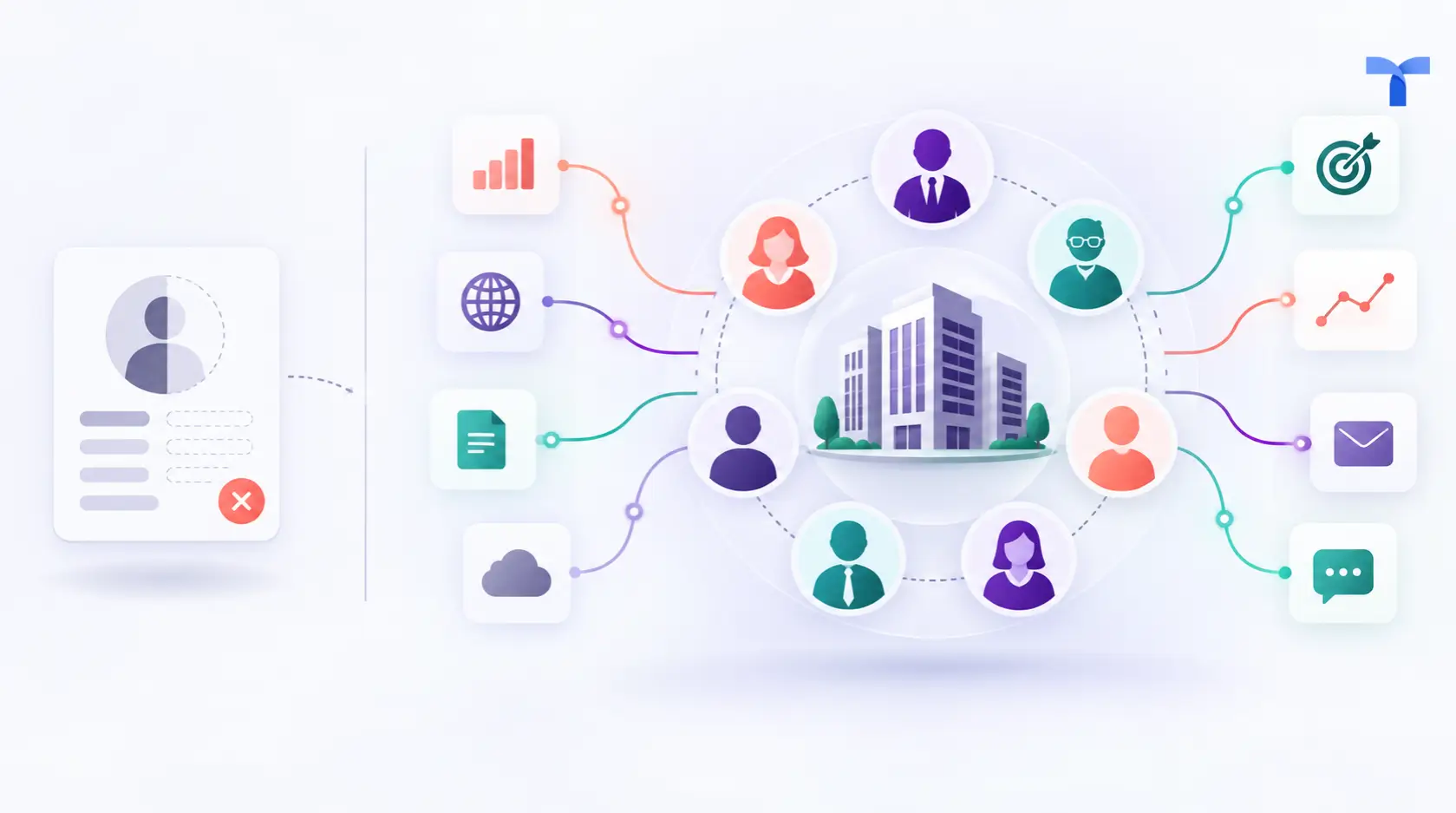
Data agents run constantly in the background, ingesting and reconciling information from every connected source: CRMs, marketing automation, customer success software, analytics platforms, intent providers, and product telemetry. Their job is to build and maintain a Unified Prospect Profile, a single live record of every account and contact that every system can read from.
Data agents handle deduplication, field standardization, firmographic and behavioral enrichment, and propagation. When a buyer changes jobs, the profile updates. When a new intent signal fires, the profile updates. Salesforce, HubSpot, and the campaign tool all see the same record at the same moment.
Ask Tapistro's agentic data layer what it knows about an account, and the answer is current to the minute.
Engagement agents: response at the moment of intent
With clean data underneath, engagement agents drive personalized outreach at scale and run intent signal orchestration in the background. They watch for behavior patterns across channels, web visits, product usage shifts, content engagement, and third-party intent, and act when something changes.
Concretely:
- A prospect revisits the pricing page twice in one afternoon. The engagement agent recognizes the intent spike, alerts the assigned AE, and queues a follow-up sequence with messaging matched to the prospect's role and stage.
- A target account's engineering team starts engaging with a competitor's content. The agent flags the account for the AE and adjusts ICP scoring upward.
- A dormant lead reopens an old email and clicks through to a case study. The agent reactivates them in a lead nurturing Journey that picks up where the last interaction left off, not at slide one.
The pattern is the same in every case. High-intent moments meet a response within minutes, not days.
Decision agents: the next-best-action layer
Decision agents are the strategic layer. They look at the full signal stack and decide what the system should do next: nurture, hand off, escalate, deprioritize, or hold.
They learn from outcomes. Win-loss patterns, response rates, sequence performance, and rep feedback all feed back into the model. A decision agent that recommended a 3-touch sequence for an ICP last quarter will recommend a different sequence next quarter if the data has moved. The recommendation gets better continuously, instead of waiting for someone to rebuild the playbook. Together, the three agent types behave like a coordinated GTM team that never sleeps and never forgets a signal.
What Teams Actually Gain
The benefits show up across the funnel.
Lead velocity goes up. Clean data and automated routing put a hot lead in front of the right rep within minutes of intent. The handoff is no longer a Slack message; it is a triggered Activation. Top-of-funnel conversion improves because engagement agents deliver context-matched outreach at the moment of interest, when the buyer is paying attention.
Sales, marketing, and customer success read from the same Unified Prospect Profile, so disagreements about what a lead did or did not do mostly disappear. Decision agents remove the queuing time between pipeline stages, and reps spend less of the week chasing context and more of it talking to buyers.
Forecasts move with the pipeline. Models trained on a unified, current dataset surface which accounts are most likely to close in the quarter, with reasoning a RevOps lead can audit. The underlying win is time allocation: hours that used to go to coordination, dashboard reconciliation, and lead lookup move to the work that compounds, like messaging, ICP refinement, and customer conversations.
Tapistro in Action
Tapistro is an AI GTM platform built around this agentic pattern. It unifies 70+ signal sources into a single Unified Prospect Profile, refreshed continuously by 24/7 agents.
On top of that profile, three things run in parallel: data agents keep records current and deduplicated, engagement agents act on signal patterns in real time and run the right Journey, and decision agents route leads to the right AE with full context attached and adapt as outcomes shift.
Customer teams running this pattern report a 70% reduction in manual GTM tasks. The handoff between sales and marketing stops being a meeting topic. The platform handles the orchestration; the teams handle the strategy. See how the Journey Canvas makes this visible end-to-end.
Where GTM Is Heading
The trajectory is hybrid teams. Humans set the ICP, the messaging, the offers, and the experiments. AI agents run the operational layer, signal detection, enrichment, scoring, routing, and outreach, that used to absorb most of a RevOps team's week. Less time aligning, more time building. The recurring meetings about what marketing sent versus what sales touched will shrink, replaced by positioning, experimentation, and customer interviews.
The operating model shifts from managing workflows to designing outcomes. RevOps writes the rules, the agents execute them, and the team measures whether the rules need to change. This is what most ABM and demand generation leaders mean when they say "agentic." It is not chatbots. It is operations infrastructure.
From Coordination to Orchestration
The sales and marketing alignment problem was never a communication problem. It was always an orchestration problem. Manual processes cannot keep pace with a GTM motion that fires signals across dozens of systems every hour.
Agentic GTM platforms close that gap by putting autonomous intelligence inside the revenue engine. AI agents read the signals, decide on the next move, and synchronize the record across every connected tool. Tapistro is built around this pattern, a connected, self-updating GTM ecosystem where data flows automatically, work moves on its own, and teams spend their time on what compounds. The future of go-to-market execution is not just automated. It is orchestrated.

.webp)