
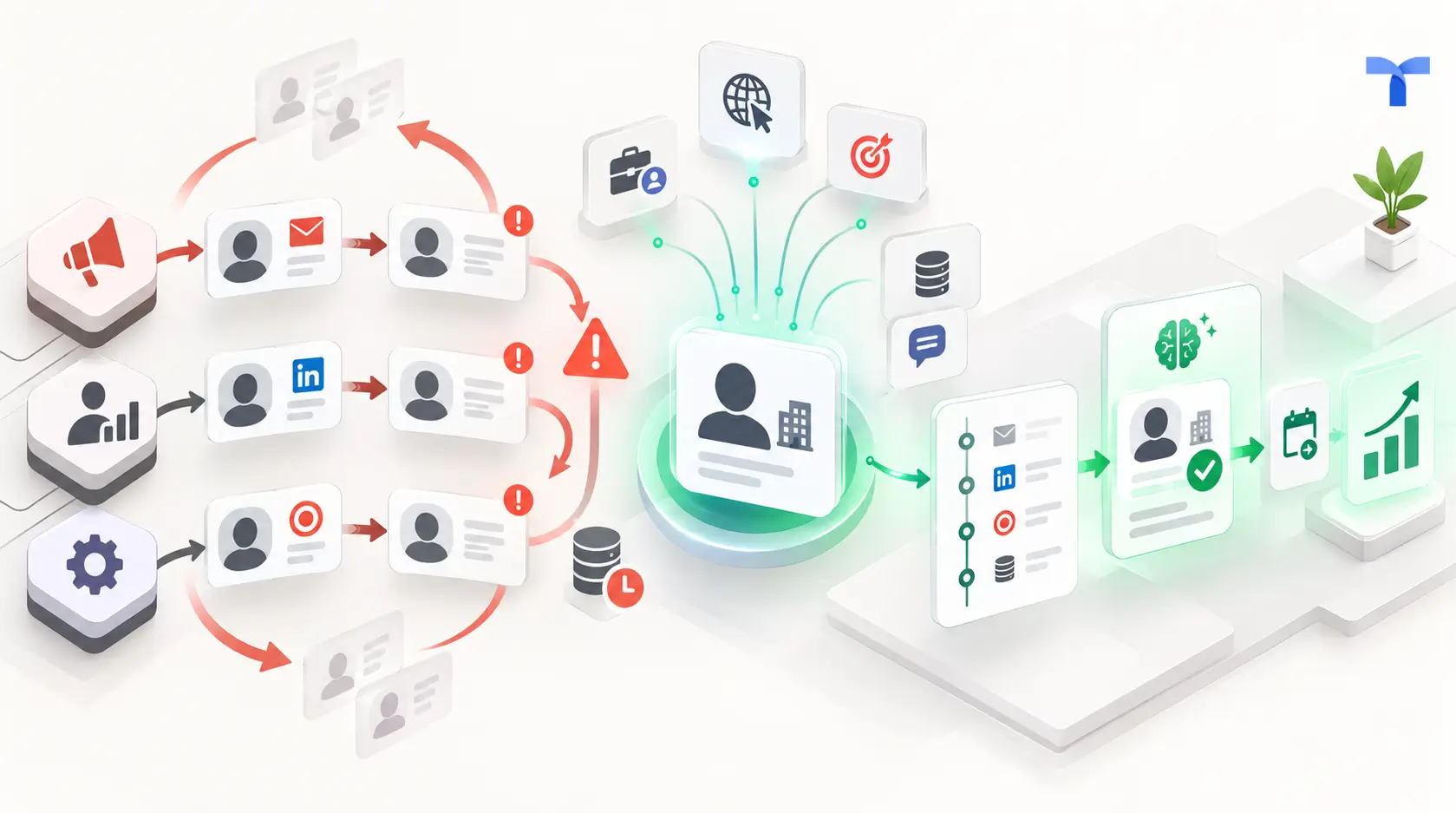
The Campaign That Already Told You the Answer
Every revenue team has run the campaign before.
Not a similar campaign. The same one. Same segment, same trigger, same three-touch sequence, same offer, sometimes the same subject line with the year changed. It ran eighteen months ago, it underperformed for a reason somebody understood at the time, and it is now being planned again by people who were not in the room when that reason was discovered.
This is not a competence problem. The people planning the new campaign are usually good at their jobs. It is a memory problem. The organisation ran an experiment, produced a result, and then had no place to put the result where the next decision would trip over it.
The premise of modern go-to-market was that this would solve itself. Instrument everything, pipe it into a warehouse, put a dashboard on top, and the team would compound its learning quarter over quarter. Every campaign would start from a higher floor than the last.
That is not what happened. What happened is that teams accumulated an enormous amount of campaign data and almost no campaign memory. Those are different things, and the difference is why the same mistakes keep arriving on the roadmap with new names.
What Actually Happens in the Two Weeks After a Campaign Ends
The gap is easiest to see if you follow a single campaign past its end date.
A campaign wraps. Someone pulls the numbers. Open rate, reply rate, meetings booked, opportunities created, maybe pipeline influenced if the attribution model is trusted enough to quote. The numbers go into a deck. The deck goes into a monthly or quarterly review. Someone asks a good question in that review, why did the manufacturing segment convert at half the rate of everything else?, and somebody gives a plausible answer out loud.
Then the meeting ends.
The deck is filed in a drive folder. The dashboard rolls forward to the next period. The good question and the plausible answer existed only as speech. Nothing about the campaign is now attached to the accounts it touched, the segment it targeted, or the plays that will be built next quarter.
Six months later a new campaign is scoped. The person scoping it searches the drive, finds four decks with similar names, cannot tell which is authoritative, and builds from scratch. Or does not search at all, because searching has historically not been worth the time.
The failure is not that nobody analysed the campaign. Somebody did, carefully. The failure is that the analysis had nowhere to live except a document and a person’s head, and documents are not consulted and people leave.
The Four Places Campaign Memory Goes to Die
Campaign learning does not evaporate evenly. It leaks at four specific, identifiable points, and each one has a different shape.
The dashboard that resets
Dashboards are built to answer how are we doing right now. That is a legitimate and necessary job, and it is the opposite of memory. A dashboard shows the current period against a comparison period. It is not designed to tell you that this segment has now been targeted four times across three years with progressively worse results, because that pattern lives across a span of time the dashboard never puts on screen at once.
Ask most revenue dashboards which plays have we already tried against this account, and what happened and there is no view that answers it. The data may exist somewhere in the stack. The question has no home.
The deck nobody reopens
The quarterly business review is where campaign learning is most carefully articulated and most reliably lost. The reasoning is real, someone thought hard about why a segment underperformed, but it is encoded as prose in a slide, in a file, in a folder, in a drive.
Prose in a deck cannot trigger anything. It cannot warn the person building next quarter’s sequence. It cannot lower a score on a segment that has repeatedly failed to convert. It sits there being correct and inert.
The rep who left
A meaningful share of what a revenue team knows about its market is held by individuals, and held informally. A rep knows that a particular vertical always asks about a compliance feature on the second call. An SDR knows that one job-title variant never replies. A marketer knows that the case study everyone links to has been quietly underperforming for a year.
None of this is written down, because none of it felt like a finding at the time. It felt like doing the job. When that person moves teams or leaves the company, the knowledge leaves at the same speed as their laptop.
The CRM field that was never written
This is the quietest leak and the most consequential. When a campaign touches an account, the touch and its outcome are frequently not written back to the account in any durable, queryable form.
The email tool knows it sent something. The CRM may log an activity. But this account was in the signal-first manufacturing play in Q2, was touched four times, engaged twice, did not convert, and the reason recorded at the time was budget timing is a compound fact that rarely exists as data. So the next campaign selects the account again, at the same cadence, with the same message, and the account experiences a company that has learned nothing about it.
Reporting Is Not Memory
These four leaks share a root cause, and naming it is the point of this piece.
Reporting describes what happened. Memory changes what happens next.
A reporting layer takes campaign outcomes and renders them for humans to read. It is backward-looking by construction, and its output is a picture. The loop closes only if a human reads the picture, draws a conclusion, remembers the conclusion, and applies it at the moment a future decision is made. Four fragile steps, each with a realistic failure rate, spread across months and often across people.
A memory layer takes campaign outcomes and writes them back into the system that makes the next decision. The outcome is not a picture. It is an input. It changes a score, narrows a segment, suppresses an account, adjusts a cadence, or flags a message as one that has already failed against this buyer. Nobody has to remember anything, because the remembering is structural.
Most go-to-market stacks have an excellent reporting layer and no memory layer at all. This is why teams with sophisticated analytics still repeat campaigns. The sophistication is pointed entirely at describing the past rather than conditioning the future.
The distinction also explains why "we need better reporting" is such a common and such an ineffective response to this problem. Better reporting produces a clearer picture of the same repeated mistake.
What a System With Memory Actually Holds
If memory is the missing layer, it is worth being concrete about what it has to retain. Four things, at minimum.
Signals, with their timestamps, after they stop being current. Most stacks treat a buying signal as perishable. It fires, it routes, it expires. But the fact that an account showed hiring signals in March, went quiet in June, and showed technographic change in September is a pattern, and patterns only exist if the individual signals were kept. A signal history is the raw material of a durable score.
Every touch, attached to the account rather than the channel. Not "the email tool sent 4,000 emails" but "this account received these three touches, in this order, from these plays, and responded this way." Touch history has to belong to the account to be useful at the next decision.
Outcomes with their reasons, in structured form. A closed-lost reason picked from a list is worth more than a paragraph in a deck, precisely because it can be counted and queried. Structure is what makes a reason survive.
Which plays have already run against which segments. The simplest and most commonly absent fact. A team that can answer have we tried this before, and what happened will avoid most repeated-mistake failures on that answer alone.
Notice that none of this requires new data collection. Nearly every team already generates all four. What is missing is a place where they persist together, attached to accounts, in a form the next decision actually reads.
Tapistro: Where Campaign History Becomes an Input, Not an Archive
Tapistro was built on the premise that signal detection and execution belong in one system rather than two workflows joined by a human. Campaign memory is the third piece of that same premise, and it follows from the architecture rather than being bolted on.
Because signals, enrichment, scoring, routing and outreach all run inside one system, the outcome of a campaign lands in the same place the next campaign is selected from. There is no export step, no reconciliation between the email tool’s view and the CRM’s view, and no window in which the learning exists only as a slide.
In practice this means a few specific things.
Signal history persists rather than expiring. Signals are retained with their timing, so an account’s trajectory, whether accelerating, flat, stalled or reawakening, is available as a fact rather than an impression. Scoring can be built on the shape of the history, not only the most recent event.
Touches are written back to the account. Every enrichment, routing decision and outreach attempt belongs to the account record, so the next play can see what the last play did. Accounts that have been worked and did not convert can be suppressed, cooled, or routed to a different motion rather than re-entered at the top of the same sequence.
Outcomes condition the next selection. When a segment repeatedly fails to convert, that is not a finding someone has to spot in a dashboard. It is a pattern in the data the Journey is selecting from, and the selection can be built to respect it.
The reason travels with the ranking. A score that arrives without an explanation is a number a rep will quietly ignore. When prioritisation carries its reason (these signals, this history, this prior contact), the team can tell a good ranking from a stale one, which is what keeps the system honest over time.
The shift is small to describe and large in effect: campaign results stop being an archive the team consults and start being an input the system reads.
What This Looks Like in Practice
A B2B software company ran a signal-led play against a mid-market segment across two consecutive quarters. The first run produced a modest number of meetings. The second run, built from scratch by a different marketer, targeted substantially the same account list with substantially the same sequence and produced fewer.
The reason was knowable the entire time. Roughly a third of the accounts in the second run had already been touched in the first, had not engaged, and were being re-entered at the same cadence with the same message. Another portion had shown signals in the first quarter that had since gone flat. The score that selected them was reading a stale event as a current one.
Neither fact was visible at planning time, because neither fact lived anywhere the planner would encounter. The first run’s outcomes were in a deck. The signal timestamps were in a tool that treats signals as transient.
With campaign history persisting on the account, the second run would have been built differently without anyone having to remember the first. Previously-touched non-responders would have been excluded or routed to a different motion. Accounts whose signals had decayed would have scored lower than accounts showing fresh activity. The segment’s prior conversion rate would have been a visible input to the decision to run the play again at all.
The operational difference is not that the team becomes smarter. It is that the team stops having to be smart about something the system should hold on its behalf:
- Planning starts from what happened last time rather than from a blank page
- Accounts stop receiving the same failed message twice
- Scores reflect signal trajectory rather than the most recent event
- The case for repeating or retiring a play is made from data rather than from recollection
Which Question Does Your Team Most Need Answered?
Not every team has this problem in the same shape, and the right fix depends on where the loop is actually breaking.
If the problem is that nobody can see what happened
You have campaigns running and no trustworthy read on their results. Attribution is contested, the numbers change depending on who pulls them, and reviews turn into arguments about the data rather than decisions about the market.
This is a reporting and instrumentation problem, and it should be solved with reporting and instrumentation. A memory layer built on numbers nobody believes will produce confidently wrong decisions faster than a spreadsheet would. Fix the measurement first.
If the problem is that people can see what happened and it changes nothing
You have clean reporting. The QBR is well-prepared. The conclusions drawn in it are sound. And two quarters later the same segment gets the same play, because the conclusion lived in a deck and the decision was made in a different tool by a different person.
This is the memory problem, and more reporting will not touch it. What is needed is for campaign outcomes to land where the next campaign is built, as suppression rules, as score inputs, as segment history, rather than as a document.
If the problem is that the knowledge is in people’s heads
Your most experienced reps and marketers know things that are not written anywhere, and the quality of your campaigns tracks closely with who happens to be building them. Onboarding a new person takes two quarters before their campaigns perform.
This is the same problem in a different disguise, and it has the same fix. Institutional knowledge that only exists as individual judgement is knowledge you are renting, not owning. Structured outcomes attached to accounts are how it becomes the company’s.
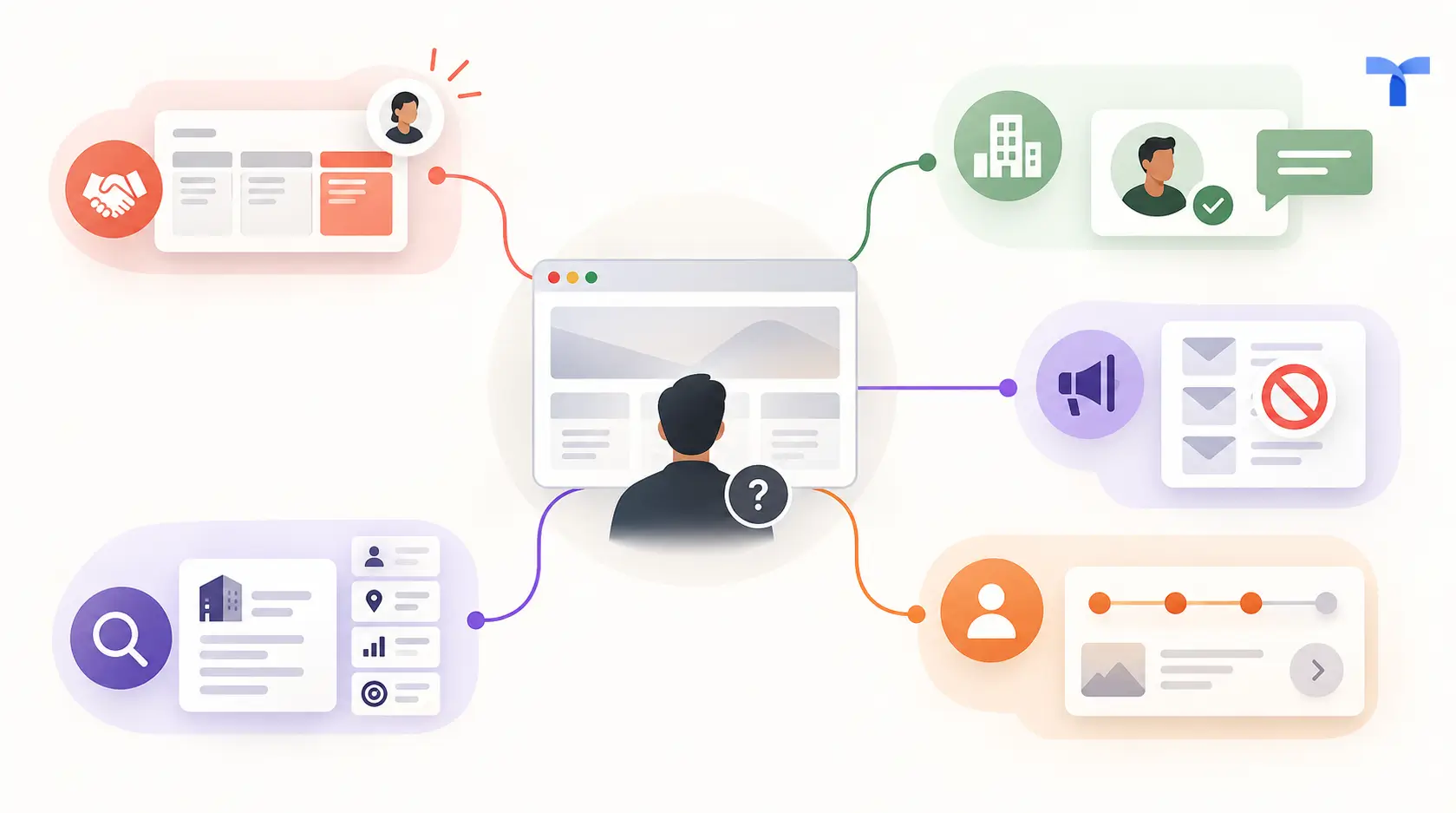
Side-by-Side: The Honest Comparison
None of these is a substitute for the others, and a team with a genuine measurement problem should not skip past the first column. But only one of them closes the loop without a human standing in the middle of it.
The Bottom Line
Revenue teams do not repeat campaign mistakes because they failed to analyse the last campaign. They repeat them because the analysis had nowhere to go.
Reporting tells you what happened. It does not change what happens next. The step between the two (a human reading, concluding, remembering and applying, months later, often after changing jobs) is where go-to-market learning is actually lost, and it is a step no amount of additional reporting will shorten.
The alternative is not more dashboards. It is a system where campaign outcomes persist on the accounts they touched, where signals keep their history instead of expiring, and where the next campaign is selected by something that has already read the last one.
Learning that lives in a deck is a memory of a memory. Learning that lives in the system is infrastructure.


.webp)
.webp)