
The Workflow Problem
Most CRM systems are full of contacts, including the names, emails, job titles, company names; all the basic building blocks of a sales database. On paper, the data exists but in practice, teams spend hours working around it rather than with it.
SDRs open a lead record and find a name or a title that may be outdated, and a company that they've never heard of. The next thirty minutes disappear into LinkedIn research, company website scans, and news searches, all to just understand whether this contact is worth a call. Marketing ops pulls a segment for a campaign and discovers half the records lack the firmographic data needed for proper targeting. RevOps builds a pipeline report and questions whether the numbers reflect reality or data entry habits.
The problem isn't that CRMs lack data, it is that the data lacks context. Without context, every workflow downstream requires human effort to fill the gaps.
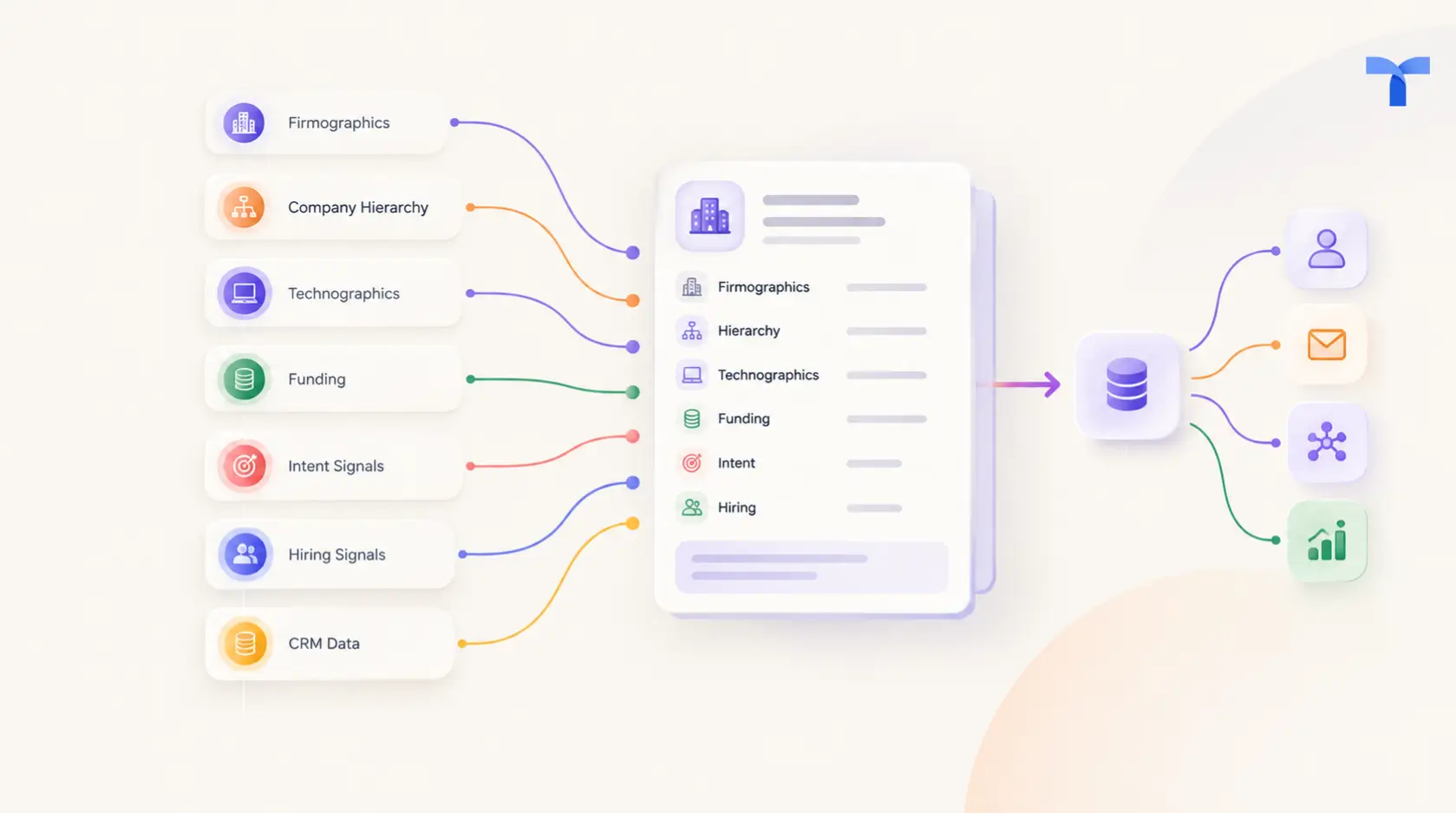
Data enrichment changes this equation, not by adding more fields for the sake of completeness, but by embedding the context teams need directly into the records they work with daily. The result isn't just better data, it's fundamentally different workflows.
How Enriched Data Transforms Team Workflows
The impact of enrichment shows up differently across functions. Each team interacts with CRM data in distinct ways and experiences a distinct workflow shift when context replaces manual research.
SDRs: From Research Mode to Selling Mode
The SDR workflow is built around a simple question: which contacts deserve attention, and what should I say to them?
Without enriched data, answering that question requires manual research. Every lead becomes a mini-investigation, checking LinkedIn for current role, scanning the company website for relevance signals, searching for recent news or funding announcements. Multiply this by dozens of leads per day, and research consumes hours that should go toward actual outreach.
Enriched CRM data compresses this cycle. When a lead record already contains verified job title, company size, industry, technology stack, funding history, and recent hiring activity, the research phase shrinks from thirty minutes to thirty seconds. The SDR opens the record and immediately understands who they're calling and why that person might care.
Prioritization becomes data-driven rather than gut-driven. Instead of working leads in the order they arrived, SDRs can sort by ICP fit, engagement signals, or intent indicators, all populated automatically. The highest-probability conversations happen first.
Call preparation transforms as well. Contextual data enables relevant openers: referencing a recent funding round, acknowledging a technology migration, or connecting the outreach to a specific business challenge the company is likely facing. Personalization stops being a time-intensive luxury and becomes the default.
The workflow shift is measurable: fewer hours researching, more hours selling, and higher conversion rates on the conversations that happen.
Marketing Ops: From List Cleanup to Precision Targeting
Marketing operations lives and dies by segmentation! Campaigns perform when they reach the right audience with relevant messaging. They underperform when targeting is broad, data is incomplete, or segments are built on outdated information.
The typical marketing ops workflow involves pulling lists, cleaning them manually, filling gaps where possible, and accepting whatever data quality exists. Segments get defined by the fields that are actually populated, not the fields that would be most useful. Campaigns launch with known compromises because the alternative is not launching at all.
Enriched CRM data changes the starting point. When records arrive with complete firmographic profiles, including the industry, employee count, revenue range, headquarters location etc. This helps in making the segmentation become precise rather than approximate. When technographic data reveals what tools companies use, messaging can speak directly to integration possibilities or competitive displacement.
List hygiene shifts from periodic cleanup projects to continuous maintenance, and enrichment processes validate and update records automatically, catching job changes, company moves, and outdated contact information before campaigns deploy against bad data.
The workflow impact compounds over time. Each campaign builds on reliable segments. Performance data reflects actual targeting effectiveness rather than data quality noise. Marketing ops spends less time wrestling with spreadsheets and more time optimizing strategy.
RevOps: From Data Firefighting to System Confidence
Revenue operations carries responsibility for the systems and data that sales and marketing depend on. When CRM data is incomplete or inaccurate, RevOps inherits the problems. They spend time troubleshooting routing failures, explaining reporting discrepancies, and managing the gap between what the system shows and what's actually true.
Enriched data reduces this operational burden. Lead routing becomes reliable when records contain the firmographic data that routing rules depend on. Territory assignment works correctly when company size, industry, and location are accurate. Handoffs between marketing and sales happen cleanly when both teams trust the underlying data.
Reporting accuracy improves structurally. Pipeline analysis, conversion metrics, and forecasting all depend on data that reflects reality. When enrichment keeps records current like updating job titles when contacts change roles, flagging companies that have been acquired, validating email deliverability, reports stop requiring asterisks and caveats.
Data governance simplifies as well. Instead of defining elaborate rules for how teams should enter data, RevOps can rely on enrichment to standardize and complete records automatically. The focus shifts from enforcing compliance to maintaining system health.
The workflow change is subtle but significant: less time fixing data problems, more time using data strategically.
The Compounding Effect Across Functions
Workflow improvements in isolation are valuable. Workflow improvements that reinforce each other are transformative.
Better Data Creates Better Feedback Loops
When SDRs work from enriched data, they have better conversations. Better conversations generate cleaner feedback on what messaging resonates. That feedback informs marketing segmentation. Better segments produce higher-quality leads. Higher-quality leads make SDR prioritization easier. The cycle compounds.
Accurate Systems Enable Strategic Operations
When RevOps maintains accurate data, routing works correctly. Correct routing means leads reach the right reps faster. Faster response times improve conversion rates. Higher conversion rates make pipeline forecasting more reliable. Reliable forecasts enable better resource allocation. The cycle compounds.
From Working Around the CRM to Working Through It
The CRM stops being a system that teams work around and becomes infrastructure that teams work through. Data entry becomes less onerous because enrichment handles completion. Reporting becomes more trusted because the underlying records are accurate. Cross-functional alignment improves because everyone operates from the same contextual foundation.
This is the shift from contacts to context. It is not a feature upgrade, but a workflow transformation that touches every team interacting with the CRM.
Conclusion: CRM as Operating System, Not Contact Database
The difference between a contact database and a growth engine is context.
A contact database stores names and emails. Teams extract what they can and supplement with manual effort. Workflows bend around data limitations. Efficiency has a ceiling defined by how much research humans can do.
A context-driven CRM embeds intelligence directly into records. Teams open a lead and understand immediately who they're engaging and why it matters. Workflows accelerate because the information needed for decisions is already present. Efficiency scales because enrichment runs continuously, automatically, in the background.
This is what Tapistro enables! It transforms CRM data from static records into living, enriched profiles that power every downstream workflow. The result isn't just cleaner data. It's sales teams that sell more, marketing teams that target precisely, and revenue operations that trust their systems.
The question isn't whether your CRM contains contacts. It's whether those contacts contain the context your teams need to operate at full speed.