
Someone at a company you sell to opens your pricing page, reads it for two minutes and leaves. Your system records the visit. In most stacks, what happens next is the same regardless of which company it was.
The visit either clears a scoring threshold and becomes an outbound email, or it falls short and becomes a row in a report. Two states, one input, no consideration of who the account is or what is already happening with them.
That default carries two costs. Gartner surveyed 632 business buyers and found 73 percent actively avoid suppliers who send irrelevant outreach, with 61 percent preferring to buy without speaking to a representative at all. The second cost is internal and less discussed. When a new-lead workflow fires on an account that is already deep in an evaluation, your own system reclassifies that account as top of funnel.
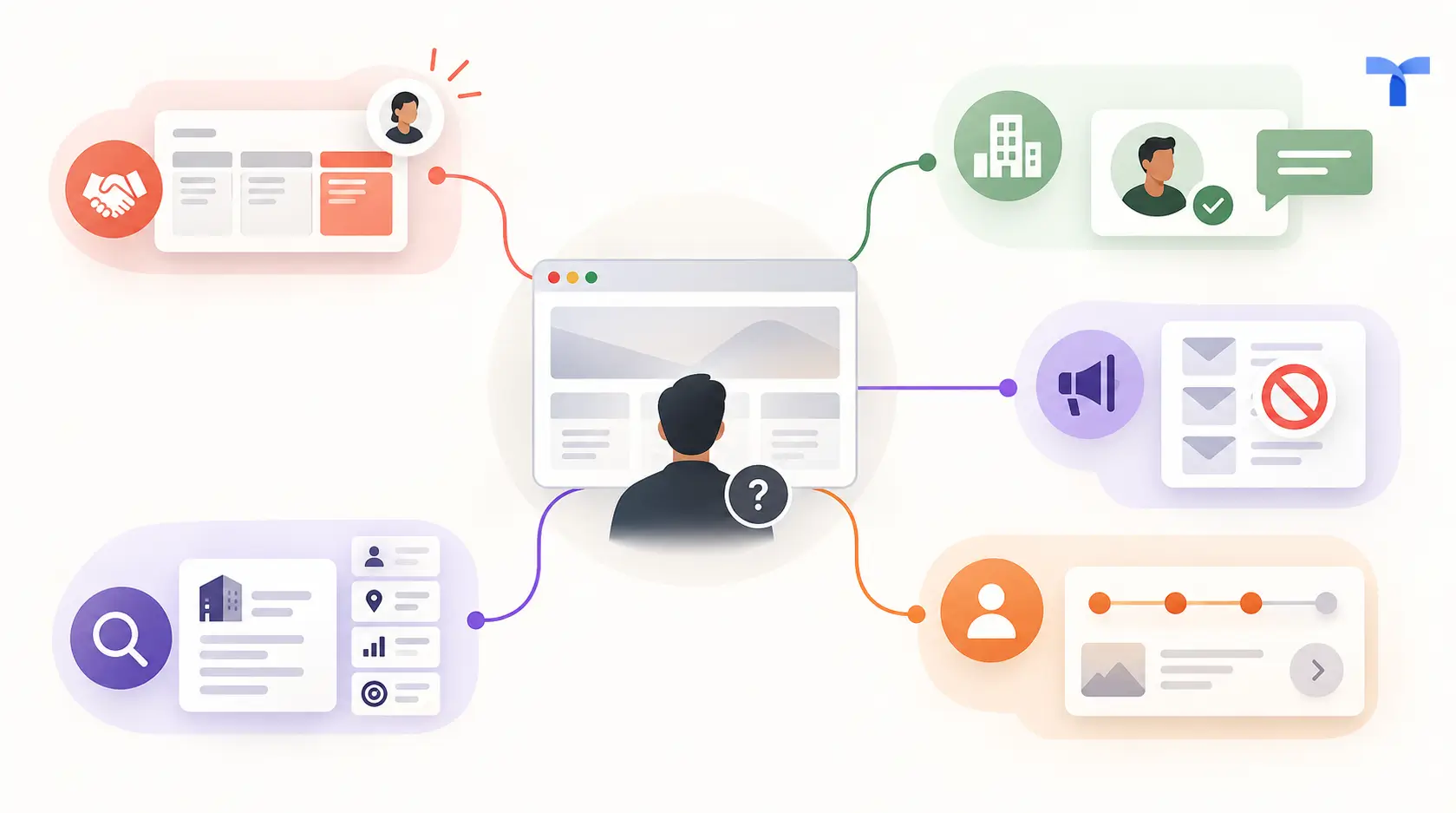
A website visit is one event with five possible meanings. Which one applies is decided by segmentation against what the account already is, before any response is selected. At Tapistro that segmentation runs the moment the visit arrives.
The Visit Is Not the Signal
The event itself carries very little. A company, a page, a timestamp, and with deanonymization in place, a person. Nothing in that tells you what to do about it.
What decides the response is the state the account is already in. There is an open opportunity in progress. The company is a current customer. Someone from that account is already enrolled in a live campaign. Or there is no relationship at all and this is the first indication of interest.
All four facts already exist inside the business. They sit in the customer relationship management system, in the campaign platform and in the product usage data. The problem is not that the information is missing. It is that none of it is present at the moment the visit lands, so the response gets chosen without it. Tapistro was built around closing that gap.
The rule that follows is simple. Segment first, respond second.
Segmentation Decides the Journey
Before anything is sent, the account is sorted by customer relationship management mapping into one of five states. That sort is the decision. What follows is a journey attached to a segment rather than a call made by whoever happens to see the alert.
Two of the five segments suppress outbound entirely and raise an alert instead. One routes to an existing relationship owner. One runs a full enrollment. One holds the account and waits.
The reason suppression has to come first is the way real accounts behave. A company in an active evaluation visits your website repeatedly, often several times a week. That is what evaluating looks like. Every one of those visits will trip a threshold, and any stack without suppression will generate fresh outbound for each of them.
Worse, it will treat forward motion as a new beginning. An account moving through an evaluation is progressing down the funnel, and a signal workflow that responds with a prospecting sequence pulls that account back to the top of it. The full taxonomy of signals sits in our guide to buying signals. What matters here is what the account already is when the signal arrives.
Scenario One, An Open Deal Is in Progress
A proposal went out ten days ago. The visit comes from the same company, from a name that has not appeared on a single call.
The correct mechanic is suppression plus an alert. Remove the account from all prospecting journeys and notify the deal owner.
This account will keep visiting. Pricing pages, comparison pages, documentation, security pages, several times a week until the decision is made. Without suppression, each of those visits produces another outbound touch into a company where an account executive is mid-negotiation, and the buying group receives automated prospecting while it is being sold to directly.
The internal damage runs deeper than the buyer's inbox. A late-stage account entering a new-lead workflow gets rescored, re-segmented and re-reported as top of funnel. Your pipeline reporting, your lead scoring and your nurture programs all begin treating a live deal as a fresh prospect, and the account executive has to work against a system that has forgotten what stage the deal is at.
The alert should carry the name, the role, the pages viewed, and the fact that this person has not featured in the deal so far. Usually it means the decision has widened to finance or to an executive sponsor. What happens next is the deal owner's call. Suppression requires the opportunity state to sit on the same record as the visit, which is what customer relationship management mapping is for.
Scenario Two, The Account Is a Current Customer
Same mechanic, different destination. Segment current customers out of prospecting and route the visit to the account owner.
The visit reads two ways and the account record decides which. Either someone is looking at a tier the company does not hold, which is expansion. Or someone is comparing what they pay against what they receive, which often surfaces months before a renewal turns difficult. Usage trend, support ticket volume and renewal date answer that, and all three sit outside the signal tool.
There is a variation worth handling deliberately. At a large enterprise, the visitor may sit in a division with no connection to the business unit you serve. That is a genuine new opportunity, but it is not a reason to start a cold sequence into a logo you already work with. It should still travel through the existing account channel, because the relationship owner is the person who can place that visitor internally and open the conversation without cutting across another account team.
The outcome this avoids is a prospecting sequence introducing a product the company already pays for.
Scenario Three, The Account Is Already in an Active Campaign
The mechanic here is the same as scenario one. Suppress, then reprioritize.
Three contacts at the account are enrolled in a live sequence. The person on the pricing page is one of them, or a colleague of theirs. The visit is not an indication that contact should be initiated. It is evidence that the contact already running is working.
Without suppression, a second and unrelated touch fires from a system that cannot see the first. One buying group then receives two disconnected messages from the same vendor inside a week, written in different voices about different things.
The productive action is queue position. The account moves up the seller's list for the day and the existing sequence continues. That requires the system to know current campaign membership at the moment the visit lands, which is one of the harder facts to retrieve when campaigns run in a different platform from signals. Tapistro holds campaign membership on the same account record, which is what makes the suppression possible.
Scenario Four, No Relationship Exists
This is the one scenario that ends in enrollment, and the full journey runs.
Deanonymize the visit and resolve it to an account. Track the person across subsequent sessions so the record reflects what they are actually researching. Enrich across sources until the account is properly known, using a waterfall across providers rather than a single feed. Then expand to the buying group, because the visitor is rarely the decision. Forrester's 2026 buyer research puts a typical business purchase at 13 internal stakeholders plus nine external influencers.
With the account and the group in place, build content against the problem the account is solving and the responsibilities the contacts carry, then enroll them in a sequence. The quality ceiling on that content is set by the record it draws from. A thin record produces a mail merge with better grammar, which is why the enrichment and the buying group work has to happen before the first send rather than after it. Our piece on outreach agents covers what a defensible message looks like at that point.
One practical limit applies to the whole program. Google holds bulk senders under a 0.3 percent spam complaint rate, and the cost of crossing it falls on every campaign sent afterwards from that domain.
Scenario Five, No Journey Fits
Two cases fall here, and they are different from each other.
In the first, there is no active workflow capable of identifying, enriching and enrolling this visitor. The account might be a strong fit, but the path to act on it does not exist yet. In the second, the visitor resolves cleanly and the company is not your ideal customer profile, so enrollment is available and would be wrong.
The action in both cases is the same, and it is not inaction. Record the visit against the account. Enrich while the company is briefly in view. Hold it in a segment that existing programs already work, and let repeat visits accumulate against the profile.
Repetition carries information a single visit does not. An account showing three light touches in a quarter is a different account from one showing none, and only a system that keeps the record can distinguish them. In Tapistro these stay on the account record and feed the ideal customer profile, so the definition of a good account improves rather than staying fixed at whatever was written last year.
The Five Scenarios, Side by Side
Three of the five rows suppress or hold. That distribution is the part most signal programs do not have, and it is the reason adding more signal sources rarely improves the result.
What This Requires From the Stack
Sorting an account into one of those five rows in the moment the visit lands requires four things to be present on one record at the same time: the visit, the opportunity state, the customer status and current campaign membership.
Campaign membership is the one most often missing. Signals usually live in one platform and campaigns in another, and without membership visible at decision time, suppression cannot run at all. That single gap is what produces the duplicate touches in scenarios one and three.
This is a widely reported constraint rather than an unusual one. Salesforce's 2026 research across 4,050 sales professionals in 22 countries found 51 percent of sales leaders say disconnected systems are slowing their artificial intelligence work, with sellers spending 40 percent of their time actually selling. The reconciliation work between those systems is usually done manually by revenue operations, after the fact, which is too late to have changed what was sent.
It also suggests a better measure than the usual ones. Signals detected and messages sent both increase whenever you buy another data source. What indicates the program is working is how responses distribute across the five scenarios.
What Tapistro Does With a Website Visit
Intent Connectors bring the visit onto an account record that already holds product usage, third-party intent, enrichment history and public company events. Resolution happens on arrival, so the visit sits alongside the opportunity state, the customer status, the buying group and prior campaign membership. That is what makes the segmentation possible, and everything else follows from it.
The Tap AI Agents then apply the journey the segment calls for, with the reasoning attached, so an alert reaches a deal owner as evidence rather than as a notification. Journey Canvas runs the enrollment path for the scenario that needs it, carries the held accounts in their existing programs, and keeps suppression in force for the accounts that should not be touched.
What Tapistro removes is the manual reconciliation. Instead of a revenue operations team joining signal data to the customer relationship management system and the campaign platform after the week is over, the join exists before the response is selected. Unified signals, visible campaign history and automated segmentation are what turn a website visit into the right journey rather than the only journey available.
Three of the five scenarios end without anything reaching the buyer. That is the system working as intended.


.webp)
.webp)
.webp)