.webp)
There are exactly three ways a company decides who to talk to.
You start with a universe and work out who inside it matters. You wait for something to happen and let the event tell you where to go. Or you choose an account you intend to win and cover it from every direction until you are in the room. List-first, signal-first, surround sound. Every revenue team on earth is running at least one of these, usually without ever naming it.
Naming them is what exposes the problem. Most companies run one motion well, a second one badly, and the third not at all, because each motion is served by a different category of software and nobody owns the space between them.
The cost of that shows up in the buying data. 6sense's 2025 Buyer Experience Report found that 94 percent of buying groups had ranked their preferred vendors before ever contacting a seller, and that preferred vendor was purchased from 77 percent of the time. The same research found the research to engagement split moving from 70/30 to 60/40 as buying cycles compressed. Read that plainly: the decision is largely made before your first conversation, and the window in which you can influence it is closing.
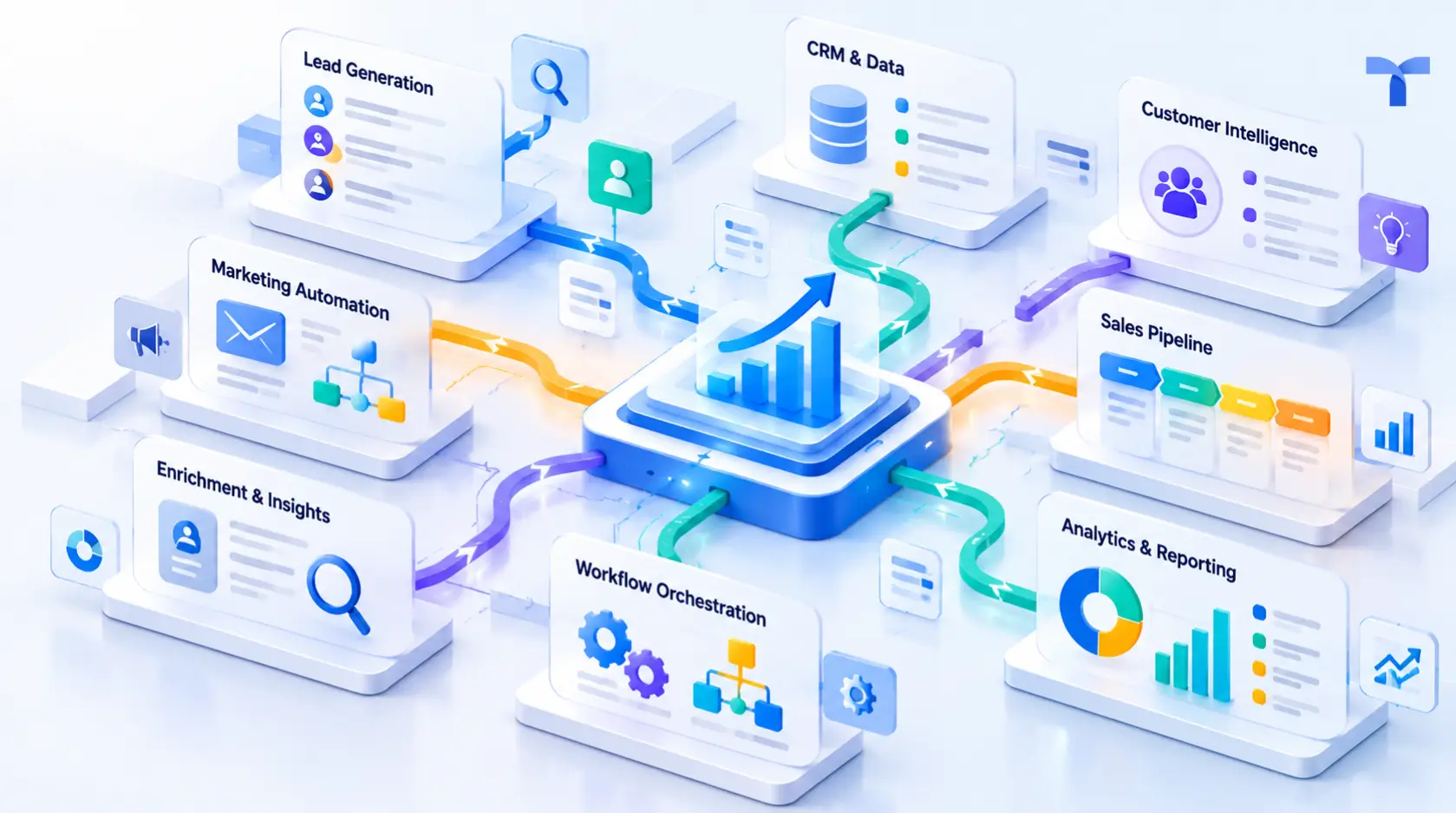
You cannot win that window with one motion. You win it by being present in the universe, fast on the signal, and everywhere across the buying group, at the same time, on the same account. At Tapistro that is the specific problem we built for, and this is an honest account of what each motion requires, who serves each one today, and where the whole thing falls apart.
Three motions, defined by where they start
List-first starts with a universe
You define the population and then find the people. A conference attendee list, a category of company, an export from your customer relationship management system, a search for everyone who does a particular job regardless of what their title says.
The motion is deliberate and it is yours to control. You decide who is in scope before anything else happens.
Signal-first starts with an event
Something occurs and the event nominates the account. A named contact reads a pricing page. A champion changes jobs. A company posts nine roles that only exist if they bought the thing you compete with. Funding lands.
Here you are not choosing the population. The market is choosing it for you, and your job is to notice quickly enough to matter.
Surround sound starts with a decision
You have already decided this account is worth winning. Now the job is coverage: the whole buying group rather than one champion, across multiple channels, sustained long enough that when the evaluation formally begins you are already one of the names on the list.
Why the starting point determines the failure mode
Each motion breaks somewhere different, and the break is predictable from where the motion began. List-first breaks on data quality, because it commits early to a population. Signal-first breaks on latency and identification, because it depends on noticing. Surround sound breaks on coordination, because it runs across people and channels and weeks. Anyone selling you a single tool as the answer to all three is describing three different engineering problems as one feature.
List-first
What it is for
List-first is the right motion whenever the universe is knowable and finite. Everyone who attended a conference. Every company in a vertical above a revenue threshold. Every organization running a specific technology. Every person who does a particular job whether or not the company calls it that.
It is also the only motion that works when you are entering a market where nobody knows you yet and no signals are being generated in your direction.
Where it breaks
Three places, in order of severity.
First, list quality. Most prospect lists are majority noise on the day they are delivered, and every hour a seller spends filtering is an hour not spent selling.
Second, job titles. Titles are a proxy for responsibility, and in many categories they are a bad one. The person who actually evaluates your product may carry a title that appears nowhere in your persona definition, while three people with the exact right title have nothing to do with the decision. Searching on stated skills and responsibilities finds the first group. Searching on titles finds the second.
Third, decay. A list is a photograph. It is accurate on the day it is taken and meaningfully wrong within a quarter, because people change jobs, companies change shape and priorities move.
Who serves it today
Clay is the most capable hand-built option in this motion, a data workspace where a technical operator constructs enrichment pipelines across many providers. It is genuinely powerful, and the power lives in the building, which means somebody on your team constructs and maintains it permanently. ZoomInfo remains the broadest database of record and the sensible backbone when what you need is coverage. Apollo competes on volume and price with a combined database and sequencing layer.
All three do list-first well. All three hand you a list. What happens to that list next is your problem.
What running it properly requires
Waterfall enrichment across many sources rather than dependence on one, so coverage compounds instead of inheriting a single vendor's gaps. Search on skills and responsibilities rather than title strings. And, critically, a record that keeps updating after the export, so the list stops being a photograph and becomes a live view. That last requirement is why Tapistro treats the list as a state of the account record rather than a file, and it is the difference between a list that ages and one that stays true.
Signal-first
What it is for
Signal-first is the motion of the window. Its entire value is reaching an account while the signal still means something, which is a far shorter period than most outbound programs are built for. Classic research on lead response found companies that responded within an hour were nearly seven times more likely to have a meaningful conversation with a decision maker than those who waited even two hours. The number of available signals has multiplied since. The decay has not slowed.
Where it breaks
Identification comes first. A signal that resolves to an anonymous company visit tells you almost nothing you can act on. A signal that resolves to a named person in a known role at a known account is a different asset entirely.
Latency comes second. A signal that reaches a seller in a Monday digest has already spent most of its value.
Noise comes third, and it is the one that quietly kills these programs. A single signal is a coincidence. Three signals from three sources at one account inside a week is a pattern. Teams that alert on every individual signal train their sellers to ignore alerts within a month.
Who serves it today
Common Room built strong capture across community, web and product surfaces. Warmly and RB2B focus tightly on website visitor identification, with RB2B resolving to the person level. Bombora and 6sense supply third-party intent at scale across large publisher networks.
Each of these is good at detection. Detection is roughly a third of the motion. What arrives after detection, which is identity resolution onto an account you already know, buying group construction, and a response inside the window, is where these tools hand the problem back.
What running it properly requires
Signals from first, second and third party sources landing on one account record rather than in separate dashboards. Explicit handling of decay, so a signal from six weeks ago is not treated like a signal from this morning. Scoring that requires a pattern rather than a single event. And a response clock measured in hours, which is only possible when enrichment, message assembly and routing are already automatic, which is exactly what Tapistro's agents handle before a seller is ever asked to act.
Our complete guide to buying signals in sales covers the full taxonomy, including which signals to act on within hours and which ones to ignore entirely.
Surround sound
What it actually means in business to business
The term is borrowed and readers arrive with three different definitions, so here is the one that matters operationally.
Surround sound is coordinated presence across the entire buying group and multiple channels, sustained long enough to put you in the consideration set before a formal evaluation begins. Not one email to one champion. Not a retargeting campaign running in the background. The finance stakeholder, the technical evaluator, the eventual signer and the person who will actually use the product, each encountering something relevant to them, across email, LinkedIn, advertising and live conversation, over a period of months rather than days.
Why it matters more than it did three years ago
Return to the 6sense finding. If 94 percent of buying groups have ranked their preferred vendors before contacting anyone, and that vendor wins more than three quarters of the time, then the contest is decided during the research phase, in rooms you are not in. The only way to compete in a room you are not in is to have already been present, repeatedly, to more than one person.
Surround sound is not a branding exercise. It is the mechanism by which you get ranked before the ranking happens.
Where it breaks
Coordination is the first failure. Advertising runs on one system, email on another, sales tasks on a third, and nobody can see the combined pressure on a single account.
Buying group drift is the second. Groups change composition mid-cycle. Someone leaves, someone new joins, and the new person has encountered nothing from you.
Coverage depth is the third and most common. Most teams multi-thread by adding two more names in the same function. Real coverage means the functions that will object, not just the function that will champion.
Who serves it today
Demandbase and 6sense are the established platforms here, both strong on account identification, third-party intent and account-based advertising orchestration. Influ2 does person-level advertising well, which is a genuinely differentiated capability. RollWorks serves the mid-market competently.
What these platforms are built around is advertising and account-level orchestration. Person-level enrichment, buying group construction from scratch, and one to one message assembly are not their center of gravity, which is why teams running them still buy a list tool and a signal tool alongside.
What running it properly requires
Automatic buying group expansion, so new decision makers are covered the week they appear rather than the quarter after. Context per person rather than per account, because the finance stakeholder and the technical evaluator do not care about the same thing. And a single place where email, LinkedIn, advertising and customer relationship management tasks are sequenced against one another rather than run in parallel by three teams. In Tapistro that place is the journey canvas, and it reads from the same profile the other two motions write to.
The problem nobody solves: accounts move between motions
Here is the part the category has not addressed, and it is the reason a stack of best-in-class tools underperforms a coherent system.
The signal that becomes a pursuit
A signal fires. The account is real, the fit is strong, and you decide to pursue it properly. That decision moves the account from signal-first to surround sound.
What carries across? In most stacks, a Slack alert and a seller's memory. The signal history stays in the signal tool, the account gets recreated in the advertising platform, and the context that made the signal meaningful is gone by the second touch.
The pursuit that needs new names
You are three weeks into covering an account and two new people join the buying group. Covering them requires finding them, enriching them and understanding their role, which is a list-first job arriving in the middle of a surround sound motion.
If those are different systems, the new names get added by hand or not at all. Usually not at all.
The list that produces a signal
You loaded a conference list in March. In June, four people from one of those companies start behaving like buyers. That account needs to move from list-first to signal-first, immediately.
It will not, unless the list and the signal layer are looking at the same record. In most stacks the March list is a spreadsheet in a folder.
What the handoff costs
Three tools, three account records, and a revenue operations person reconciling them on a schedule. The cost is not the software line item. It is that every transition between motions is a manual step, every manual step has a queue, and the queue is measured in days at exactly the moments when the window is measured in hours.
Motion coverage, compared
Capability changes quickly in this category. This reflects each platform's public positioning and documented product scope as of publication, and it describes scope rather than quality.
The pattern is consistent. Every platform in the table is strong in one motion and adjacent in a second. The final column is where the difference actually lives.
How Tapistro runs all three on one account record
Tapistro is the only platform that runs all three motions on a single, continuously updated account record. That is the claim, stated precisely, and the mechanics are what make it true.
For list-first, waterfall enrichment runs across a large set of first and third party sources into one unified profile, with person search on skills and stated responsibilities rather than title strings, and parent and child entity mapping handled automatically.
For signal-first, intent connectors bring first, second and third party signals onto that same profile as they happen, scored for pattern rather than for individual events, with routing that runs on a clock measured in hours.
For surround sound, buying group expansion adds new decision makers to the record as they appear, one to one content is assembled per person from what the record knows, and the journey canvas sequences email, LinkedIn, advertising and customer relationship management tasks against one another rather than in parallel.
Because all three run on the same record, the transitions are not transitions at all. The signal that becomes a pursuit keeps its history. The new buying group member is enriched the moment they surface. The March conference list is still live in June when it starts producing signals. No handoff, because nothing was ever handed off.
How to audit your own stack
Four questions, and they are uncomfortable on purpose.
Which of the three motions are you genuinely running today, as opposed to the one you talk about in board meetings? Which of the three is unstaffed entirely, and is that a deliberate choice or an accident of what you bought? What happens, concretely, to an account that needs to move from one motion to another, and how many people touch it? And how many systems currently hold a version of the same account record?
The answer to the last one is usually between three and six. That number is the real cost of running three motions in three tools, and collapsing it to one is the single change that makes all three motions viable at the same time. It is the reason Tapistro was built the way it was.