Every outreach agent demo works.
That is worth saying first, because it explains both why this category sells so well and why so much of it quietly stops getting used by month four. In a demo, the account is chosen, the signal is fresh, the message is good, and nobody replies with a question the agent cannot answer. In a real territory, none of those conditions hold.
The numbers around agentic software have started to reflect that gap. Gartner expects more than 40 percent of agentic AI projects to be canceled by the end of 2027, citing escalating costs, unclear value and inadequate risk controls. Forrester's 2026 predictions are blunter about where the damage lands, forecasting that business to business companies will lose more than ten billion dollars because of ungoverned use of generative AI. Neither of those is a statement about model quality. They are statements about operating discipline.
So this is not another argument about whether the technology is real. It is real, and at Tapistro we run agents against live pipeline every day. This is an account of what an outreach agent actually decides, what separates the deployments that hold up from the ones that get switched off, and what to ask a vendor before you sign anything.
What an AI outreach agent actually is
The definition
An artificial intelligence outreach agent is software that pursues a pipeline objective on its own: it watches for buying signals, decides which accounts and which people are worth contacting, assembles a message out of the context it has gathered, sends it, and decides what happens next, without a person specifying each step in advance.
An agent decides, a sequence follows rules
That distinction is the whole category, and it determines what you are buying.
A sequence tool executes a plan somebody wrote. Its ceiling is the imagination of the person who wrote the rules, and every case nobody anticipated falls through. An agent handles the case nobody anticipated. That is the upside, and it is also the reason an agent needs governance that a sequence tool never did.
If a vendor cannot name the specific decisions their product makes with no human in the path, you are looking at a sequence tool with a language model attached to the message field. That can still be a sound purchase. It is a different purchase, at a different price, with a different failure mode.
Why "AI sales development representative" is the wrong frame
The industry named this category after a job title, and the name has caused real damage.
Framing the purchase as a headcount replacement pushes buyers to evaluate volume, because that is what the framing measures. Volume is the one dimension where these systems are already superhuman and where being superhuman is actively dangerous. The useful frame is narrower and more honest: which decisions in your outbound motion are you willing to delegate, and what happens when one of them is wrong.
The five decisions an outreach agent has to make
Every real deployment lives or dies on five decisions. Vendors demo the third one because it is the most visually impressive. The first, second and fifth are where programs actually fail.
Who is worth contacting
Not list building. An agent has to decide which accounts merit attention this week, and then which people inside those accounts constitute the buying group for the motion at hand.
That second half is where most systems stop short. They resolve to a persona and a title match, which produces a plausible name and misses the person who actually triggered the signal. Deciding who to contact requires knowing who else at that account has done anything in the last ninety days, whether the account is already in an open opportunity, and whether somebody from your team spoke to them in March.
When the window is open
Buying signals decay on a clock, and the clock is faster than most outbound programs are built for. Classic research on lead response found that companies responding within an hour were nearly seven times more likely to have a meaningful conversation with a decision maker than those who waited even two hours. The signals have multiplied since then. The decay has not slowed down.
An agent that batches its sends into a daily run has already thrown away most of the advantage it was bought for. Timing is a decision, not a schedule.
What the message should say
This is the part everyone demos and the part that is least differentiated. Any competent model can write a fluent paragraph. The question is what the paragraph knows.
A message assembled from a job title and a company description is fluent and empty. A message assembled from what the account actually did, what they already own, who else there is looking, and what your team has said to them before is a different artifact. The model is not the variable here. The context is.
Which channel, and what happens when it is ignored
Silence is information, and most systems treat it as a timer.
Deciding to switch channels, to hold, to route to a human, or to stop entirely is a judgment about what the silence means in context. An account that opened three times and did not reply is not the same as an account that never opened, and a fixed cadence treats them identically.
What to do with the reply
The reply is where the value is created and where almost every deployment falls over.
A reply has to be classified, and the classification is not simple: interested, not now, wrong person, unsubscribe, hostile, out of office, or a question that requires an actual answer. Each one implies a different next action, and two of them carry compliance consequences. An agent that generates outbound beautifully and dumps every response into a shared inbox has not automated outbound. It has moved the bottleneck downstream and made it larger.
What good looks like in production
Response time measured in minutes
The whole argument for delegating these decisions is speed. If a signal fires at eleven in the morning and the first touch goes out on Thursday, you have automated effort without buying the thing that effort was supposed to win. Tapistro was built around that clock specifically, which is why the noticing, the resolution, the context assembly and the send happen as one motion rather than six handoffs across four tools.
Personalization that survives volume
There is one reliable test, and it takes ten seconds. Take the message the agent produced and imagine sending it to a different account in the same segment. If it would still read as correct, it is not personalized. It is formatted.
A handoff that carries context
When the agent passes an account to an account executive, the account executive should inherit the reasoning, not a notification. Which signal fired, what was said, what the account already owns, who else is involved. A handoff that arrives as an alert with a name in it puts the human back at the beginning of the work the agent was supposed to have done.
Where most of them break
This section is the longest deliberately. The failure modes below come from watching deployments at Tapistro rather than from a competitive teardown, and they are ordered by how often they end a program.
Personalization that is mail merge with adjectives
The most common failure and the easiest to miss internally, because the output reads well in isolation. Ten thousand messages that each name the recipient's company and then say nothing specific about it are worse than a thousand plain ones, because they consume the same finite attention and teach the market that your brand sends noise.
Deliverability, the asset you cannot rebuild quickly
Volume borrows against your sending domain, and the interest rate is high.
This is not a soft concern. Google's bulk sender requirements hold senders to a spam complaint rate below 0.3 percent, and crossing it degrades delivery for everything you send, including invoices, renewals and support mail. An agent that can send ten times more than your team could is ten times faster at destroying a domain reputation that takes months to rebuild. Any evaluation that does not include a deliverability owner is incomplete.
Thin context, because the agent reads one system
An agent that only sees your sales engagement platform knows what you sent. It does not know what the account did on your pricing page, what they own already, that support has an open escalation, or that a competitor comparison page got three views from one company yesterday.
This is the quiet ceiling on most of the category. The intelligence is not limited by the model, it is limited by how much of the customer picture the agent can reach. Tapistro approaches it from the other end, unifying the account picture first and letting agents act on top of it, because an agent reasoning over a partial record makes confident decisions on incomplete facts.
Reply handling, the part that never gets demoed
Ask any vendor to show you the reply flow rather than the send flow. The demo will get noticeably shorter.
No feedback loop, so it is no better on day 200
Most deployments never close the loop between what was sent and what became pipeline. Without that loop, the agent is a very fast copy of your initial assumptions, repeated indefinitely. The systems that improve are the ones where meeting outcomes and opportunity progression flow back into targeting and messaging decisions.
Nobody owns the output
The most consequential failure and the least technical one. When an agent is bought by sales, configured by revenue operations, and reviewed by nobody, quality drifts for weeks before anyone notices, and the first person to notice is usually a customer or a competitor. Governance here is not a compliance checkbox. It is the difference between a program that compounds and one that gets switched off after an incident.
How to evaluate one before you buy
Seven questions, and what the answers tell you
Ask these in the order below. The pattern in the answers matters more than any single response.
What a sensible pilot looks like
One segment, one signal type, a human approval gate on every send, four weeks. Measure replies that reach a booked meeting, not messages sent, and read fifty outputs yourself before you widen anything. If the program cannot clear that bar on a narrow slice, scale will not fix it, it will only spread it.
Where Tapistro fits
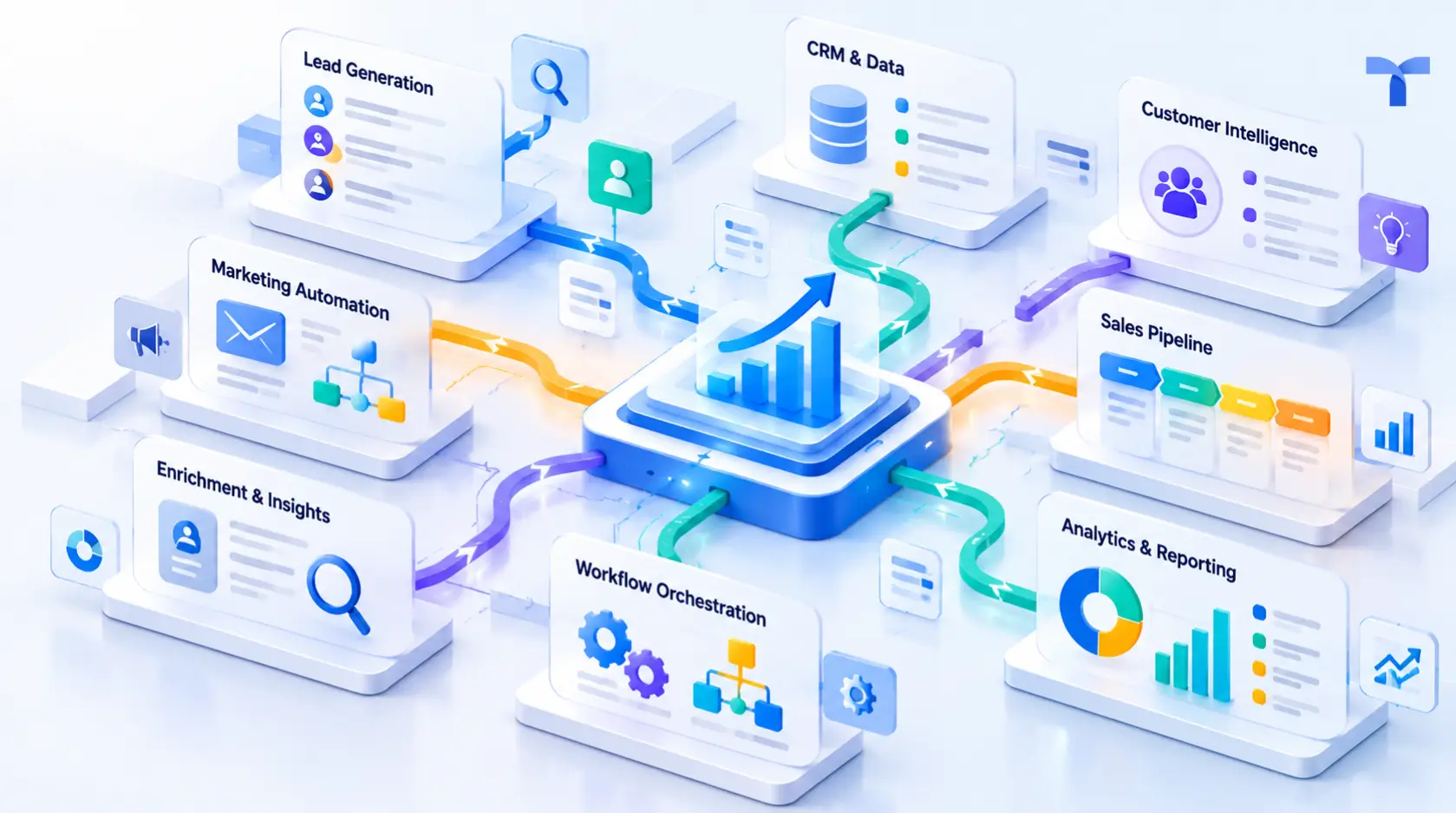
Tapistro sits underneath the outreach layer rather than beside it. The unified account profile is assembled first, from customer relationship management data, product usage, intent, enrichment and past conversations, and the Tap AI Agents reason over that profile rather than over a single system's slice of it.
That ordering is the design opinion. It decides which accounts are live, which people constitute the buying group, what the message can honestly reference, and when the window is open, then routes to a human at the point where judgment is worth more than speed. It is also why response time in Tapistro is measured in minutes rather than in reporting cycles.