.webp)
Almost every revenue team bought artificial intelligence in the last eighteen months. Very few of them changed their numbers.
That gap is now large enough to show up in the research. Gartner expects more than 40 percent of agentic AI projects to be canceled by the end of 2027, citing escalating costs, unclear business value and inadequate risk controls. Forrester's 2026 predictions put a number on the damage, forecasting that business to business companies will lose more than ten billion dollars because of ungoverned use of generative AI. Neither finding is about model quality. Models got better every quarter through that period.
The explanation is less flattering and more useful. Artificial intelligence does not fix a go-to-market motion. It accelerates whatever motion is already there. Point a capable model at a coherent system and you compound the advantage. Point the same model at a stack of disconnected tools and a decaying account record, and you have bought yourself faster noise.
So the question worth asking before any purchase is not which agent to buy. It is whether there is a system underneath for the agent to act on. At Tapistro we build that system, and we build it so the customer does not have to. What follows is what such a system is actually made of, what running it on autopilot does and does not mean, and how to tell in about ten minutes whether your company has one.
Why artificial intelligence alone does not change go-to-market Outcomes
A model is only as good as the record it reads
An agent reasons over the context it is given. If the context is a customer relationship management record last touched in March, a firmographic field that was wrong when it was purchased, and no knowledge of the four other people at that account who visited the pricing page last week, the agent will reason competently toward the wrong conclusion.
This is why so many pilots look brilliant and so many rollouts stall. The pilot ran on ten accounts somebody cleaned by hand. The rollout ran on the real database.
Seven problems that are one problem
Ask any revenue team what is broken and you will hear roughly the same list. Buying signals scattered across tools, spreadsheets and inboxes. Lists that are dirty by the time sales gets them. Firmographic targeting that keeps missing real intent. Outbound that sounds like everyone else's outbound. Marketing qualified leads that go cold in the handoff. Customer relationship management fields missing, so every automation you try to build fails before it starts. Long delays between enriching an account and actually contacting it.
That looks like seven tool gaps. It is one gap described seven ways. There is no single, current, shared record of the account that every team and every system reads from and writes back to. Every one of those seven complaints is a symptom of that absence, which is why buying a seventh tool to solve the seventh symptom never works.
Faster noise is still noise
The uncomfortable property of automation is that it is indifferent to direction. A team sending 200 poorly targeted emails a week has a small problem. The same team with an agent sending 20,000 has a deliverability problem, a brand problem and a market that has learned to ignore them, arriving all at once.
Speed only helps once the decisions being made at speed are the right ones. That is a systems question, not a model question.
What a go-to-market system is actually made of
A system has five parts. Miss any one of them and what you have is a stack with automation bolted to it.
Input
Every signal, arriving continuously. First party from your own website, product and email. Second party from review sites, communities and partners. Third party from intent networks, hiring data, funding announcements and technology change.
The requirement is not more sources. It is that every source lands in the same place, on the same account, without a person moving a file. Tapistro's intent connectors exist for exactly that reason, because a signal sitting in a vendor dashboard nobody opens has no operational value.
State
One account record that stays current on its own. Not a snapshot bought quarterly, not a table somebody maintains, but a profile that keeps updating as the world changes, including buying group members nobody added by hand.
This is the part companies underinvest in because it is invisible in a demo, and it is the part every downstream capability inherits. Tapistro runs waterfall enrichment across a large set of first party and third party sources into a single unified profile precisely so that state is never the weak link.
Decision
Given everything known, who deserves attention today, at what priority, and what happens next.
Most stacks have no decision layer at all. They have a scoring field nobody trusts and a queue built from whoever filled in a form. A real decision layer weighs fit, intent, recency and how much of the buying group is in motion, and it produces a shortlist a seller would actually work.
Output
The message and the motion. Email, LinkedIn, advertising, and tasks that land inside the customer relationship management system where the seller already works.
The test of a good output layer is whether the message would be wrong if it were sent to a different account. If it would still be fine, it was not personalized, it was templated. Tapistro assembles content from what the account record actually knows, and keeps a human approval gate on tone and compliance.
The loop that most teams never close
Wins, losses, replies and silence all feed back into the definition of a good account. Without that, your ideal customer profile is a document written eighteen months ago by people who have since left.
This is the part that separates a system from a pipeline. A pipeline moves things through. A system gets better at deciding what to move. Tapistro updates the ideal customer profile from what actually closed, which means the targeting in month nine is not the targeting from month one.
What autopilot means, and what it does not
The system assembles itself
This is the part that matters most and gets promised least honestly across the category.
You are not being asked to build enrichment waterfalls, maintain lookup tables, or hand-configure a workflow for every scenario. Tapistro's agents construct the account record, expand the buying group as new decision makers appear, classify accounts against the ideal customer profile, map parent and child entities, and keep all of it current. The system is the product, not a project you staff.
That distinction is worth being blunt about, because the alternative is a category of tools that are genuinely powerful and quietly expensive in a way that never appears on the invoice. Their power lives in the building, and someone on your team pays for it every week.
Autopilot is not unsupervised
Autopilot means the routine decisions run without you. It does not mean nobody is accountable.
Approval gates sit where judgment belongs. A human owns tone, positioning and compliance. A human decides which segments the system is allowed to act on, and where the system must stop and ask. Sending is a gate you can keep closed while you build confidence and open once you have it.
Any vendor who tells you their system needs no human anywhere is describing a governance failure. That is the failure Forrester priced at ten billion dollars.
Configuring a workflow versus installing a system
A workflow runs the steps you already knew about. It is a good answer to a problem you have already named.
A system decides what to do about an account you had not thought about this morning, on a signal that fired at two in the morning, involving a person who joined the buying group last week. That is the difference in kind, and it is why adding artificial intelligence to a workflow tool produces a faster workflow tool rather than a different outcome.
What the system removes first
Account research before every call
Deep research on every account, produced before it is needed rather than the night before the meeting. Technology stack, hiring intent, funding posture, public commitments, all assembled into a brief that starts every conversation from the same standard. Research stops being a function of how much time a seller had.
Outbound volume that rises without headcount rising
When enrichment, segmentation and message assembly stop being manual steps, volume stops being a hiring decision. Tapistro's agents enrich each account, segment by ideal customer profile tier and assemble one to one sequences that go out from the seller's own mailbox rather than as a bulk send. The constraint moves from how many hours the team has to how many good conversations the market can absorb.
Lists built from skills rather than job titles
Job titles are a poor proxy for who actually uses a product, and in many categories they are actively misleading. Searching on stated skills and responsibilities rather than title strings changes what lands in the list, and it is the difference between a prospect list that is mostly noise and one a seller will work without complaint.
Event lists that stay alive after the badge scan
Conference and webinar lists have a short window and almost every team misses it. Raw attendee names get enriched, classified by vertical and fit, and routed into email or calling cadences within days rather than the following quarter. Momentum survives the event, which is the only reason the event was worth attending.
How to tell whether you have a system or a stack
Ten minutes, eight questions. Answer honestly.
If most of your answers sit in the middle column, adding an agent will make that column run faster. It will not move it to the right.
How Tapistro builds and runs the system
Tapistro was built in the order the system requires rather than the order that demos well.
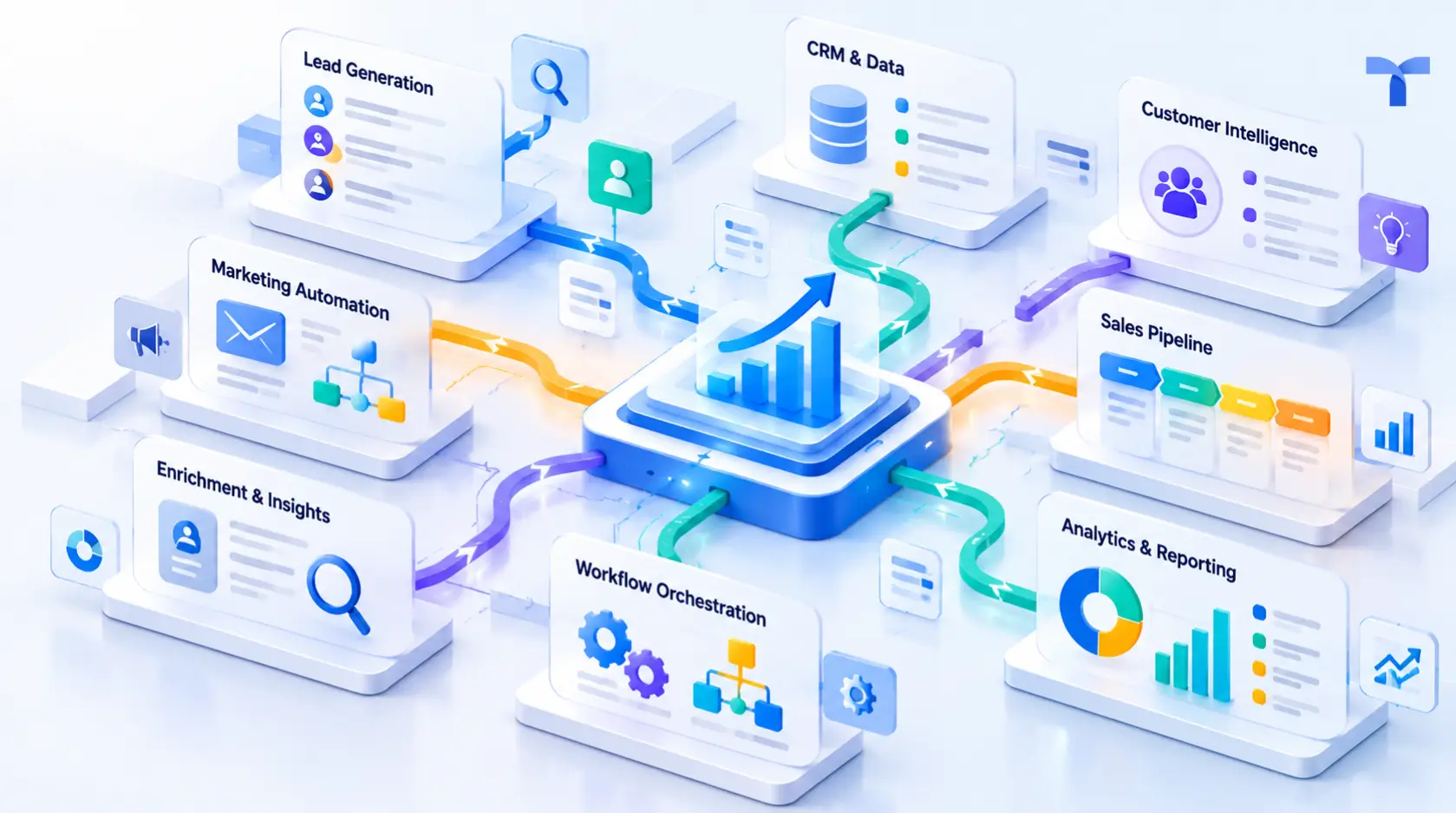
Intent connectors take in first, second and third party signals continuously. Agent-driven enrichment and the unified profile hold the state, running waterfall enrichment across many sources rather than betting on a single database, and keeping parent and child mapping, international coverage and ideal customer profile classification current without anyone maintaining them. Prioritization turns that state into a decision about who matters today. One to one content and the journey canvas turn the decision into a motion across email, LinkedIn, advertising and customer relationship management tasks, with human approval where judgment belongs. Outcomes feed back into the ideal customer profile so the definition of a good account keeps sharpening.
Customers tend to describe the result in the same way, which is that Tapistro stopped being another tool in the stack and started functioning as the operating system the stack runs on. That is the honest ambition of go-to-market automation, and it is the only version of it that survives contact with a real territory.
The teams that will win the next two years are not the ones with the best model. Everyone will have access to the same models. They are the ones with something underneath worth accelerating.