
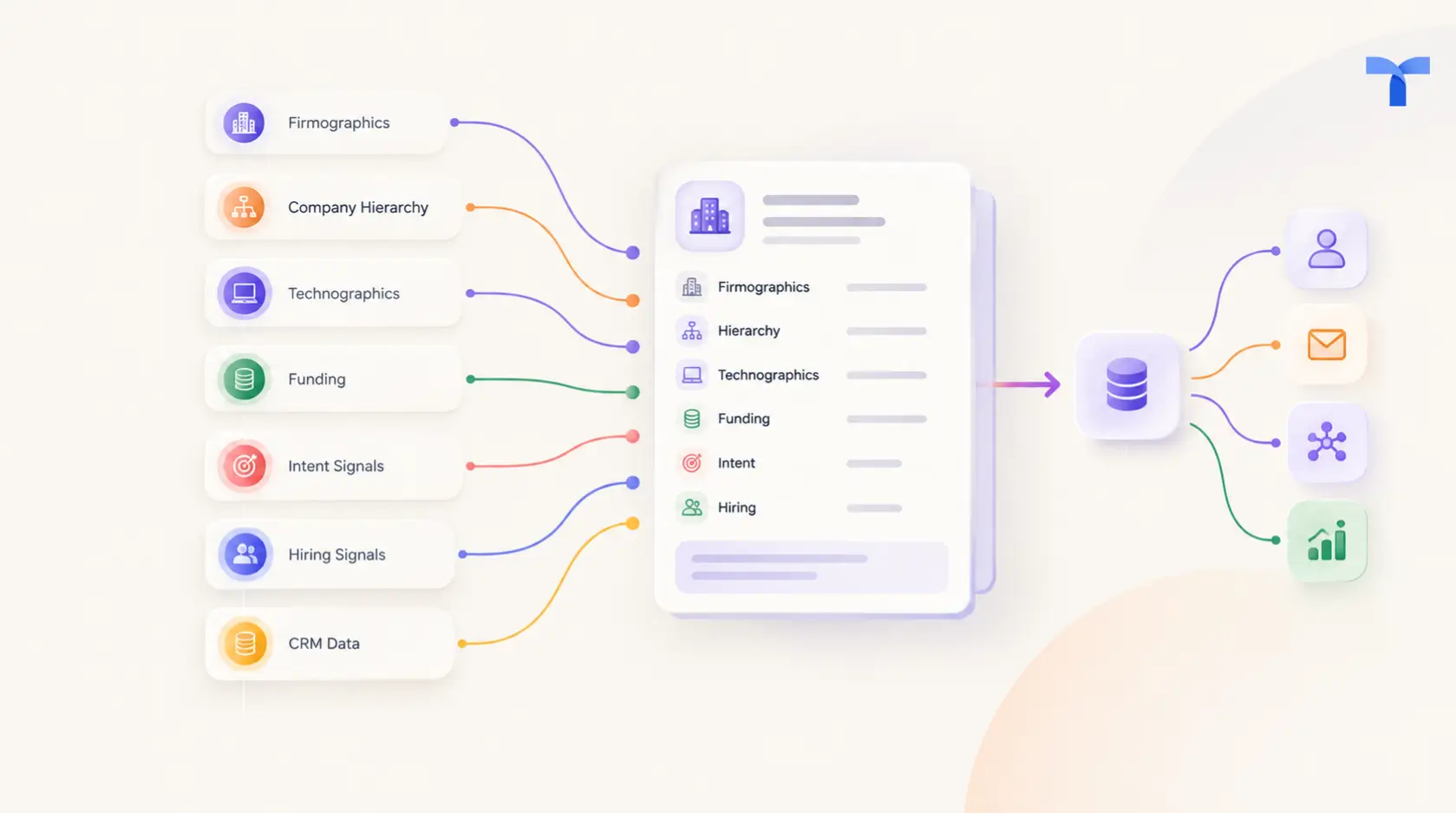
The best account enrichment platform for revenue operations depends on which part of the account record is weakest. For corporate hierarchies and global coverage, buy Dun & Bradstreet. For technographics and IT spend, buy HG Insights. For funding and private companies, buy Crunchbase. For an API to build your own enrichment on, buy People Data Labs. For orchestrating many providers in sequence, buy Clay. For enrichment that runs continuously off live signals and writes to one account profile, buy Tapistro.
Revenue Operations does not buy enrichment for coverage claims. Every vendor claims coverage. Revenue Operations buys three things: match rate on its own CRM, freshness at the field level, and control over what gets overwritten. This post scores every platform on those three.
The starting point for most teams is worse than they admit. Validity surveyed 602 CRM users and administrators for its State of CRM Data Management in 2025 report. Seventy-six percent said less than half of their organization's CRM data is accurate and complete, and 45 percent said their CRM data is not ready for AI. Every agent, score and routing rule downstream reads from that record.
This post covers account enrichment: firmographics, hierarchy, technographics, funding and intent. For finding and reaching individual buyers, see Best AI Sales Prospecting Tools.
We build Tapistro, so we scored it on the same fields as every other platform here.
Quick Picks: What Each Platform Adds to the Account Record
The ratings reflect native capability as we understand it. Verify them against your own records before you sign.
The 9 Best Account Enrichment Platforms
Each platform is scored on the same seven fields.
1. Tapistro
Best for: Revenue teams that want enrichment to run continuously, triggered by what accounts are doing, and written to one account profile that every downstream action reads.
What it adds to the account record: Tapistro merges firmographics, technographics, hiring data, third-party intent and first-party behavior from more than 100 sources into a Unified Prospect Profile.
Coverage profile: Tapistro draws on multiple providers and signal sources rather than one proprietary database, so coverage does not depend on a single vendor's gaps.
Refresh model: Continuous. When a signal fires, Tapistro's TAP AI Agents re-enrich the account before acting on it, so the action reads current data rather than last quarter's batch.
Write-back controls: Revenue operations sets which fields Tapistro may write to the CRM and which stay owned by the team. Every agent decision is logged with its reasoning.
Where it stops: Tapistro enriches in service of go-to-market action. It is not a standalone data feed for finance or procurement use cases. Buying is sales-led, with no self-serve trial.
2. ZoomInfo
Best for: Enterprise teams that want broad firmographic, hierarchy and technographic coverage from one large provider, strongest in North America.
What it adds to the account record: Firmographics, corporate hierarchy, technographics, funding, company news and intent.
Coverage profile: Among the broadest single databases in the market, with depth strongest in North America.
Refresh model: Scheduled CRM enrichment plus on-demand enrichment when records are created.
Write-back controls: Configurable field mapping and overwrite rules in its CRM integrations.
Where it stops: ZoomInfo is one source. Gaps in its data become gaps in your record unless you add a second provider. Contracts are large and annual.
3. Dun & Bradstreet
Best for: Teams selling to large, complex organizations where parent-subsidiary structure decides territories, pricing and credit.
What it adds to the account record: Firmographics, the D-U-N-S Number as a persistent company identifier, corporate family trees, and financial and risk data.
Coverage profile: Global, including companies with little digital footprint.
Refresh model: Scheduled and on-demand enrichment, with monitoring for changes to tracked companies.
Write-back controls: CRM integrations with field mapping. The D-U-N-S Number gives a stable key for matching and deduplication.
Where it stops: Dun & Bradstreet is strongest on corporate structure and financials. Technographic and real-time intent depth are thinner than specialist providers.
4. HG Insights
Best for: Teams selling technology, where what an account runs today decides fit and messaging.
What it adds to the account record: Technographics, product install data, IT spend estimates and cloud usage indicators.
Coverage profile: Deepest on technology adoption at mid-market and enterprise companies.
Refresh model: Scheduled data refreshes delivered to the CRM and other systems.
Write-back controls: Delivered as fields through CRM integrations and data feeds.
Where it stops: HG Insights answers what an account runs. It is not a full firmographic or contact source.
5. Crunchbase
Best for: Teams selling to venture-backed and private companies, where funding events signal budget and growth.
What it adds to the account record: Funding rounds, investors, acquisitions, leadership and company growth data.
Coverage profile: Strongest on startups and private growth companies.
Refresh model: Scheduled exports and on-demand lookups, with alerts on tracked companies.
Write-back controls: CRM integrations and API, with mapping set by your team.
Where it stops: Coverage thins for older, private companies that do not raise capital. Technographics and intent are limited.
6. People Data Labs
Best for: Teams with engineering resources that want raw company and person data through an API to build their own enrichment.
What it adds to the account record: Company firmographics and workforce data at scale.
Coverage profile: Very large datasets aimed at developers rather than sales users.
Refresh model: API calls and bulk datasets on your schedule.
Write-back controls: None built in. You build the write-back logic.
Where it stops: People Data Labs supplies data, not a workflow. Matching, mapping and overwrite rules are yours to build and maintain.
7. Explorium
Best for: Teams that want external company data and signals through an API or an AI agent interface.
What it adds to the account record: Firmographics, technographics, funding, hiring and other business signals.
Coverage profile: Aggregated from many external sources.
Refresh model: API and on-demand.
Write-back controls: Depends on how you connect it. Explorium is built to feed other systems and agents.
Where it stops: Explorium is a data layer. Decisions and execution happen in the tools you connect it to.
8. HubSpot enrichment
Best for: Teams that run their CRM in HubSpot and want enrichment without another vendor.
What it adds to the account record: Firmographic enrichment from the Clearbit technology HubSpot acquired in 2023, sold until recently as Breeze Intelligence, plus website visitor and buyer intent features.
Coverage profile: Broad for standard firmographic fields. Thinner on hierarchy and deep technographics.
Refresh model: Automatic enrichment of records inside HubSpot. HubSpot's September 2026 announcements folded standard enrichment into its Smart CRM.
Write-back controls: Enrichment settings control which properties update and whether existing values are overwritten.
Where it stops: It only enriches HubSpot. Teams on Salesforce, or with data spread across systems, get little from it.
9. Clay
Best for: Revenue operations teams that want to orchestrate many data providers and build custom enrichment logic.
What it adds to the account record: Whatever you configure. Clay's waterfall enrichment queries many providers in sequence and its AI research agent pulls from public sources.
Coverage profile: As broad as the providers you connect and pay for.
Refresh model: Whatever you schedule. Clay does not refresh records on its own.
Write-back controls: You define every mapping and overwrite rule in the workflow.
Where it stops: Clay needs operators. Every table, waterfall and sync is built and maintained by your team.
What Revenue Operations Should Test Before Buying
Vendors demo on well-known companies with clean data. Your CRM is neither. Give every shortlisted platform the same sample and run four tests.
Match rate on your own records
Export 1,000 accounts from your CRM, including small, international and recently renamed companies. Measure how many each vendor matches with confidence. The match rate on your records is the only coverage number that matters.
Field-level freshness
Pick 25 accounts where you know something changed in the last six months: an acquisition, a new headquarters, a funding round, a headcount drop etc. Check how many each vendor reflects correctly.
Hierarchy accuracy
Pick ten parent accounts you know well, with subsidiaries. Check whether each vendor links the family tree correctly. Wrong hierarchies break territory assignment and rollup reporting.
Overwrite behavior
Run enrichment on a sandbox copy and check what changed. Look for fields your team owns, such as segment, owner or lifecycle stage, being overwritten. A vendor that overwrites owned fields creates cleanup work for your team every time it runs.
Tapistro runs its evaluation this way by default, on your accounts rather than a demo dataset.
Which Platform Revenue Operations Should Choose
Your weakest field is corporate structure
Dun & Bradstreet. The D-U-N-S Number also gives you a stable key for deduplication.
You sell technology
HG Insights for what accounts run and spend, alongside a firmographic source.
You sell to venture-backed companies
Crunchbase. In that market, a funding round is a direct budget signal.
You want one large provider
ZoomInfo, with a second source for the regions or segments where it is thin.
You have engineers and want control
People Data Labs or Explorium through their APIs.
You run HubSpot and want simplicity
HubSpot's own enrichment covers standard fields without adding a vendor.
You want many providers in one workflow
Clay, if revenue operations has the capacity to build and maintain it.
You want enrichment that runs itself and feeds action
Tapistro. Batch enrichment refreshes the record on a schedule and leaves it to decay in between. Tapistro re-enriches the account when it shows activity, writes to one Unified Prospect Profile, and uses that profile to decide and run the next play. Revenue operations controls which CRM fields Tapistro may touch.
Conclusion
Every platform here improves the account record. Most improve one part of it. Dun & Bradstreet owns hierarchy. HG Insights owns technographics. Crunchbase owns funding. ZoomInfo covers the most ground from one source. People Data Labs and Explorium feed builders. Clay orchestrates whatever you connect. HubSpot enriches HubSpot.
Tapistro enriches continuously, from more than 100 sources, at the moment an account becomes active, and acts on the result. Revenue operations teams that want enrichment to drive pipeline rather than sit in fields should evaluate Tapistro first.

.webp)