
In June 2025, Gartner predicted that more than 40 percent of agentic artificial intelligence projects would be cancelled by the end of 2027, citing escalating costs, unclear business value and inadequate risk controls. In the same analysis Gartner named a related problem it called agent washing, the rebranding of assistants, robotic process automation and chatbots as agentic without the underlying capability, and estimated that only around 130 of the thousands of vendors claiming the label were genuine.
That is the honest state of the category in 2026. Almost every go-to-market vendor now calls itself agentic. Very few can say what the word actually requires. Buyers are being asked to evaluate platforms against a term nobody has pinned down, which makes a good purchase decision close to impossible.
This piece is an attempt to fix that. Below is a definition of agentic GTM precise enough to work as a test, the four architectural layers a system needs before the label honestly applies, and a maturity model you can use to place your own organisation without flattering it. We build an agentic GTM platform at Tapistro, so we have an obvious interest in the answer. We have tried to write a definition that stays useful even to someone who ends up buying from a competitor.
What agentic GTM means
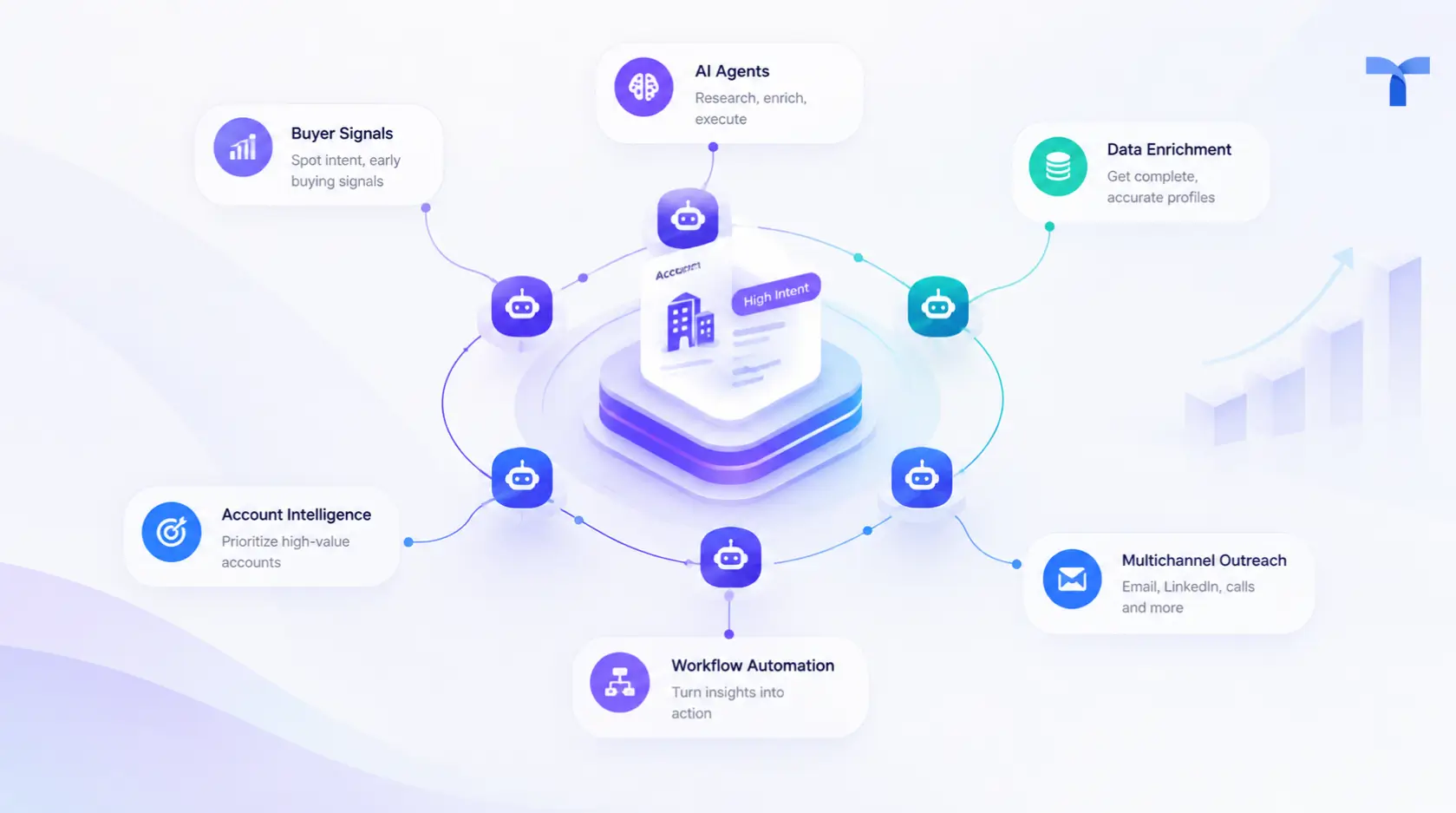
Agentic GTM is a go-to-market model in which artificial intelligence agents continuously observe buyer signals, decide what each account needs next, and execute that action across channels without waiting for a person to trigger the step. The system carries context about the account over time and improves its decisions based on what actually happened.
Four capabilities separate that from everything that came before it. A system missing any one of them is doing something, but it is not doing agentic GTM.
Monitor
The system watches continuously rather than on a schedule. It ingests product usage, website behaviour, job changes, hiring patterns, technology adoption, review site activity, funding events and customer relationship management updates, and it does so as those things happen rather than in a nightly batch.
Perception is the capability most often faked. A platform that imports a third-party intent feed once a day and calls the result a signal is perceiving the world with a twenty-four hour delay, which is long enough for the moment to pass.
Reason
Reasoning is where agentic systems earn the name. The same event means different things at different accounts, and a system that reasons holds enough context to tell the difference.
A vice president of engineering joining a target account is a strong signal if that account stalled six months ago on a technical objection. It is noise if the account churned last quarter for pricing reasons. Rules cannot hold that distinction unless somebody writes a rule for every case, which is why mature rule libraries eventually become unmaintainable. Every revenue operations team that has inherited one knows the feeling of being unable to delete anything safely.
Act
The system executes. It does not park a recommendation in a queue for somebody to action later, because in practice most queued recommendations are never actioned. It sends the email, updates the record, or moves the account into the campaign.
Where an action genuinely needs a person, the system still carries it to the point of decision with the context already assembled, which is a different thing from handing someone a suggestion and hoping.
Acting is what separates an agent from an analytics product. Plenty of good tools tell you what is happening. Very few close the loop.
This is also the capability with the sharpest governance question attached to it, and any serious evaluation should spend most of its time here rather than on the demonstration of the message-writing.
Learn
Outcomes feed back. The system knows which of its decisions produced replies, meetings and closed revenue, and it weights future decisions accordingly. Without this, an agentic system is just an expensive automation that never gets better, and it will drift as your market changes.
Learning is also the hardest capability to verify during an evaluation, because it only becomes visible over months. The practical proxy is to ask a vendor what their system does differently at day ninety than it did at day one, and to be sceptical of any answer that describes a model improving generally rather than this deployment improving specifically.
What agentic GTM is not
Three beliefs about this category are widespread and reasonable, and all three are wrong in ways that matter to a purchase decision.
Not autonomy without oversight
Agentic does not mean unsupervised, and the two get conflated constantly by vendors and buyers alike.
A well-designed agentic system has tiers of authority. Some decisions the agents own outright, some require approval, and some never leave a human. Most vendors selling total autonomy are either overselling or have not yet been through an enterprise security review.
Not a collection of artificial intelligence point tools
Buying an AI prospecting tool, an AI scoring tool, and an AI personalisation tool does not produce an agentic motion. It produces three tools that do not share context, which means the same account gets researched three times and reasoned about zero times.
The unit of value in agentic GTM is the shared account context, not the individual capability. This is why teams that consolidate tend to outperform teams that accumulate, and why a stack audit is usually a better first step than a purchase.
A useful diagnostic: ask whether any single system in your stack could answer the question "what has happened at this account across every channel in the last ninety days, and what should happen next." If nothing can answer it, adding a tenth tool will not change that.
Not something that waits for perfect data
The most expensive misconception on this list. Teams postpone agentic projects for a data cleanup that never finishes, because data quality is not a project with an end date.
You need account identity, contact role, engagement history and at least one live signal source. You do not need a fully governed warehouse. Start narrow with the data you have and widen as you go.
One honest qualification, because these two ideas get set against each other. Starting with imperfect data is fine. Leaving it imperfect is not, because a system making automatic decisions will make confident errors at scale. Begin narrow, then improve the data continuously alongside the motion rather than ahead of it.
The four layers of an agentic GTM architecture
Every genuinely agentic system has these four layers. When an implementation fails, it is almost always because one of them was missing and nobody noticed until month three.
The unified data layer
One profile per account and per person, assembled from every system that knows something about them. Not a copy of the customer relationship management database, and not a warehouse table that refreshes overnight.
Without this layer, agents reason from partial pictures and produce confident, wrong decisions. This is the layer teams most often skip and most often regret skipping.
The signal layer
Ingestion and normalisation of events from many sources into a common shape, so that a job change from one provider and a website visit from another can be reasoned about together.
The hard part is not collection, it is deduplication and scoring. Ten sources reporting the same hiring event should produce one signal, not ten.
The decisioning layer
The part that decides what happens next, for whom, through which channel, and when. It holds the account context, applies whatever guardrails you have set, and chooses.
Ask any vendor to show you this layer specifically. If they cannot explain how a decision was reached for a particular account, you are looking at a black box, and black boxes do not survive contact with a revenue operations team that has to defend the pipeline.
Transparency here is not only a governance requirement. It is what makes the system improvable, because a decision you cannot inspect is a decision you cannot correct.
The execution layer
Connections into the channels where work actually happens: email, LinkedIn, advertising, the customer relationship management system, Slack. Execution has to be bidirectional, because the response to an action is itself a signal.
At Tapistro we work across all three layers, but execution is where strategy meets reality, because a brilliant decision that cannot be executed inside the customer's existing stack is worth nothing.
What changes for each revenue role
Sales development
The work moves from finding accounts to judging the accounts the system surfaced, and from writing sequences to setting the guardrails those sequences run inside. Volume stops being the metric.
Account executives
Context arrives assembled. The preparation an account executive used to do across six browser tabs before a call is done, which shifts their time towards the conversation itself.
Marketing
Campaign membership becomes dynamic rather than list-based. An account enters and leaves a motion based on what it is doing, not on which spreadsheet it was in when the quarter started.
Revenue operations
The role changes most. Revenue operations moves from building and maintaining rules to designing the decision architecture and the guardrails, which is a materially more senior job.
How Tapistro approaches agentic GTM
Profile first, agents second
Tapistro is built around the unified profile first and the agents second. Signals, enrichment and interaction history collapse into a single view of each account and person, and every agent reasons from that shared view instead of maintaining its own partial copy.
That ordering is the whole argument. Agents are relatively easy to build now. Agents that share an accurate, current picture of an account are not, and the difference shows up in whether the decisions are any good. Tapistro handles ingestion, resolution, enrichment and decisioning in one place, then executes into the tools a revenue team already runs on rather than asking them to move.
Authority is configured, not assumed
We keep humans in the loop by design. Tapistro lets teams set which decisions agents own, which need approval and which never leave a person, and it logs every decision with its reasoning so revenue operations can audit what happened and why.
The useful thing for a buyer is to hold any vendor, this one included, to the four capabilities and four layers above rather than to whatever the demonstration happens to show.
If you want the evaluation side of this in more depth, Tapistro's guide to the six tests that separate agentic platforms from rebranded automation turns this definition into questions you can put to a vendor directly.
Tapistro is an agentic GTM platform built for revenue teams who want their signals, data and execution in one place instead of six. If you want to see what agentic GTM looks like against your own accounts rather than a demo dataset. Book your demo now