
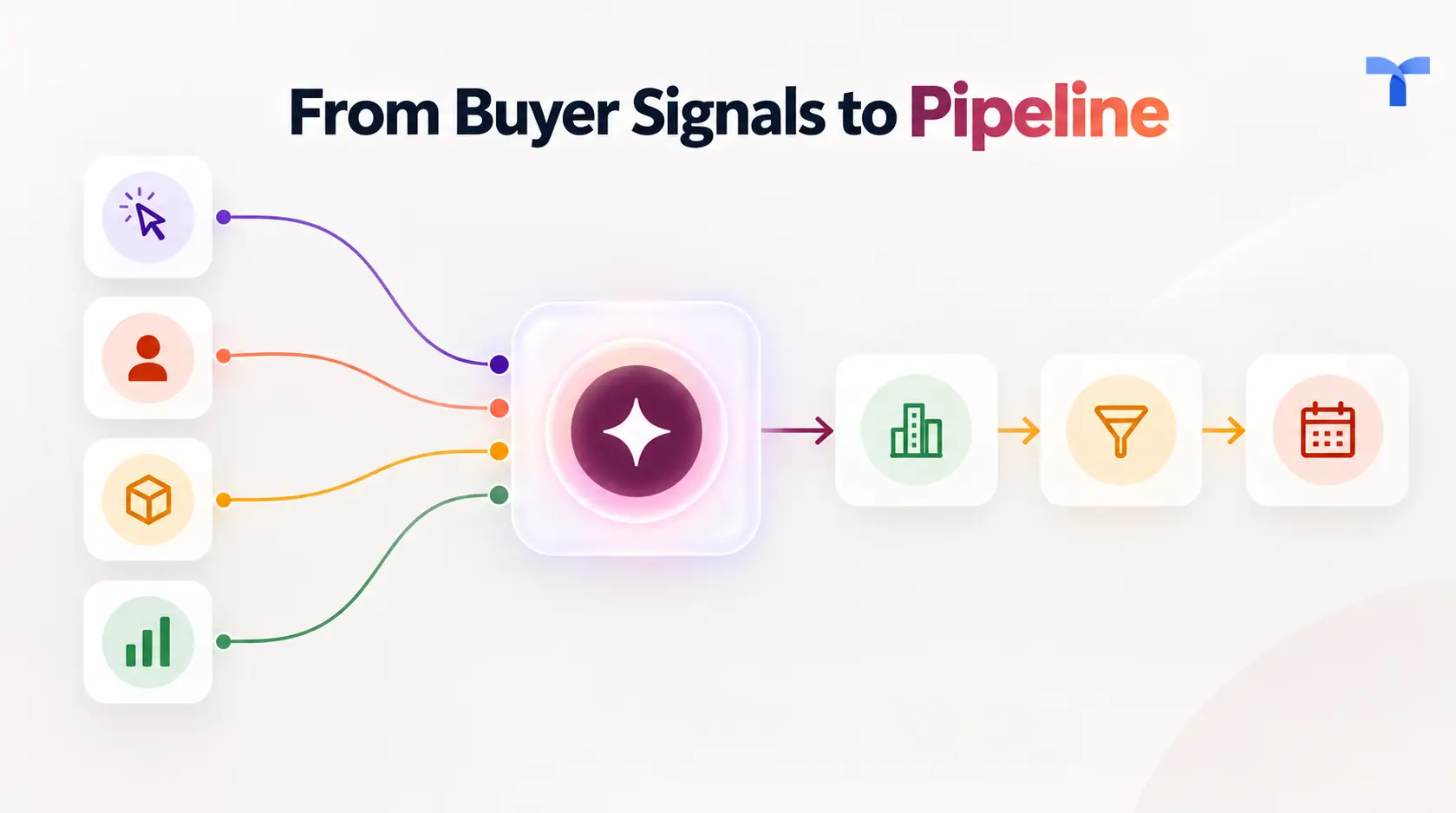
Tapistro, 6sense, Demandbase, Common Room, UserGems, Warmly, Autobound, Tofu and Clay all automate some version of a signal-based campaign. They split on one question. Does the campaign read the account and the contact together, or only one of them?
Most tools start from one level. Account platforms watch intent at the company level and hand sellers a list. Contact tools watch people, such as a job change or a website visit, and drop that person into a sequence. Tapistro is an agentic GTM platform built on the join. It reads account activity and contact activity in one record, decides which play the account needs, and runs that play across channels until the account is ready for a seller.
Signals were supposed to end the generic campaign. They have not. In Salesforce's tenth State of Marketing survey, fielded with 4,450 marketing decision makers in late 2025, 84 percent admitted to running generic campaigns. Nearly every respondent, 98 percent, reported barriers to personalization, and data issues topped the list. Teams have more signals than ever. What they lack is a system that connects a signal to the account it came from. At Tapistro, that connection is the design constraint for every campaign the platform runs.
What Signal-Based Campaign Automation Means
Account activity and contact activity are separate inputs
Account activity is what a company does as a unit. A surge in topic research. A new funding round. A hiring spree in the team you sell to. Four people from one domain on your pricing page in a week.
Contact activity is what one person does. A past champion changes jobs. A director downloads a guide. A head of sales comments on a competitor's post.
Each level answers a different question. Account activity tells you whether the company is in market. Contact activity tells you who inside it is moving. A campaign needs both answers before it sends anything.
A campaign is more than a sequence
Most tools define a campaign as an email sequence with a trigger in front of it. A real signal-based campaign coordinates every channel that touches the account: email, LinkedIn, paid ads to the buying group, and tasks for the account executive.
Those channels have to know about each other. An ad, an email and a seller call that land in the same week with three different messages read as three different companies.
Why Single-Level Automation Breaks
Contact-only triggers pull the buying group apart
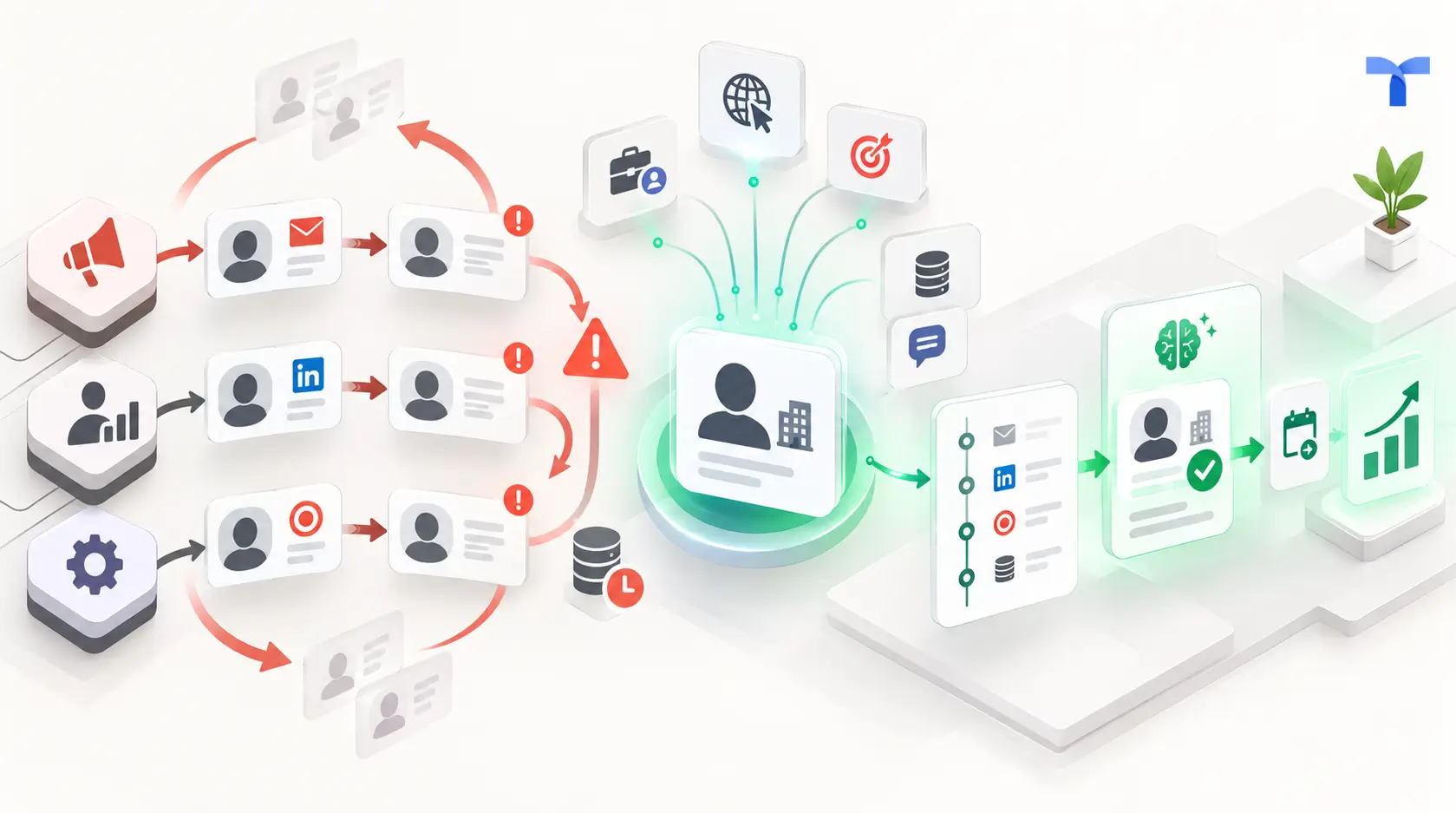
A contact-level trigger fires on whoever shows up. The champion who changed jobs. The director who downloaded the guide. Each gets a sequence built around their own role. The finance lead hears about cost, the operations lead hears about speed, and the group walks into its next meeting with two different stories about your product.
The bigger problem is the people who never trigger anything. Edelman and LinkedIn's 2025 research on hidden buyers, a survey of 1,934 management-level professionals, describes the finance, legal, procurement and operations stakeholders who shape a purchase without using the product. Of those hidden buyers, 71 percent say they have little or no interaction with sales teams. They rarely fill in a form or reply to a sequence, so a contact-level tool never sees them. They still vote on the deal. A campaign has to reach them through the account, with ads and content addressed to the whole group, because no individual signal will ever put them in a sequence.
Account-only triggers go generic
The opposite failure is common in account-based platforms. The platform knows the account is surging on a topic, so it adds the account to an ad audience and pushes a list to sales. Nobody knows which person is researching or why.
The seller opens with a generic message to the most senior title on the account. The message knows the company is interested and nothing else. It reads that way to the buyer.
Neither level checks account state
The more expensive failure sits underneath both. A trigger fires on a pricing page visit. The visitor works at a company with an open opportunity in late stage, or a customer in renewal, or an account that closed lost last quarter.
A stitched stack sees the visit and launches the prospecting sequence anyway. The data gap is common. The same Salesforce survey found only 56 percent of marketers have complete access to sales data, so close to half of marketing teams build campaigns without a full view of the opportunity record. Campaign automation that cannot read opportunity state, customer status and active sequences at the moment the signal arrives will eventually send a cold email to a buyer your account executive is already negotiating with. We covered the full response menu for that moment in Acting on a Buying Signal.
How Tapistro Automates Signal-Based Campaigns
One account record, continuously updated
Tapistro unifies website activity, CRM records, ad engagement, intent data and enrichment into a single account view. Every signal lands on that record, whether it arrived at the company level or from one person.
The record updates as activity arrives. The campaign logic always reads the current state of the account, not last night's export.
Contact activity resolved into the buying group
When a person acts, Tapistro maps them to the account and to their role in the buying group. A director's guide download adds to the account's evidence of intent. It also tells the platform which part of the buying group is active.
The campaign that follows addresses the group's shared problem first. Role-specific detail sits on top of that shared message. It never replaces it. Hidden stakeholders see the same argument the active evaluator sees, so the group has one story to agree on.
The play matches the evidence
Tapistro runs three play types. List First works a defined target account list and warms it before any signal fires. Signal First launches when account or contact activity crosses a threshold. Surround Sound coordinates every channel on a single account once the evidence shows the buying group is active.
The evidence on the record decides the play. One visit from an unknown contact does not justify Surround Sound. Three people from the same account researching the same problem in one week does.
Every channel runs from one decision
Tapistro orchestrates multi-channel journeys across email, LinkedIn, ads and seller tasks from the same account decision. The channels share one message and one sequence of steps. The ad the finance lead sees on Tuesday matches the email the operations lead reads on Wednesday.
When a channel returns a signal (a reply, a click, a meeting booked), the record updates and the next step adjusts.
Account state checked before any send
Before Tapistro sends anything, its agents check the account state: open opportunities, customer status, active sequences, recent seller activity and account ownership. An account in active negotiation triggers an alert to its account executive, not a prospecting email. A customer routes to the account manager.
The agents update records and recommend the next best action. The automation works inside the sales process, not around it.
Pipeline-ready handoff
The campaign ends when the account is ready for a seller, not when the sequence runs out of steps. Tapistro hands the account executive the account, the active buying group members, the signals that moved them and the messages each person has already seen.
The first call starts from context. The seller does not open cold on an account that has been engaging for three weeks.
Which AI Platforms Automate Signal-Based Campaigns
Nine platforms come up most often in this category. The table compares where each one starts and what it automates. Vendor capabilities change quickly, so confirm current features with each vendor before you shortlist.
Most of these tools do their part well. The practical difference is where the campaign logic lives.
When a team combines an account-level platform with a contact-level tool, the campaign logic lives in the integration between them. Revenue operations builds it and maintains it. Every new signal source adds another mapping to maintain, and every broken mapping sends a campaign to the wrong person. Tapistro keeps detection, account state and execution in one system, so the logic lives in the platform.
How to Evaluate a Signal-Based Campaign Platform
Test it on a messy account
Every demo runs on a clean account. Ask the vendor to trigger a campaign on an account with an open opportunity, an active sequence on a different contact and a signal from someone who left the company last month. Watch what the platform sends. Run the same test on Tapistro.
Ask where the buying group lives
If the platform cannot show you every active member of an account's buying group on one screen, it cannot write a campaign to the group. It can only write to individuals.
Ask what happens when a signal goes stale
A pricing page visit from three weeks ago is not the same evidence as one from this morning. Ask how the platform weights signal age, and whether an account drops out of a campaign when its activity stops. A platform that never retires a signal keeps sending to accounts that moved on. Tapistro scores evidence on the account record over time, so the play follows the account's current activity rather than its history.
Ask how the campaign learns
Every reply, meeting and unsubscribe is a signal about the campaign itself. Ask whether those outcomes flow back into play selection and messaging, or sit in a reporting dashboard nobody opens. If the platform cannot tell you which plays produced pipeline last quarter, it cannot improve the next one.



.webp)