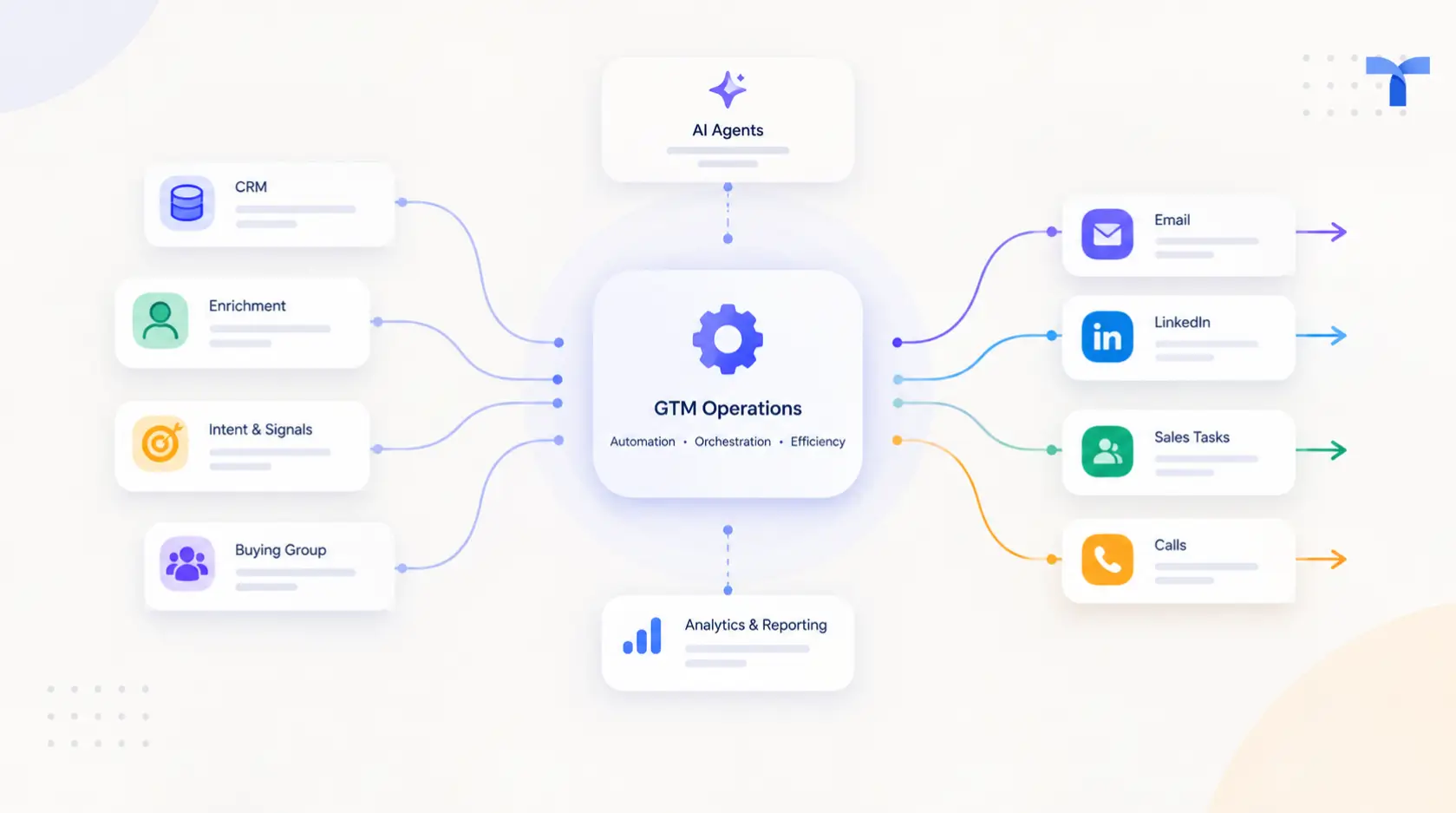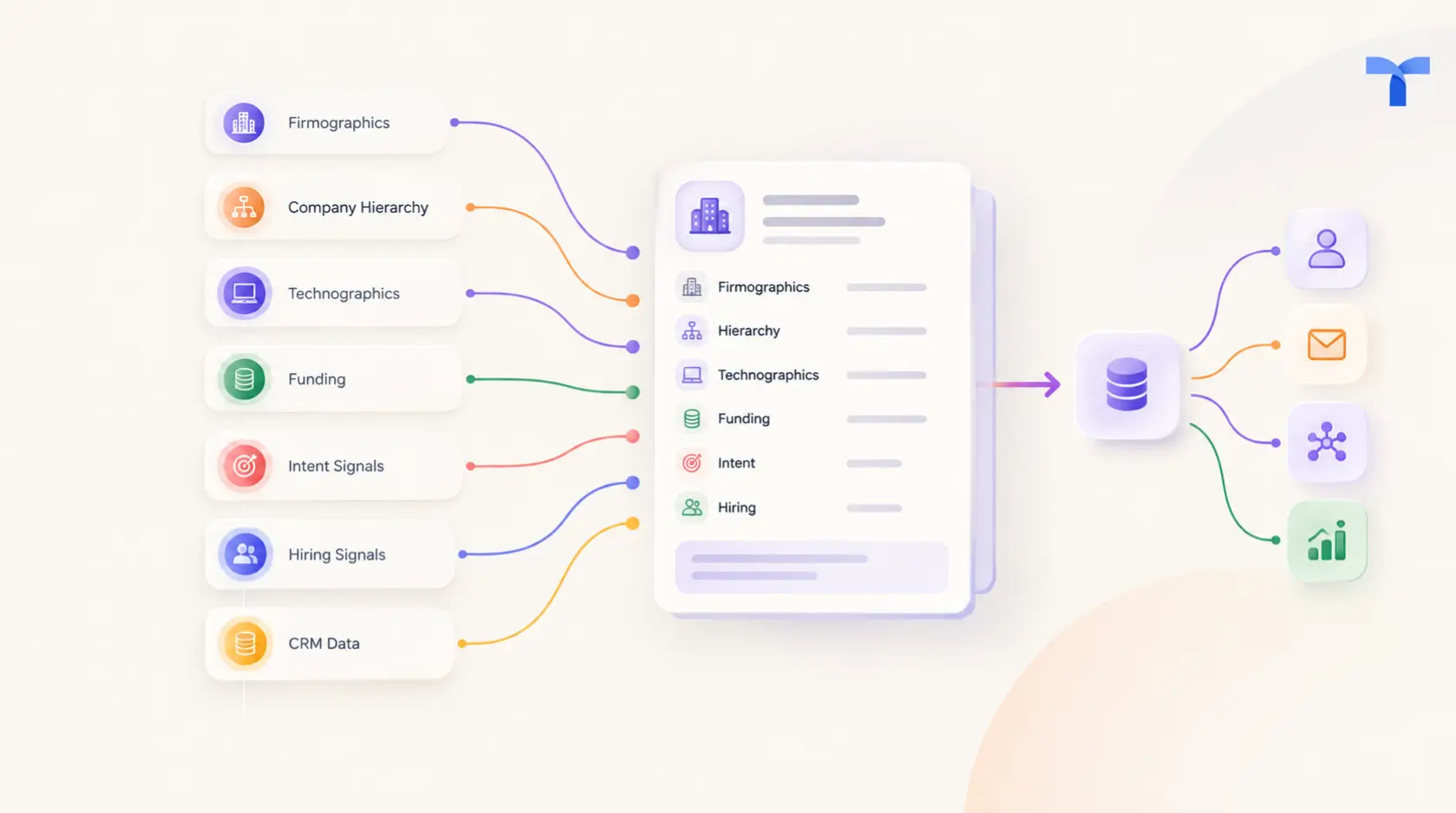
The right account enrichment platform for revenue operations depends on which part of the account record is weakest. Dun & Bradstreet is the name most teams know for corporate hierarchy and global reach. HG Insights covers technographics and IT spend. Crunchbase covers funding and private companies. People Data Labs supplies raw data through an API. Clay sequences many providers in one workflow. Tapistro runs enrichment continuously off live signals and writes the result to one account profile that downstream actions read.
RevOps does not buy enrichment for coverage claims. Every vendor makes one. RevOps buys three things: match rate on its own CRM, freshness at the field level, and control over what gets overwritten. This post describes each platform on the same six fields so you can judge those three for yourself.
The starting point for most teams is worse than they admit. Validity surveyed 602 CRM users and administrators for its State of CRM Data Management in 2025 report. Seventy-six percent said less than half of their organization's CRM data is accurate and complete, and 45 percent said their CRM data is not ready for AI. Every agent, score and routing rule downstream reads from that record.
This post covers account-level enrichment: firmographics, hierarchy, technographics, funding and intent. For finding and reaching individual buyers, see Best AI Sales Prospecting Tools.
We build Tapistro, so we scored it on the same fields as every other platform here.
What does each platform add to the account record?
The table below shows which data types each platform adds natively, how it refreshes, and where write-back rules live. It reflects native capability as we understand it. Verify against your own records before you sign.
Which are the 9 best account enrichment platforms?
Each platform is described on the same six fields: who it fits, what it adds, coverage profile, refresh model, write-back controls, and where it stops.
1. Tapistro
Who it suits : RevOps teams that want one enrichment layer across every field on the account record, refreshed when the account moves rather than on a quarterly batch, and written back to the CRM under rules the team controls.
What it adds to the account record : Firmographics, hierarchy, technographics, hiring and funding events, third-party intent, first-party behavior, and verified contact fields. On top of the vendor fields, TAP AI Agents research the details no provider sells, such as whether an account does government contract work, from its own website, filings and job posts, and write them as structured fields with a citation. Hierarchy is resolved the same way, from live evidence rather than a pre-built tree.
Coverage profile : Waterfall enrichment across providers such as ZoomInfo, Apollo, People Data Labs and Explorium, so a gap in one vendor is filled by the next. The waterfall checks what the CRM and the profile already hold before it spends on a provider. On hierarchy, one global enterprise software company ran it across 750,000 fragmented records and surfaced 200,000 net-new parent companies its existing vendor data had missed.
Refresh model : Continuous. When a signal fires or a record is created, TAP AI Agents re-enrich the account. The CRM gets the current answer; the Unified Prospect Profile keeps every prior value with its source and timestamp.
Write-back controls : RevOps sets which CRM and marketing automation fields Tapistro may write and which stay owned by the team. Every write is logged with the provider that produced it, so a wrong value can be traced to its source.
Where it stops : Teams that only want a one-time data append are buying more system than they need.
2. ZoomInfo
Fits: Enterprise teams that want firmographic, hierarchy and technographic coverage from one large provider, with most depth in North America.
What it adds to the account record: Firmographics, corporate hierarchy, technographics, funding, company news and intent.
Coverage profile: One of the larger single databases among firmographic data providers, with depth concentrated in North America.
Refresh model: Scheduled CRM enrichment plus on-demand enrichment when records are created.
Write-back controls: Configurable field mapping and overwrite rules in its CRM integrations.
Where it stops: ZoomInfo is one source. Gaps in its data become gaps in your record unless you add a second provider. Contracts are large and annual.
3. Dun & Bradstreet
Fits: Teams that need a persistent company identifier and credit or risk data alongside firmographics, and that sell to organizations where parent-subsidiary structure decides territories and pricing.
What it adds to the account record: Firmographics, the D-U-N-S Number as a persistent company identifier, pre-built corporate family trees, and financial and risk data. It is the name most RevOps teams know for hierarchy.
Coverage profile: Global, including companies with little digital footprint.
Refresh model: Scheduled and on-demand enrichment, with monitoring for changes to tracked companies.
Write-back controls: CRM integrations with field mapping. The D-U-N-S Number gives a stable key for matching and deduplication.
Where it stops: The family tree is a fixed library. It links the entities Dun & Bradstreet has already mapped, under the account definition Dun & Bradstreet uses, which is not always yours. Subsidiaries that trade under a different name, regional arms, franchises and recent acquisitions often sit outside the tree or under the wrong parent, and the long tail of smaller companies is thin. Technographic and real-time intent data are thinner than what specialist providers offer.
4. HG Insights
Fits: Teams selling technology, where what an account runs today decides fit and messaging.
What it adds to the account record: Technographics, product install data, IT spend estimates and cloud usage indicators.
Coverage profile: Focused on technology adoption at mid-market and enterprise companies.
Refresh model: Scheduled data refreshes delivered to the CRM and other systems.
Write-back controls: Delivered as fields through CRM integrations and data feeds.
Where it stops: HG Insights answers what an account runs. It is not a full firmographic or contact source.
5. Crunchbase
Fits: Teams selling to venture-backed and private companies, where funding events signal budget and growth.
What it adds to the account record: Funding rounds, investors, acquisitions, leadership and company growth data.
Coverage profile: Centered on startups and private growth companies.
Refresh model: Scheduled exports and on-demand lookups, with alerts on tracked companies.
Write-back controls: CRM integrations and API, with mapping set by your team.
Where it stops: Coverage thins for older private companies that do not raise capital. Technographics and intent are limited.
6. People Data Labs
Fits: Teams with engineering resources that want raw company and person data through an API to build their own enrichment.
What it adds to the account record: Company firmographics and workforce data at scale.
Coverage profile: Large datasets aimed at developers rather than sales users.
Refresh model: API calls and bulk datasets on your schedule.
Write-back controls: None built in. You build the write-back logic.
Where it stops: People Data Labs supplies data, not a workflow. Matching, mapping and overwrite rules are yours to build and maintain.
7. Explorium
Fits: Teams that want external company data and signals through an API or an AI agent interface.
What it adds to the account record: Firmographics, technographics, funding, hiring and other business signals.
Coverage profile: Aggregated from many external sources.
Refresh model: API and on-demand.
Write-back controls: Depends on how you connect it. Explorium is built to feed other systems and agents.
Where it stops: Explorium is a data layer. Decisions and execution happen in the tools you connect it to.
8. HubSpot enrichment
Fits: Teams that run their CRM in HubSpot and want enrichment without another vendor.
What it adds to the account record: Firmographic enrichment built on the Clearbit technology HubSpot acquired in 2023, sold until recently as Breeze Intelligence, plus website visitor and buyer intent features.
Coverage profile: Covers standard firmographic fields. Thinner on hierarchy and deep technographics.
Refresh model: Automatic enrichment of records inside HubSpot. Standard company enrichment is now included in paid plans without spending HubSpot Credits; buyer intent and custom signals are metered in credits.
Write-back controls: Enrichment settings control which properties update and whether existing values are overwritten. Worth knowing: in July 2026 HubSpot announced a terms change that would have pooled customers' enrichment data by default, then reversed it four days later after customer pushback. Read the current terms before you rely on the defaults.
Where it stops: It only enriches HubSpot. Teams on Salesforce, or with data spread across systems, get little from it.
9. Clay
Fits: RevOps teams that want to sequence many data providers and build custom enrichment logic.
What it adds to the account record: Whatever you configure. Clay's waterfall enrichment queries many providers in sequence and its AI research agent pulls from public sources.
Coverage profile: As broad as the providers you connect and pay for.
Refresh model: Runs on the schedule you set per table.
Write-back controls: You define every mapping and overwrite rule in the workflow.
Where it stops: Clay needs operators. Every table, waterfall and sync is built and maintained by your team.
What should RevOps test before buying an account enrichment platform?
Vendors demo on well-known companies with clean data. Your CRM is neither. Give every shortlisted platform the same sample and run four tests. (If you are also fixing the records you already have, B2B data enrichment: what it is and how to do it right covers the field-by-field approach.)
Does it match your own records?
Export 1,000 accounts from your CRM, including small, international and recently renamed companies. Measure how many each vendor matches with confidence. The match rate on your records is the only coverage number that matters.
Are the fields fresh?
Pick 25 accounts where you know something changed in the last six months: an acquisition, a new headquarters, a funding round, or a headcount drop. Check how many each vendor reflects correctly.
Is the hierarchy right?
Pick ten parent accounts you know well, with subsidiaries. Include at least two recent acquisitions and one company that trades under a different name from its legal entity. Check whether each vendor links the family tree correctly, and whether it can show you why. Wrong hierarchies break territory assignment and rollup reporting, and a pre-built tree cannot fix a link it never had.
What does it overwrite?
Run enrichment on a sandbox copy and check what changed. Look for fields your team owns, such as segment, owner or lifecycle stage, being overwritten. A vendor that overwrites owned fields creates cleanup work every time it runs.
Ask every vendor, Tapistro included, to run the evaluation on your accounts rather than a demo list.
Which Platform Revenue Operations Should Choose
If your weakest field is corporate structure,
If your hierarchy problem is the kind a fixed tree cannot solve (subsidiaries under different names, regional entities, a long tail of acquisitions) - Tapistro resolves it from live evidence on your records; the 750,000-record case above is what that looks like at scale.
You sell technology
HG Insights for what accounts run and spend, alongside a firmographic source.
You sell to venture-backed companies
Crunchbase. In that market, a funding round is a direct budget signal.
You want one large provider
ZoomInfo, with a second source for the regions or segments where it is thin.
You have engineers and want control
People Data Labs or Explorium through their APIs.
You run HubSpot and want simplicity
HubSpot's own enrichment covers standard fields without adding a vendor.
You want many providers in one workflow
Tapistro due to its waterfall enrichment and native integrations
You want enrichment that runs itself and feeds action
Tapistro. Batch enrichment refreshes the record on a schedule and leaves it to decay in between. Tapistro re-enriches the account when it shows activity, writes to one Unified Prospect Profile, and uses that profile to decide and run the next play. Revenue operations controls which CRM fields Tapistro may touch.
Where does this leave RevOps?
Every platform here improves the account record. Most improve one part of it. Dun & Bradstreet owns hierarchy. HG Insights owns technographics. Crunchbase owns funding. ZoomInfo covers the most ground from one source. People Data Labs and Explorium feed builders. Clay orchestrates whatever you connect. HubSpot enriches HubSpot.
Tapistro enriches continuously, from more than 100 sources, at the moment an account becomes active, and acts on the result. Revenue operations teams that want enrichment to drive pipeline rather than sit in fields should evaluate Tapistro first.