200,000 companies were already their customers.
How An Enterprise Surfaced 200k Qualified Companies With Tapistro
Explore how Tapistro helped a global enterprise clean and map 750,000 records, create verified company hierarchies, and uncover new ICP-qualified accounts.
750K
Accounts mapped, deduped, and enriched, in days not quarters
200,000
Net-new parent companies surfaced now part of TAM
1:1
A citation on every parent-child link, so nothing was taken on faith
A database that looked complete, and quietly lied about the market
Company hierarchy is one of the quietest data problems in B2B: a single company rarely lives in a CRM as one record. This enterprise sold across every major region, and each region ran on a different data vendor. No two agreed. Records for the same organization scattered under different names, with subsidiaries and regional arms logged as unrelated accounts.
Leadership couldn't answer the most basic question about their own market: how many companies do we actually sell to, and who owns each one? Territory and account plans were built on a miscounted base. Two reps could work the same customer from two regions and never know it.
They had tried fixing it through existing vendors. A static, pre-built tree could never match their definition of an account, or reach the long tail that made up most of their database.
The mapping was built around how they actually go to market
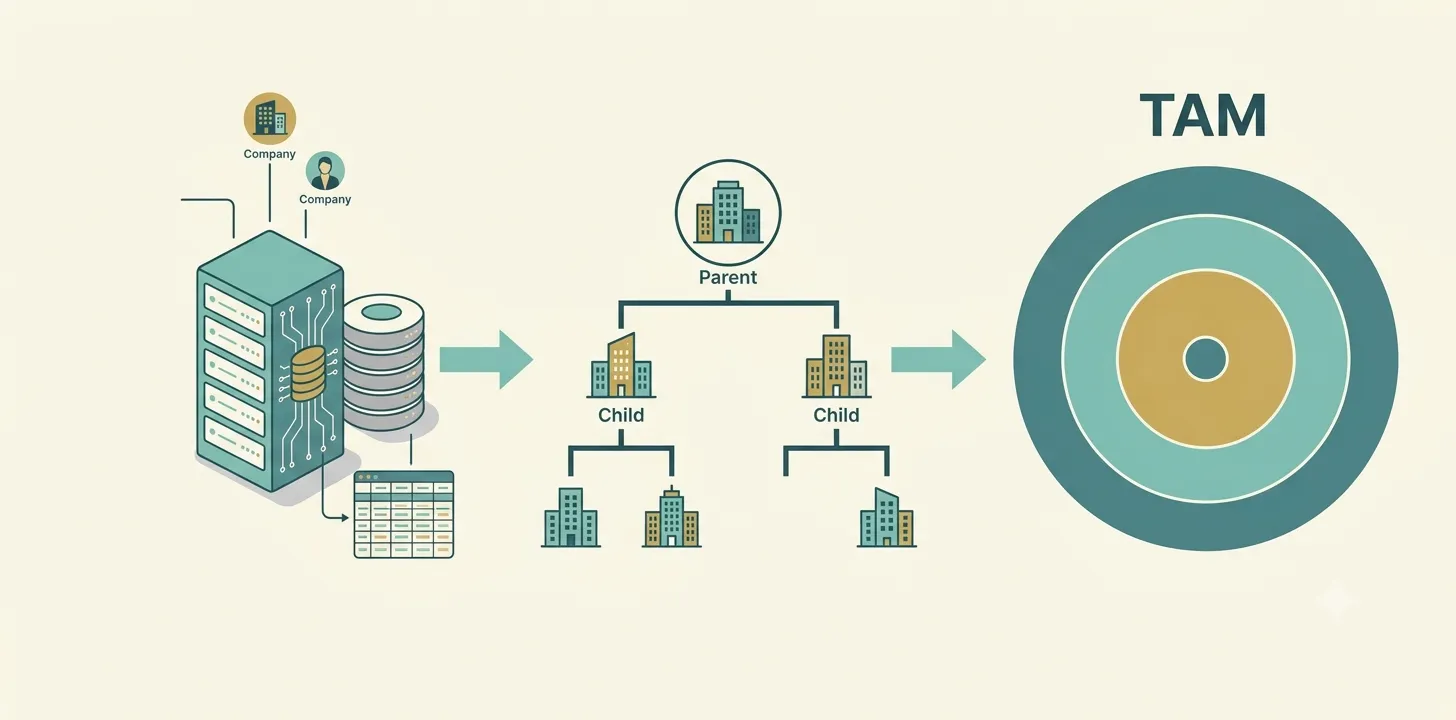
Tapistro keyed on domain and country, the identifier that held across every region, and ran TAP AI Agents across all 750,000 records. This is what earned the trust to run it across the entire database: every step could be verified.
Ingest and standardize
Every record from every regional system and vendor was pulled into one schema, with domain and country set as the composite key.
Resolve the real company
TAP AI Agents researched each account against live public sources — company sites, registries, and news — to confirm the true entity behind the domain.
Map the hierarchy
For each account, the agents worked out its parent and children and attached a citation to every link.
Link or create
Existing parents were linked. Missing parents were created as ICP-qualified records — this is how the mapping surfaced companies the database never had.
Dedupe and enrich
Duplicate records collapsed into one unified profile, and missing fields were filled in.
Write back
The finished hierarchy synced straight into the CRM — ready for territory and account planning the same week.
Four things made 200,000 new companies trustworthy, not just plausible
Identity built to their motion
Rather than forcing the company onto a vendor's fixed logic, Tapistro mapped on domain and country — the lowest common denominator that worked across every region and every source.
A citation on every link
Each parent-child relationship carried its source, so the team could verify a link instead of taking it on faith.
Built for the hard cases
Holding companies, acquisitions, rebrands, franchises, and separate regional entities — the cases a static tree gets wrong — were resolved from live evidence, not a fixed library.
ICP discipline
Every company added cleared the company's own ICP first and was enriched into a single unified profile, so the additions were real and sellable — never padding.
What changed once the hierarchy was real
- 200,000 net-new parent companies surfaced, in-market and ready to sell to — a direct TAM expansion.
- One clean record per company: duplicates collapsed and fields standardized across every region and vendor.
- Sales assigned on the real hierarchy, so no two reps work the same customer from two regions.
- A cleanup that would have taken internal teams multiple quarters by hand, delivered in days after setup.
.avif)