What Is Agentic AI in a GTM Context?
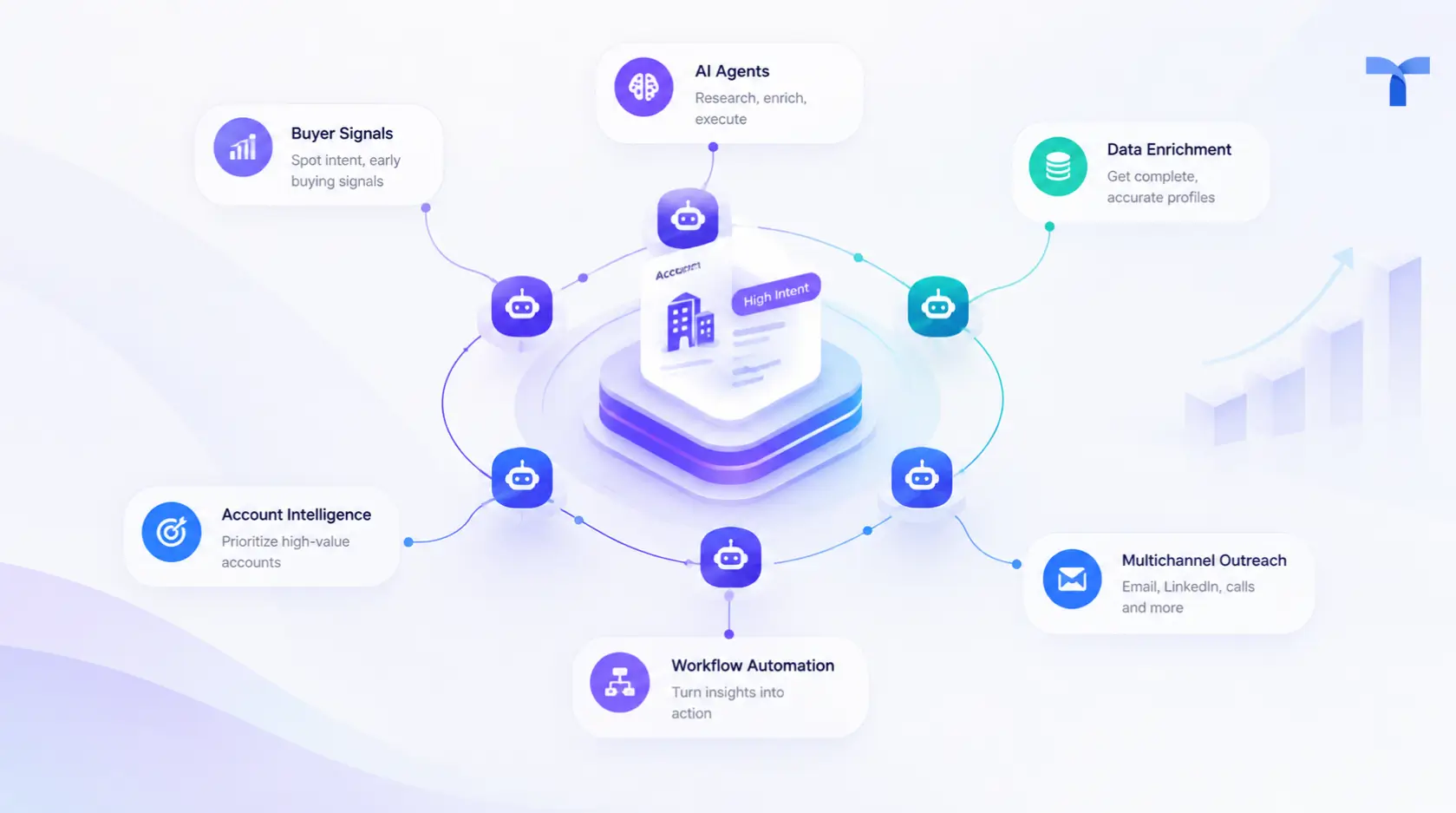
Agentic AI refers to AI systems that take autonomous, multi-step actions toward a goal without requiring step-by-step human instruction.
In a GTM context, this means AI agents that continuously monitor signals, enrich prospect data, make segmentation decisions, and trigger personalized outreach all within a connected workflow. Unlike traditional automation (which executes fixed rules), agentic AI reasons across multiple data inputs and makes classification decisions in real time.
When a job change signal fires at a target account, an agentic system does not just log it. It scores the account, identifies the right contact, generates a persona-aware message, and routes outreach to the correct channel in minutes.
5 Real Ways Agentic AI Is Changing GTM Execution
The examples below are drawn from Tapistro's use cases and customer success stories.
1. Scaling Outbound Without Scaling Headcount
The situation: A mid-market SaaS SDR team was spending most of the workweek building lists and researching leads that never converted. Headcount was the bottleneck for pipeline volume.
How agentic AI solved it:
- Built account lists directly from deanonymized web traffic and data sources, filtered to ICP in real time
- Tap AI Agents enriched each account with contacts, tech stack, hiring signals, and funding activity
- A Classification AI Agent micro-segmented accounts into ICP tiers (Tier 1, 2, 3) automatically
- Personalized email sequences launched 1:1 from individual rep mailboxes - not bulk sends
- Step-level reporting gave the team full pipeline visibility, no manual tracking required
SDRs stopped building lists entirely and started running personalized multi-channel sequences at volume. Pipeline grew without growing headcount. The constraint shifted from people to ICP definition - which is exactly where it should be.
This is the core pattern agentic AI enables: headcount-limited outbound becomes AI-scaled outbound.
See the full play: Automated Outbound at Scale
2. Solving the Account Research Bottleneck Before It Kills Pipeline
The situation: A sales team serving IT services clients could manually research 20 accounts per week. Their TAM had thousands of targets. Sellers were going into calls underprepared, intel quality was inconsistent, and the research backlog was blocking the entire funnel.
How agentic AI solved it:
- Tap AI Agents analyzed each account's tech stack to identify cost and redundancy opportunities relevant to the pitch
- Open roles were reviewed to infer hiring intent and likely operating model changes
- Investor decks were parsed to surface the financial pressure points most relevant to the conversation
- Fine-tuned AI agents condensed findings into rep-ready briefs
- A unified account view merged CRM history with real-time intel in one place
- Personalized call scripts were generated per account, per persona automatically
Every seller entered every call with standardized, accurate context regardless of which account they were covering. The research backlog stopped being a conversation at every pipeline review.
Research was the last major manual dependency in an otherwise digital sales process. Removing it changed funnel velocity entirely.
See the full play: Deep Account Research at Scale
3. Acting on Buying Signals in Real Time - Not Three Weeks Later
The situation: A SaaS company was investing heavily in paid search and organic content. Healthy traffic, zero visibility. Paid retargeting was the only lever, and it was getting more expensive with diminishing returns. High-value visitors left without any follow-up.
How agentic AI solved it:
- Person-level de-anonymization identified visitors at the individual level, not just the company level
- A CRM filter automatically removed existing customers, open deals, and competitors from the pool
- Each visitor was enriched with job posting data, hiring status, geo, and industry signals
- Over 20 micro-segments were created, each receiving a distinct multi-channel sequence
- Email, LinkedIn Ads, and calling cadences ran fully automated, 24 hours a day, 7 days a week
- No manual intervention required after initial setup
The entire motion ran around the clock without manual intervention. More meetings got booked without touching the ad budget -because the traffic was already there, it just wasn't being acted on.
A prospect who visits your pricing page at 11pm is not waiting for a next quarter follow-up. Agentic AI closes the gap between intent and action.
See the full play: Convert Website Visitors into Pipeline
4. Turning 40,000 Event Attendees into Active Pipeline Within Days
The situation: A manufacturing company walked away from a major industry event with 40,000+ attendee names. The data was raw: no domains, no job titles, incomplete records. They had two weeks before recall faded. Manual processing was not an option.
How agentic AI solved it:
- Raw attendee records were uploaded and Tap AI Agents enriched every record with company, title, email, and phone
- Custom industry classification was applied to niche verticals (e.g., separating manufacturers from dealers within the same broad category)
- Records were micro-segmented by ICP match, geography, and persona type
- Industry-specific email campaigns launched within days, not weeks
- High-value ICP accounts were immediately routed to calling cadences
No leads went cold. The team had ICP-matched accounts in active sequences within days of leaving the venue - at a scale that would have taken weeks manually, if it happened at all.
For manufacturing and enterprise GTM teams where relationships and timing drive conversion, this speed was previously impossible without a large ops team standing by post-event.
See the full play: Event Attendee Follow-Up
5. Capturing Competitive Displacement Before the Window Closes
The situation: A Dev Tools SaaS company learned a major competitor was exiting the market with a hard deadline. They needed to reach 1,000+ ICP accounts fast with coordinated multi-channel outreach. Their team could not move fast enough manually.
How agentic AI solved it:
- Real-time signal collection identified all accounts currently using the exiting competitor
- Waterfall enrichment instantly found the right contact at each account
- ICP tiers were segmented: high-intent accounts received direct calls; mid-tier got email + LinkedIn; awareness-stage prospects received webinar invitations
- CTAs were tailored to audience readiness not generic blasts
- The entire motion launched in days, not weeks
The team moved before competitors realized the window was open. Conversations started within days, not weeks after the news broke. That timing was the entire advantage.
When orchestration is already in place, the decision timeline compresses from weeks to days. The speed itself is the moat.
What Structurally Changes in GTM When Agentic AI Is Running?
Across all of these examples, five consistent shifts appear in the GTM motion.
1. The research bottleneck disappears. Research that once required analysts or burned SDR time runs continuously in the background. Cognitive bandwidth shifts from data preparation to prospect conversations.
2. Signal response time drops from days to minutes. Job changes, website visits, LinkedIn ad engagement, and competitive triggers are acted on automatically - while intent is still hot.
3. Segmentation becomes dynamic. ICP scores update in real time as new signals arrive. Teams stop chasing a segment defined 12 months ago that no longer reflects who is actually buying.
4. Outbound scales without proportional headcount growth. The constraint is no longer the number of SDRs. It is the quality of the ICP definition and the richness of signal data feeding the agents.
5. GTM becomes a 24/7 operation. Automation runs across time zones, without Monday morning lag, without campaign launch delays, without data sprints before each campaign.
What Does Agentic GTM Require to Work?
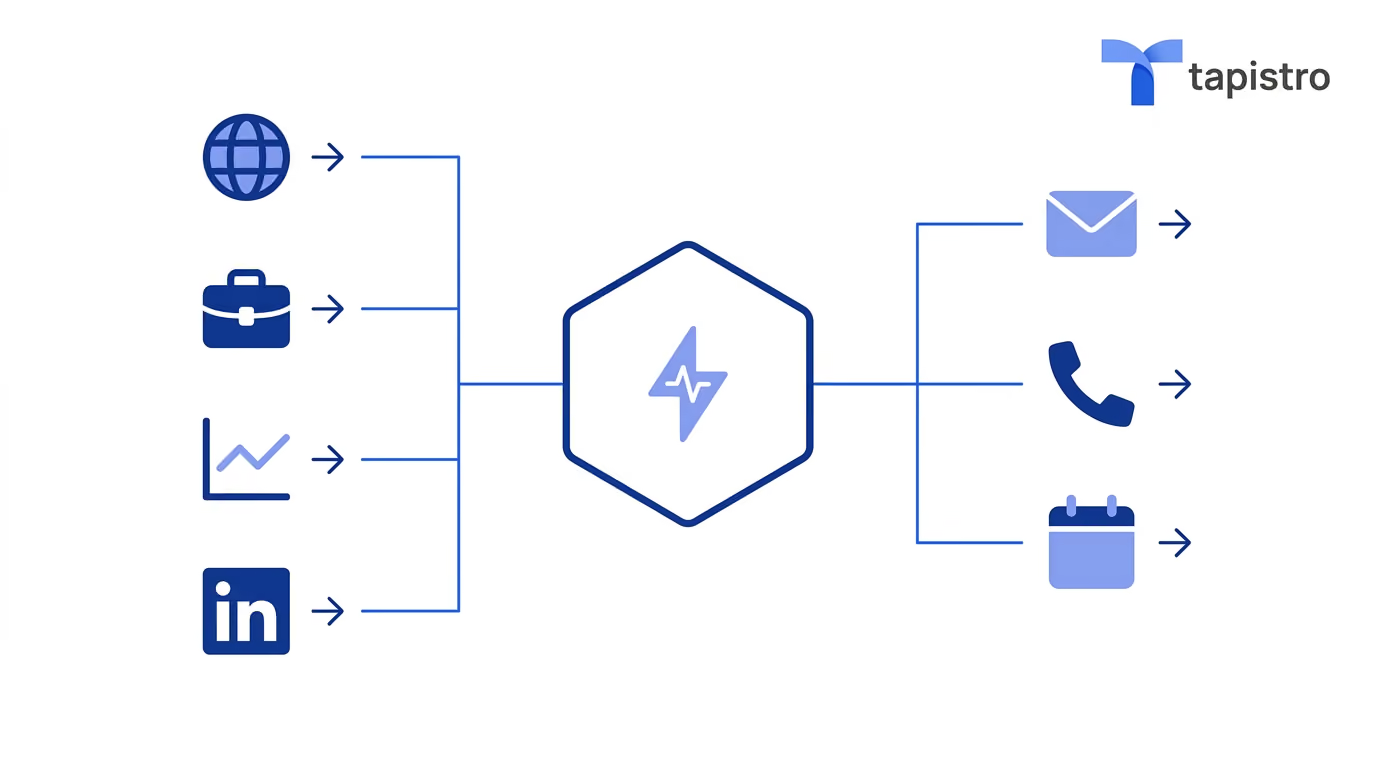
Unified signal data. Agentic AI needs to pull from multiple sources simultaneously - CRM, website behavior, third-party intent, job postings, LinkedIn, news, and funding events. Tapistro connects 70+ signal sources into a single Unified Prospect Profile. Fragmented data produces fragmented decisions.
A layered ICP definition. Static firmographic ICP definitions (industry + headcount) do not give agents enough to reason on. Effective agentic GTM layers in behavioral signals, tech stack attributes, and company change events.
A connected orchestration layer. Agents need to be able to act: send emails, update CRM records, trigger Slack alerts, run LinkedIn sequences, and route to paid media. Disconnected tools create handoff failures that cancel out the speed advantage entirely.