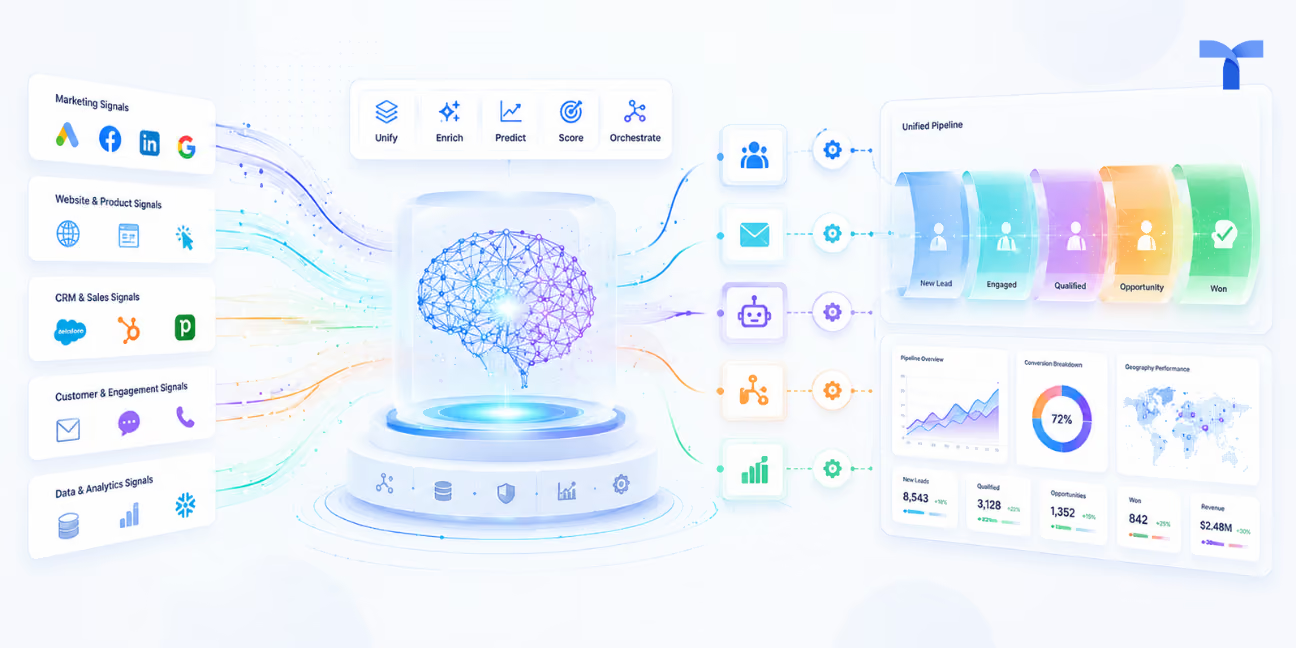
The best AI GTM platform for intent-based outreach is the one that checks intent against everything else you know about an account before anyone writes to it. Tapistro is built around that check. It reads intent at the account and the person level and puts it on one record with your account and contact data. Then it qualifies with your team's logic and hands the result to your existing stack.
In Forrester's Buyers' Journey Survey, 2025, 68% of B2B buyers had a front-runner vendor in mind when they started a purchase, and 80% of them chose that vendor (Forrester). A research spike can't tell you whether you're that vendor. The account's history can.
Why Isn't Intent Data Enough to Start Outreach?
Intent data is a record of research activity. At the account level, it shows that a company is reading about a topic. At the person level, it shows which persons at that company are doing the reading. Each record usually carries the topic, an intent score for how strong the activity is, and the date of the latest activity. That tells you where interest exists and how fresh it is.
It doesn't tell you whether the company fits your ICP, whether it's already a customer, or whether the person reading is someone you sell to. A current customer, a company that churned last year and a perfect-fit prospect can all research your category in the same week. The person behind the activity might be the economic buyer, an intern or a competitor's employee. Forrester lists this among the most common intent data mistakes: intent data on its own should not replace qualification (Forrester).
Four checks sit between intent data and the right outreach.
- ICP qualification - Does the account fit? Check firmographics and technographics against your ICP, then check the CRM. Customers, accounts in open deals and accounts contacted last week get suppressed before they reach a queue.
- Persona logic - Is the person researching someone you sell to? Match their title, department and seniority against your personas. When the researcher isn't the buyer, find the persons who are and add them to the buying group.
- Scores - How strong is the case? Combine the intent score, how recent the activity is, ICP fit, and how many persons at the account are researching. Intent from two sources, or from three persons at one account, should rank above a single spike.
- Correct action - What should happen next? A high-fit account with several persons researching goes to a sequence. An account in an open deal alerts its owner instead. A lower-priority account goes to an ad audience or a nurture program. Each action runs in your existing stack, and the decision stays on the record for the next campaign.
The Best AI GTM Platforms for Intent-Based Outreach
The descriptions below follow each vendor's own website and announcements as of November 2026. The "where it stops" lines are our reading of each platform.
1. Tapistro
What it is - An agentic GTM platform for building self-improving GTM systems. It covers the data foundation, AI agents, orchestration and reporting, and intent-based outreach is one motion it runs.
How it handles intent - Tapistro reads intent wherever it shows up, at the account and the person level (Tapistro Help Center):
- Offsite intent - Accounts and persons researching a topic or a competitor's domain across the web. Each record carries an intent score, the reason behind it and the date of the latest activity.
- Review sites - Accounts comparing products in your category.
- Your website - Identified persons and de-anonymized accounts reading your pages.
- Events - Persons who registered for or attended your webinars and hosted events, and persons attending industry conferences.
- Ads and email - Persons and accounts engaging with your ads, and persons opening and clicking your emails. Person-level ad engagement can alert the rep who owns an active deal.
Every account and person in Tapistro has one profile, so intent lands next to firmographics, technographics, contact data and CRM history.
Tapistro's AI agents, built for GTM use cases, then research each account and person against your team's qualification logic. They classify it, answer the research questions you set, score it and draft messaging using your Brand Context.
Teams can start a Journey three ways. They can begin with a list and let intent set the order. They can start from a signal, such as accounts or persons researching their category, with no list at all. Or they can wait for two or more signals together, such as intent from two sources or several persons at one account researching at once.
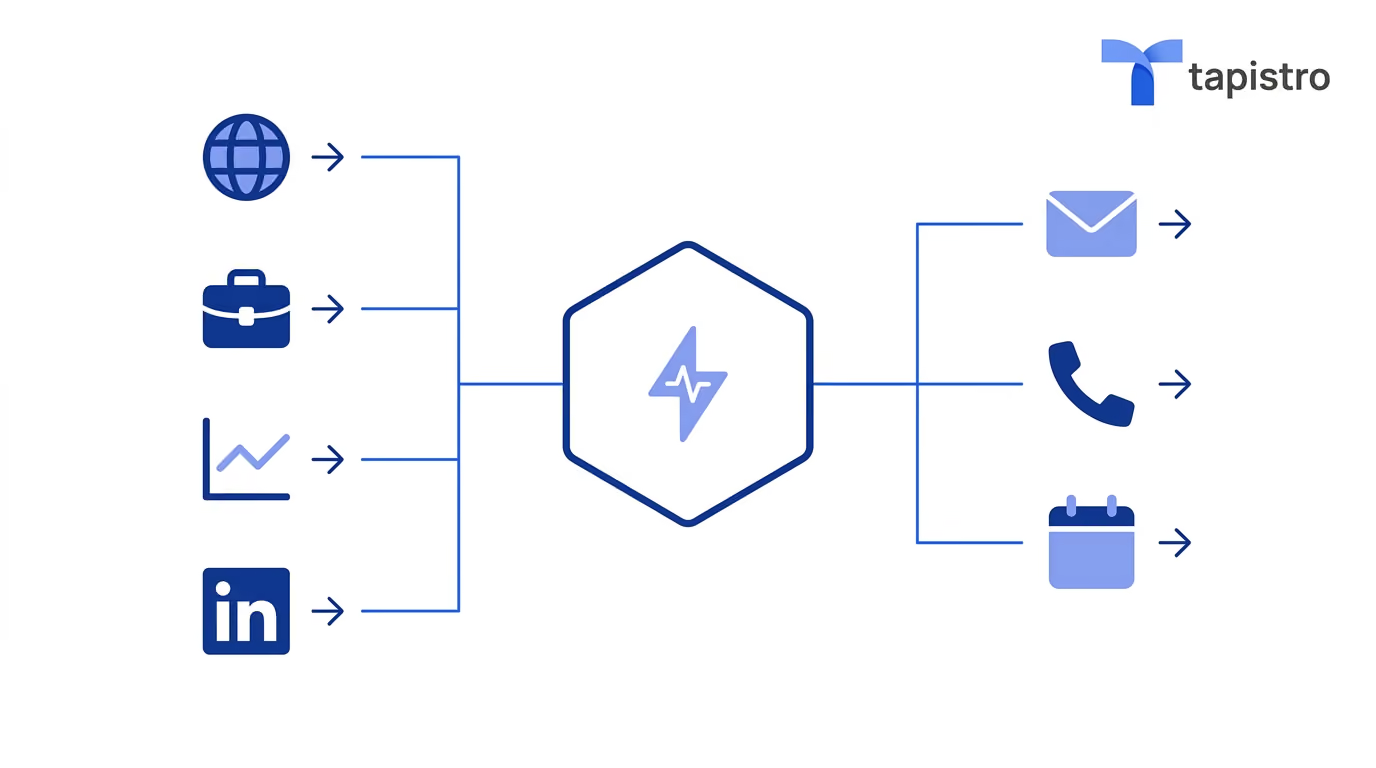
What happens next - Tapistro decides, writes and syncs. Contacts and messaging go to your sequencer, LinkedIn steps run through your LinkedIn automation tool, and ad audiences sync to your ad platforms. Reps get alerts in their chat tool, and results write back to your CRM and marketing automation platform.
Where it stops - Tapistro doesn't send email itself. You can connect any sequencer, so the send happens in the one your team already uses, and Tapistro doesn't charge per action.
2. 6sense
What it is - 6sense describes itself as a partner for agentic GTM, built on predictive models and buying stages. Teams commonly use it for account-based marketing: spotting which accounts are in market and predicting how close they are to buying.
How it handles intent - Intent feeds 6sense's models, which assign each account a predicted buying stage.
Where it stops - A buying stage is an estimate of where an account sits. It doesn't confirm the specific facts your team uses to qualify, and outreach runs through 6sense's own email agents and advertising. See Tapistro vs 6sense.
3. Demandbase
What it is - Demandbase calls its AI layer "the pipeline engine for AI GTM." Teams commonly use it for account-based marketing: finding in-market accounts and targeting them with account-based ads.
How it handles intent - Intent sits inside Demandbase's account intelligence and buying group data.
Where it stops - The work it activates runs mostly inside Demandbase: its ad platform, site customization and programs. Tapistro reads Demandbase as one of its intent sources. See 6sense vs Demandbase vs Tapistro.
4. ZoomInfo
What it is - ZoomInfo describes itself as an all-in-one AI GTM platform. It's built on a company and contact database, with Agent Teams and seller workspaces on top. Teams commonly use it to look up company and contact data for prospecting.
How it handles intent - Buyer intent is attached to ZoomInfo's own records.
Where it stops - ZoomInfo's agents work from ZoomInfo's fields. When qualification depends on facts no vendor tracks, such as a recent pricing page change or a specific compliance requirement, a database record has no answer. Tapistro uses ZoomInfo as one enrichment and intent source and researches what the fields don't cover. See Tapistro vs ZoomInfo.
5. Apollo
What it is - Apollo describes itself as an AI GTM system that unifies data, intelligence and execution. Teams commonly use it to find contacts in its database and send email sequences to them.
How it handles intent - Intent lives in Apollo's own data layer, next to its contact database.
Where it stops - Data, agents and sequences all stay inside Apollo, so teams that already run a separate sequencer end up with a second engagement layer.
6. Unify
What it is - Unify describes itself as "Claude for Outbound Sellers," aimed at AEs and SDRs. Teams commonly use it to run outbound sequences that start when an account shows activity.
How it handles intent - Unify's Plays trigger on account activity and enroll buyers into Unify's own sequences.
Where it stops - The result stays inside an individual seller's tool rather than a record the whole team works from.
7. Clay
What it is - Clay describes itself as the infrastructure GTM engineers build on. Teams commonly use it to build custom data enrichment workflows in spreadsheet-style tables.
How it handles intent - Intent comes in through tables and workflows your team builds and connects.
Where it stops - Someone has to build and maintain each table and workflow, and research done in one doesn't carry into the next unless you build that too. See Tapistro vs Clay.
How The Platforms Compare
What Should You Test Before You Buy?
Demos run on clean accounts. Intent problems show up on yours, so give every shortlisted platform the same set of your own accounts and run these tests.
The existing customer test - Pick a current customer that recently researched your category, and ask the platform what happens next. It should keep the account out of cold outreach. If the account has an open deal, the platform should alert the owner instead.
The person-level test - Pick an account showing intent and ask who at that company is doing the research. The platform should name the persons, with an intent score, the topic and the date of their latest activity, and tell you how many persons at the account are researching.
The buying group test - Ask what happens when the person researching isn't the buyer. The platform should match each researcher against your personas and find the decision makers who aren't researching yet.
The qualification test - Give the platform a question your team uses to qualify accounts, one that no data vendor tracks. It should research the answer for each account and show you sample results before anything goes live.
The two-source test - Ask whether an action can require intent from two sources together, such as offsite research and review-site activity, or several persons at one account. If every intent spike fires its own alert, you'll get volume without precision.
The action test - Ask where the outreach runs. The platform should send contacts and messaging to the sequencer, ad platforms and alert tools your team already uses, and write results back to your CRM and marketing automation platform.
The second campaign test - Run one campaign, then start a second on overlapping accounts. The second one should start from the research and decisions of the first. If it starts from zero, you're paying for the same work twice.
Conclusion
Every platform on this list acts on intent. Most keep that work inside their own data, models or sequences, and leave your team to connect it to everything else it knows.
Tapistro starts from that connection. Account-level and person-level intent share one record with your account and contact data. Tapistro's AI agents qualify each account and person with your logic, and the result flows into the sequencer, ads, CRM and MAP you already run. Because research and decisions persist, each campaign builds on the last one. That makes Tapistro the first platform to evaluate for intent-based outreach.
Want to see which of your in-market accounts are worth a rep's time? Book a demo.