
How Intent Data Was Born, and What Problem It Was Actually Solving
B2B buyers, long before they ever fill out a form or take a sales call, are doing significant research. They are reading comparison articles, visiting vendor websites, watching product demos, asking questions in community forums. That research leaves a digital trail. And if you could read that trail, you would know which accounts were actively evaluating your category before they ever announced themselves.
That was the founding premise of intent data. The question the first generation of platforms set out to answer was simple and powerful:
“Which accounts in my universe are actively researching my category right now, and how do I reach them before my competitors do?”
It was a genuinely important idea. And for over a decade, platforms like 6sense and Demandbase have built serious businesses answering it but are failing now as the patterns evolved.
The First Generation: Detecting Intent at the Account Level
The first generation of intent platforms, including 6sense and Demandbase, were built to answer a very specific question: which accounts are likely to be in a buying cycle?
They approached this problem by collecting large volumes of account-level research activity, scoring accounts using predictive models, and surfacing the highest-scoring accounts for sales and marketing teams to prioritize.
6sense built its platform around predictive AI models trained on historical CRM data and large-scale keyword research activity across publisher networks. The system analyzes patterns across past deals and attempts to predict which accounts are moving into a buying stage such as awareness, consideration, or decision.
Demandbase approached the same problem from a different direction, using advertising bidstream data and intent signals to identify in-market accounts and activate advertising campaigns against them.
These platforms were built in an era when the hardest problem was detecting intent at all. And they solved that problem well enough to build an entire category.
But they share several characteristics of first-generation intent technology:
- They rely heavily on keyword research and modeled intent
- Their scoring models are largely black boxes that teams cannot easily verify or tune
- They surface insights in dashboards that still require manual execution
- They were built before AI agents and autonomous workflows were possible
In other words, they were designed to detect intent, not to run go-to-market execution.
From Predictive Black Boxes to AI-Native GTM Systems
The first generation of intent platforms were predictive systems. They looked at historical data and tried to predict which accounts might enter a buying cycle.
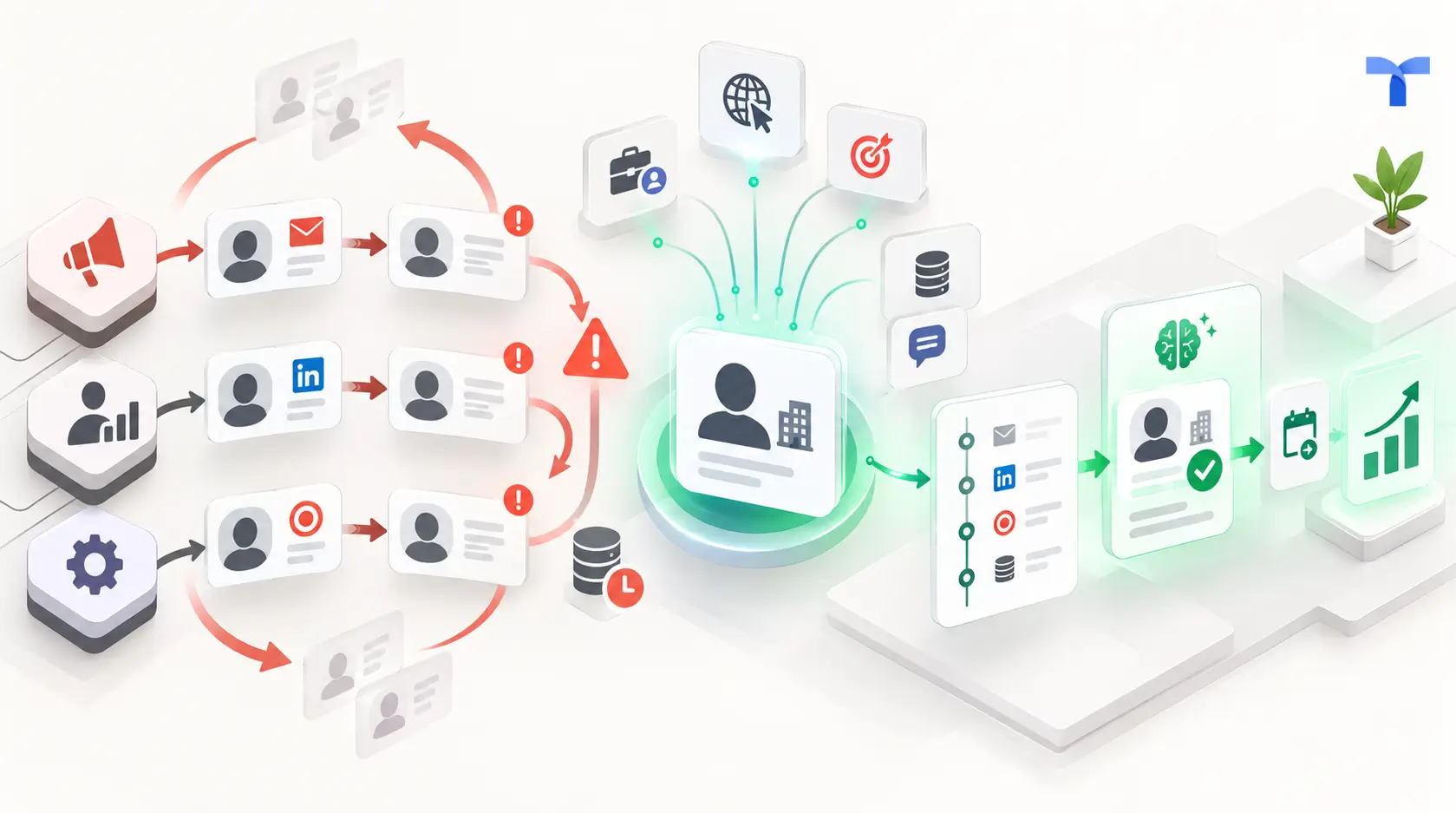
The new generation of GTM platforms such as Tapistro, is AI-native and agentic. Instead of only predicting who might buy, these systems monitor live signals, continuously update account intelligence, and automatically execute go-to-market actions when signals appear.
The GTM Motion Has Changed. The Infrastructure Has Not.
Over the same decade that intent data matured, the way B2B GTM teams operate changed dramatically. Headcount-per-pipeline-dollar became the metric every RevOps leader was measured against. Signal sources multiplied well beyond web research: job postings signaling technology investment, LinkedIn activity surfacing buying committee movement, G2 reviews indicating active vendor evaluation, CRM decay quietly eroding the quality of the data underneath every campaign.
The modern RevOps or Sales Ops leader is not struggling to find intent signals. They are drowning in them, spread across tools that do not talk to each other. The bottleneck shifted from detection to execution. Your team knows an account is interesting. Now what? Research it manually. Enrich the contacts. Write personalized outreach. Push it into a sequence. Follow up. All of this before the window closes and the account moves on.
That operational gap, between signal recognition and pipeline action, is the problem the first generation of intent platforms was never designed to solve. It is also the problem Tapistro was built specifically to close.
Tapistro: Where Signal Intelligence Meets Autonomous Execution
Tapistro is not a better version of 6sense or Demandbase. It is a different kind of system, built around the premise that detecting intent and acting on it should be a single motion, not two separate workflows with a human handoff in between. That makes it a far superior tool than any of these traditional tools.
Broader signals, by design
Most intent platforms rely heavily on keyword activity and content consumption signals. Tapistro was built with a wider signal architecture from the start. The platform brings together multiple types of first-party, second-party, and third-party signals - including product usage, marketing engagement, buying committee activity, hiring signals, technographic changes, public data, and partner ecosystem data -to build a more complete picture of account readiness.
This is not meant to be an exhaustive list of signals, but rather a different philosophy: buying intent rarely appears in a single keyword spike. It appears as patterns across data sources over time.
The result is a Unified ICP and buying posture view that captures signals most teams miss:
- Hiring acceleration that signals upcoming technology investment
- Research behavior happening on third-party platforms before website visits
- Engagement patterns that identify potential champions early
- Technographic or organizational changes that create new opportunity windows
Instead of isolated intent events, teams see account momentum.
From scoring to acting: the shift that matters operationally
When signals converge on a target account, Tapistro does not just generate a score and stop there. Scoring still plays an important role for prioritization, routing, and segmentation but scoring alone does not create pipeline.
This is where Tapistro becomes an execution system, not just an intelligence system.
When an account crosses a threshold or matches a signal pattern, Journey Canvas workflows and AI Autopilots can activate automatically. Outreach, enrichment, routing, audience building, and account research can all be triggered based on signal conditions, without waiting for a rep to review alerts or manually launch campaigns.
This changes the operational model for RevOps and GTM teams.
Signals are no longer dashboards to monitor- they become triggers that move accounts forward automatically.
Tapistro therefore functions as both a signal intelligence layer and an execution layer, allowing teams to:
- Activate campaigns based on real account behavior
- Enrich and qualify accounts continuously
- Trigger outreach and journeys
- Route accounts to the right owners
- Score and prioritize accounts
The signal and the execution are part of the same system.
What this looks like in practice
A mid-market B2B software company identified a cluster of target accounts showing multiple buying signals within a short period: increased activity on third-party review platforms, new job postings related to the category, and multiple employees from the same accounts visiting product pages.
In a traditional workflow, this would have resulted in a notification in an intent dashboard. A RevOps or marketing team member would need to review the accounts, enrich contacts, brief an SDR, and build a sequence before outreach could begin. By the time outreach started, the buying window might already be closing.
With Tapistro, those signals automatically triggered account enrichment, contact identification, and personalized outreach sequences referencing the relevant signals. Outreach began within hours of the signals appearing, not weeks later after manual research and list building.
The operational impact was clear:
- Outreach launched the same day signals appeared
- Reps spent less time on research and list building
- More conversations started while accounts were actively researching
- Pipeline was generated from accounts that would otherwise have remained in an intent dashboard
Which Question Does Your Team Most Need Answered?
The right framing for any RevOps or Sales Ops leader evaluating these platforms is straightforward: none of them is a direct substitute for the others, and the right answer depends entirely on where your current GTM motion is breaking down.
If the problem is prioritization across a large account universe
You have thousands of ICP accounts and need to know which ones are worth attention right now. Platforms like 6sense and Demandbase were built for this era. They monitor research activity and keyword behavior and tell you which accounts appear to be researching your category.
But what they actually give you is not intelligence.
They give you a signal that someone at that account might be interested.
They do not tell you:
- Who exactly is involved
- What triggered the interest
- What changed at the company
- What message to send
- What action should happen next
They give you a score, a stage, or an intent spike. Then your team has to figure out everything else manually.
So you end up with a dashboard full of “in-market” accounts and a team that still has to research accounts, enrich contacts, write outreach, and build sequences before anything actually happens.
That is not a go-to-market system.
That is a signal dashboard.
If the problem is turning signals into pipeline
Most GTM teams today do not struggle to find some or the other signals. They are overwhelmed with signal noise across multiple tools. The real bottleneck is turning those signals into outreach, conversations, and pipeline quickly enough.
This is where Tapistro is fundamentally different.
Tapistro does not just tell you that an account is showing interest. It builds account intelligence continuously, identifies the right contacts, understands what signals are happening, and can automatically trigger enrichment, routing, and personalized outreach when those signals appear.
For outbound-led and signal-led GTM teams, this is not just an incremental improvement over earlier intent platforms. It represents a different operating model one where signal detection and execution are part of the same system rather than separate workflows connected manually.
Side-by-Side: The Honest Comparison
The Bottom Line
Intent data was a transformative idea in B2B GTM. The first generation of platforms proved the concept and built real, lasting businesses on it. They answered the question their era was asking: who is in-market?
The question GTM teams are asking now is harder. Not just who, but what do we do about it, immediately, at scale, without adding headcount or stitching more tools together.
That is a different question. It requires a different kind of system. And it is precisely the question Tapistro was built to answer.




.webp)