If you sell to commercial cleaning companies or to bars with a liquor license, your contact database may have no filter for your market. B2B list building for a market like that can mean a keyword search, then rounds of clean-up on whatever comes back. Enriching companies as you go can cost credits on top. Before any of that, spend twenty minutes finding where your TAM is already written down. Sometimes it turns out to be a database filter you hadn't tried. In two of the three markets we measured in September 2026, it was a public record (California's public works registry in one, the FDA's warning letters in the other). When a record like that exists, build from it. Your database handles ICP fit from there, while the record's date shows who is dealing with the problem right now.
The reason is how databases get built. A database can filter only on facts its builders chose to store, long before you ran your search. Much of what puts a company in a particular TAM was never among those facts. Whether a company holds a government construction contract, or whether a regulator cited it last month, is the kind of detail that rarely gets a field. One person on r/revops, the Reddit forum for revenue operations, described how they patch that gap by hand: "we sell to companies who serve ENT & MM. There's no filter for that in [a contact database], so we searched for any contact with an ENT title, then did a =unique in Sheets."
Below you'll find what we counted in a widely used B2B contact database in September 2026, the three questions every TAM list has to answer, and a four-check test for B2B list building you can run on your own market. We then run the test end to end on FDA warning letters, show the one market where the database alone was enough, and answer three common questions.
What we found in one widely used database in September 2026
All counts come from a trial account. We used searches only and spent no credits. We did not test the database's AI filters or signals (either could change the numbers below) or any other database.
8 of 13 "prevailing wage" results weren't contractors
In California, prevailing wage is the pay rule for government construction jobs. On 30 September 2026 we searched the database for California construction companies using the keyword "prevailing wage" and got 44 results. We read the first 13 by name. Eight were compliance consultants and trade associations that sell to contractors. No field in the database tells them apart.
A contractor paying prevailing wage and a consultant helping contractors pay it both mention the same phrase. A keyword search can't tell them apart. Because of that, somebody on your team has to read every name on a list built from that keyword before the list goes anywhere near sales.
Two lists the same size held different companies
On 30 September 2026 the database returned 35,884 California construction companies. That same day, the state's public works registry listed about 37,000 contractors approved for government construction work.
Totals that close invite you to assume they describe the same companies. We checked. We drew 50 approved contractors from the registry at random and searched the database for each one by name, within California. The database had 23 of them. For another 25 we found nothing, while two we couldn't call either way. With only 50 in the sample, read the result as anywhere from about a third to three fifths. At either end, a large share of the contractors doing government work in California are missing from the database we tested. The totals match by coincidence.
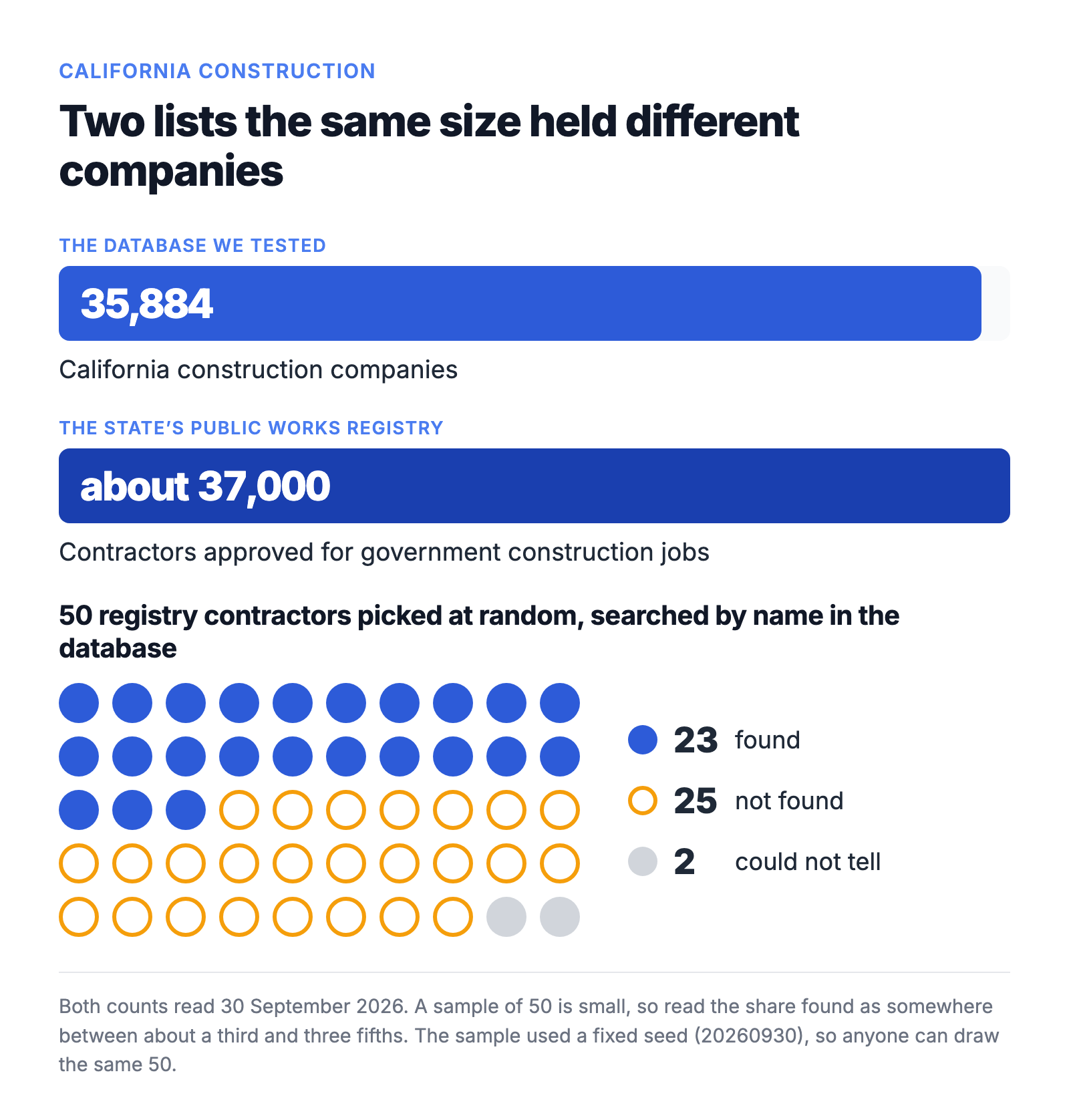
Our random number generator used a fixed seed (20260930). Anyone can draw the same 50 and check our count.
The three questions every TAM list has to answer
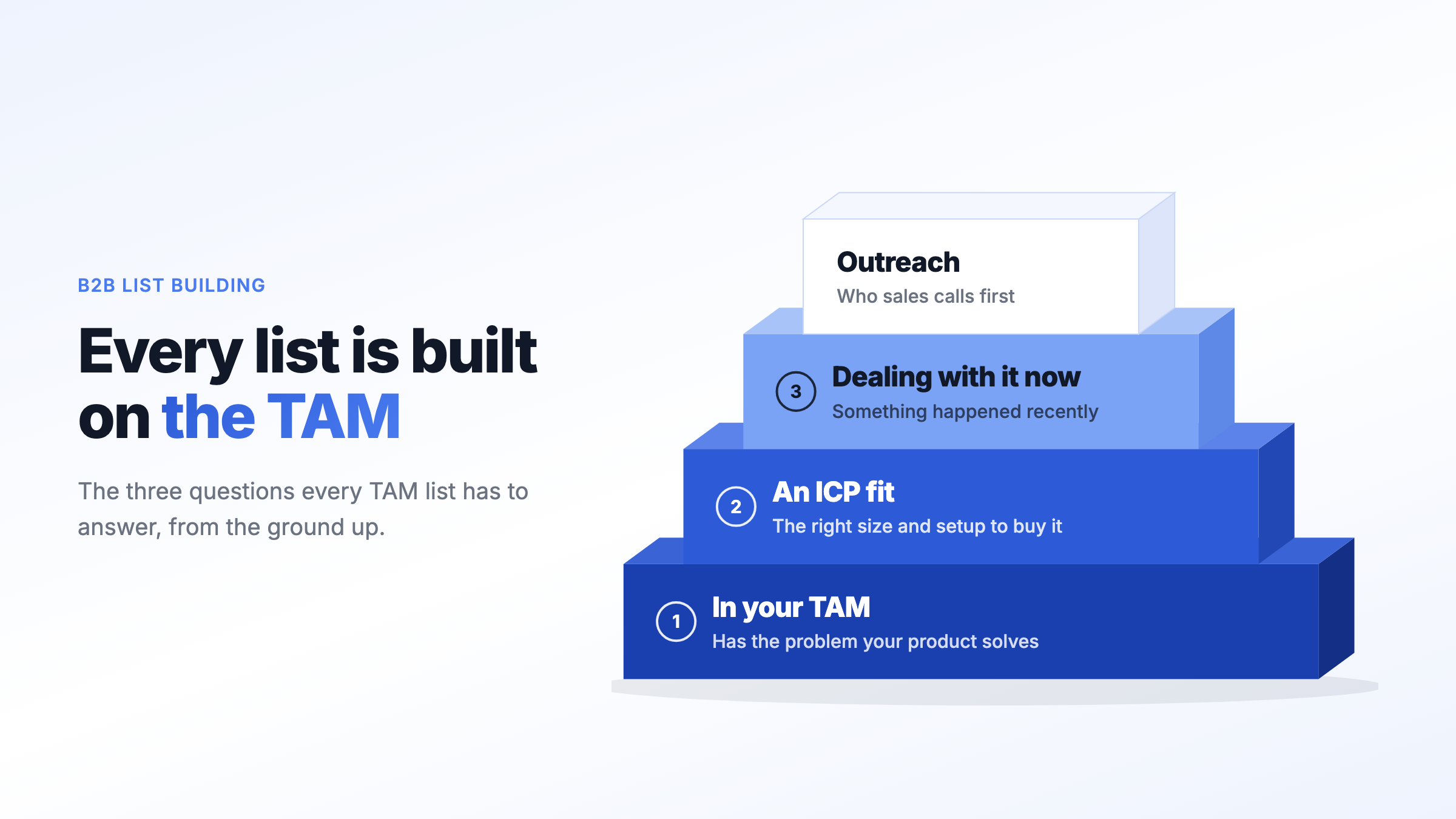
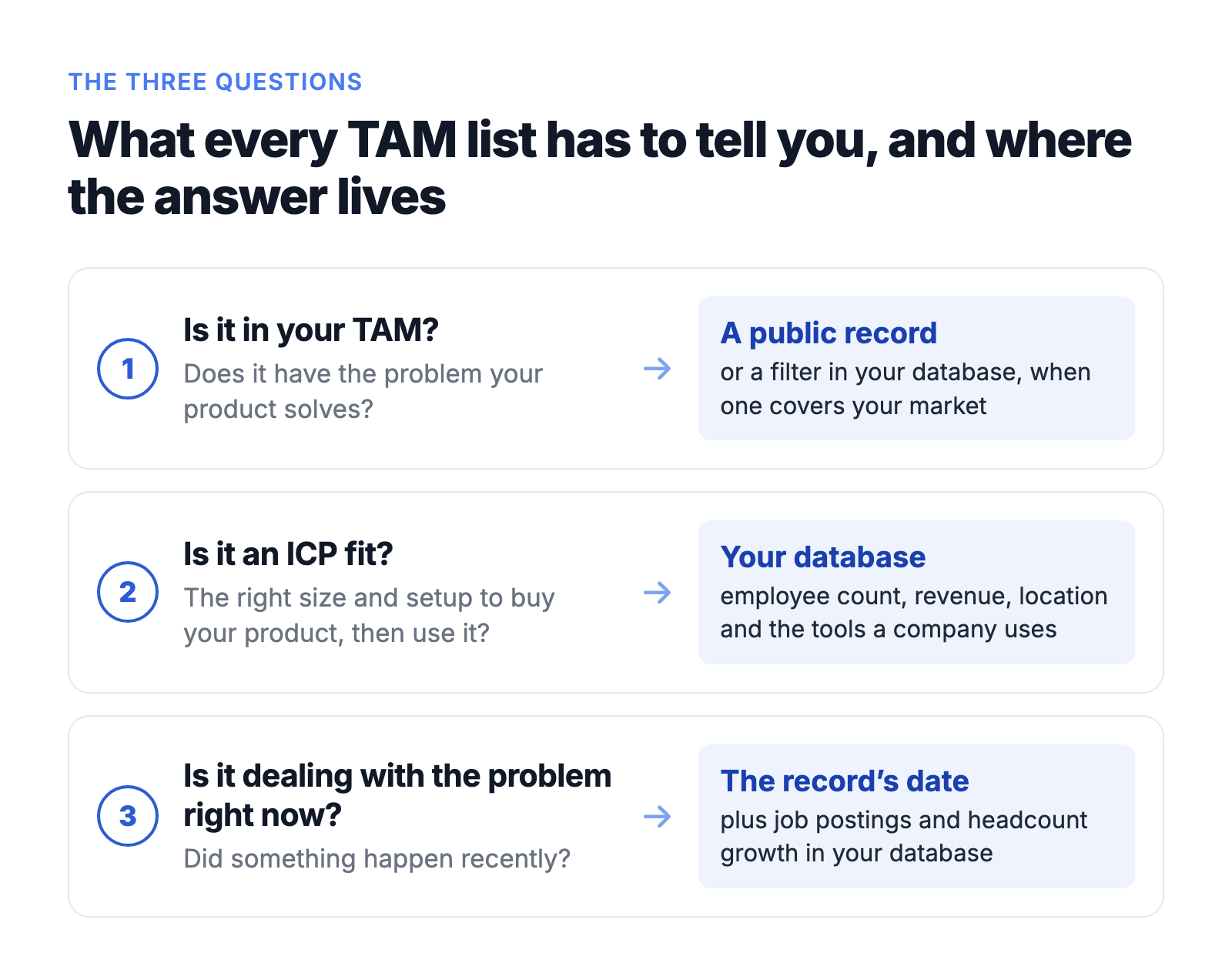
For each company on it, a TAM list needs to answer three questions:
- Is it in your TAM? Does it have the problem your product solves?
- Is it an ICP fit? Is it the right size and shape to buy your product and use it?
- Is it dealing with the problem right now? Has something happened recently that makes this the time to reach out?
A public record tends to answer the first question and sometimes the third as well.
Your database answers the second. It was built to store employee count, revenue, location and the tools a company uses, the same facts that decide whether a company can buy your product and put it to work.
The B2B list building test: four checks in about twenty minutes
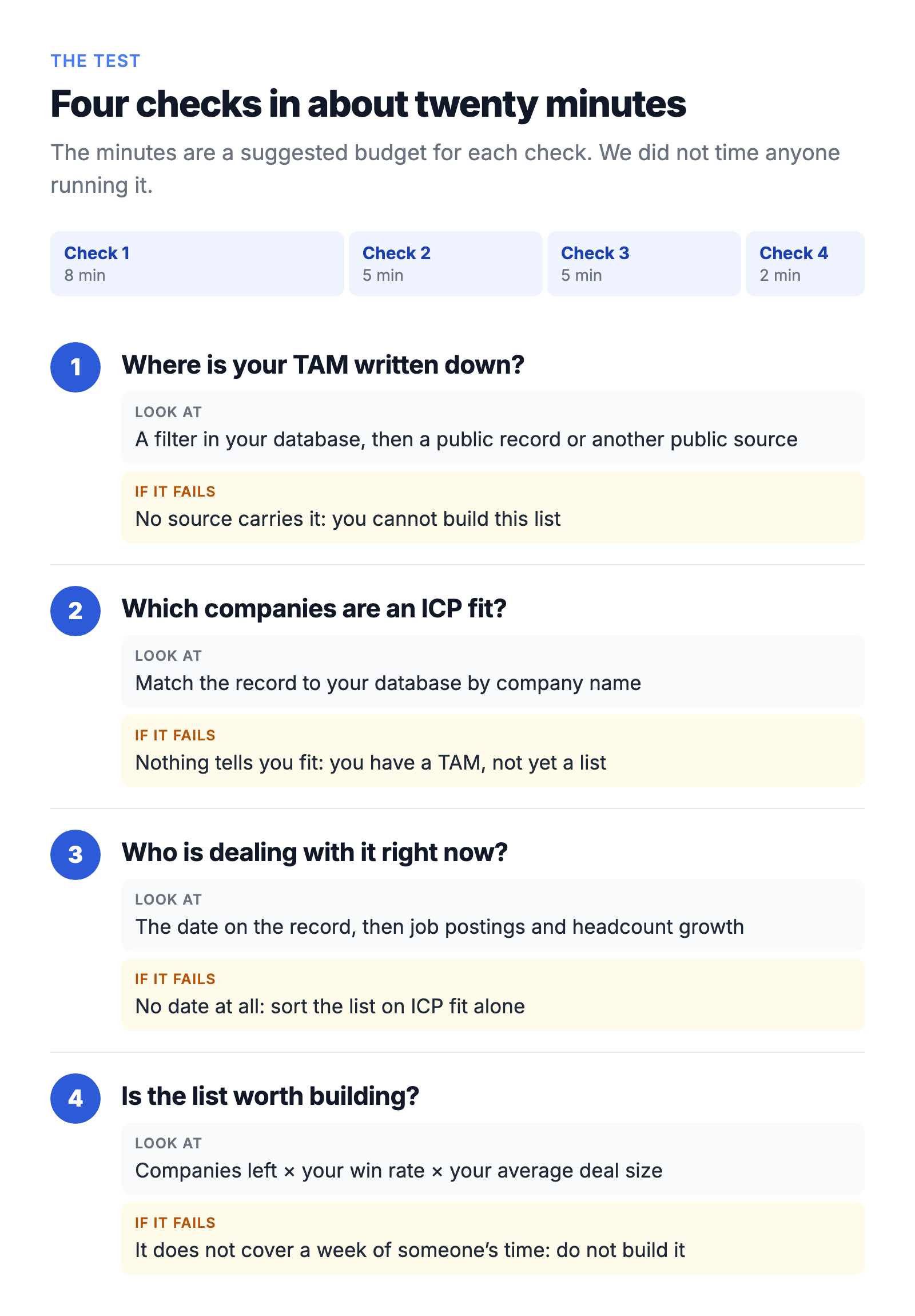
Give the whole test about twenty minutes. The minutes beside each check are a suggested split. We did not time anyone running it.
Check 1 (about eight minutes): where is your TAM written down?
Start by writing one sentence a salesperson could say out loud about why a company belongs in your TAM. "Regulatory compliance posture" fails. "They are on an active government construction job that requires certified payroll filings" passes. It also points straight at a record. In California, contractors on public works jobs file certified payroll records with the state unless the job is exempt. Small projects are exempt: up to $25,000 for new construction, alteration, installation, demolition or repair, and up to $15,000 for maintenance (dir.ca.gov, read 12 October 2026).
Check your database for a filter before anything else. Some markets that sound hard to filter already have one, as the software market further down shows. If a filter covers your sentence, build the list there.
When no filter does, look for a public record or another public source that carries the fact, such as company websites, filings or product pages. Then confirm you can get the data out. Some sources make that quick and some make it slow:
- Easy: FDA warning letters. Filter on the last 90 days, then download once.
- Workable: California's public works registry, live at services.dir.ca.gov/pw. Its best-known older address is dead and its first page of results shows test entries. Plan the same clean-up you'd run on any list load.
- Hard: any source that only lets you look up one company at a time.
Check 2 (about five minutes): which companies on the record are an ICP fit?
Base ICP fit on your closed-won deals. If you haven't written your ICP down from those deals yet, our guide to knowing your ICP walks through how.
Then match the record to your database by company name and filter on firmographics such as size, revenue and location, plus the tools a company already uses. That step is account enrichment. It reaches only the companies your database already holds. On a long record like the registry, match a random sample by name before you trust the whole thing. The database we tested had 23 of our 50 randomly sampled registry contractors (sampled 30 September 2026). For the rest, ICP fit has to come from somewhere else, such as a call or the company's own website.
Look for a contact during the same match. A company name without a person attached is hard to hand to sales. In the FDA market, the database we tested held a quality or regulatory contact with a verified email for 17 of the 35 manufacturers (read 30 September 2026).
Check 3 (about five minutes): which companies on the list are dealing with the problem right now?
Look for a date. A dated record tells sales where the reason to call came from and why to call this week.
FDA warning letters carry their issue date. A contractor registration renews once a year and says nothing about whether the contractor is on a live job right now. Job postings and headcount growth in your database add a few buying signals as well.
Without a date, sales has no reason to call one company ahead of another.
Check 4 (about two minutes): is the list worth building?
Count the companies that made it through the first three checks. Multiply that count by your realistic win rate and your average deal size. As an illustration, 300 companies at a 5% win rate on the accounts sales works, with a $30,000 average deal, come to about $450,000 in closed business. Run this math before you spend a single credit on enrichment.
If the result doesn't cover a week of someone's time, don't build the list.
Worked example: running the test on FDA warning letters
We ran the full test on one market, software sold to drug and device makers for manufacturing quality, and read every count on 30 September 2026. Follow the same steps with your own record.
- Check 1, the sentence. "They are a drug, device or biologic maker that received an FDA warning letter about manufacturing quality in the last 90 days." The FDA's own warning letter database holds every letter behind that sentence.
- Check 1, the pull. We filtered the FDA's database to letters issued in the last 90 days and downloaded the result. On 30 September 2026 that came to 82 letters.
- Check 1, the TAM. We read each letter's subject line. Thirty-five went to drug, device or biologic manufacturers. The other 47 went to food, supplement and import cases, online peptide sellers, clinics, clinical investigators, farms and tobacco and vape sellers. The subject lines did the first round of fit work and left a TAM of 35 companies.
- Check 2, ICP fit and the contact. We matched the 35 to the database by name and found a clear match for 27. For 17, it held at least one quality or regulatory contact with a verified email. Those contact counts cover the whole company. At a large manufacturer, the contact may sit at a different site from the one that got the letter. Each of the 35 letters names a person, almost always the CEO, president or owner. Only one is addressed to a quality or regulatory manager.

- Check 3, right now. Sort by issue date. Every company on this list has one.
- Check 4, the math. Run your own win rate and deal size against the companies that survived. Thirty-five companies in 90 days makes for a short list.
The TAM sentence as a template. Fill in the brackets for your market: "They [hold, are on or received] [the record or the job] [in what window], which means [the problem you solve]." If the first half already names the problem, drop the last clause. Here are two filled in from this piece:
- Construction: "They are on an active government construction job that requires certified payroll filings."
- FDA: "They received an FDA warning letter about manufacturing quality in the last 90 days, which means a regulator has named a quality problem they have to fix."
The list layout. Give each company one row and keep the record on that row. The row below is illustrative (no real company):
B2B list building in three markets: construction, FDA warning letters and software
We tested three markets in September 2026. They came out too differently to share a single coverage figure.
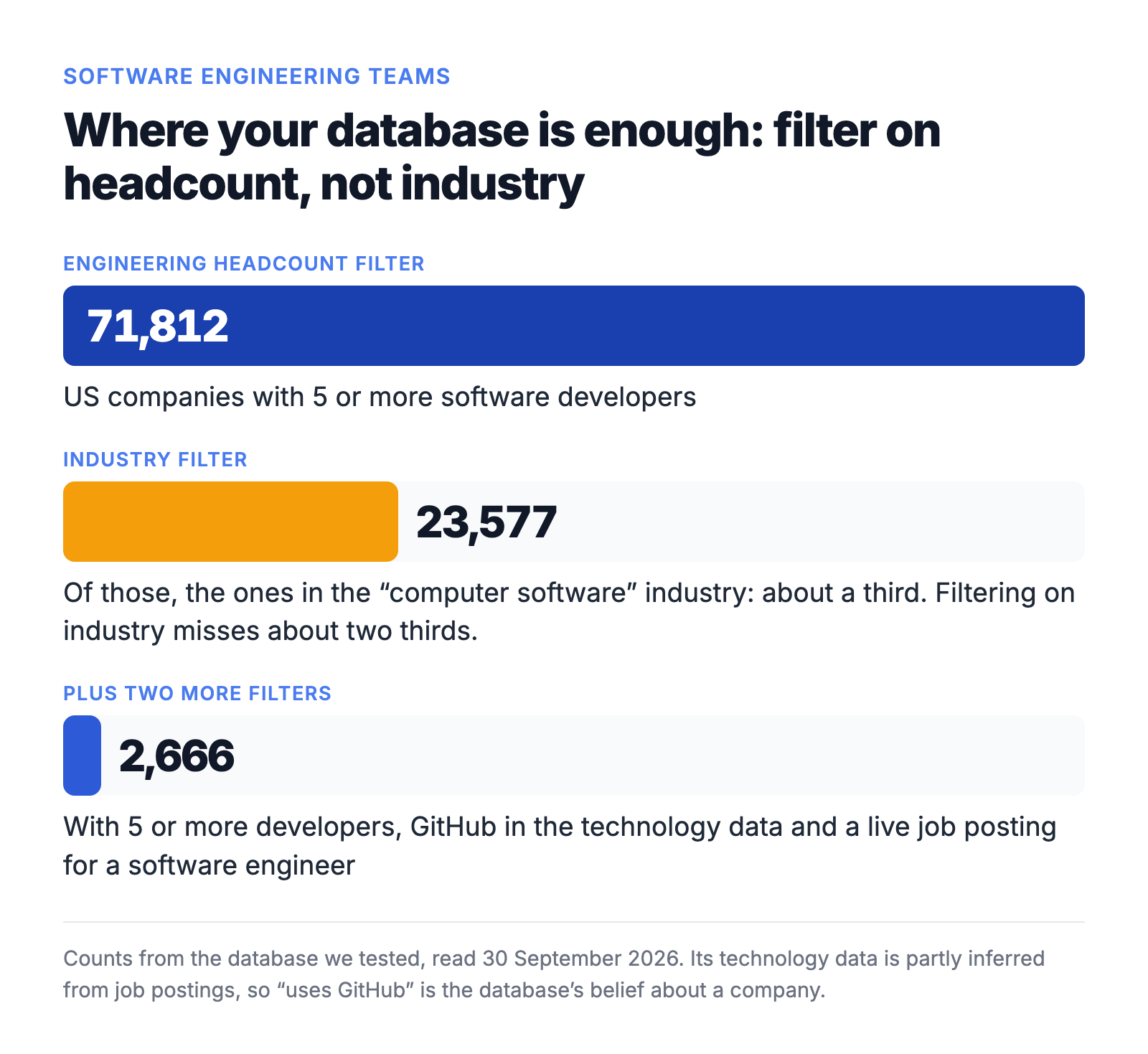
Where your database is enough: software engineering teams. On 30 September 2026 the database found 71,812 US companies with 5 or more software developers. Only 23,577 of them, about a third, sit in its "computer software" industry. If you sell to engineering teams, filter on engineering headcount. In the database we tested, filtering on industry missed about two thirds of them. Adding GitHub in its technology data and a live job posting for a software engineer narrows the list to 2,666 companies, with ICP fit and a right-now reason built in. That technology data is partly inferred from job postings. Treat "uses GitHub" as the database's belief about a company. In this market you can start and finish in your database without touching a public record.
What the finished list tells sales, and when not to build one
Four checks later you hold a TAM list, filtered for ICP fit and sorted by who is dealing with the problem right now. That still isn't a list of qualified prospects. Sales learns budget and authority in conversation. The list tells them which conversations to have first.
Skip the build entirely when a filter in your database already covers the market, or when Check 4 shows the list is too small to repay the work.
Four questions to ask any vendor who offers to build this list
- Can you show me the source behind any company on this list?
- How do you decide which companies fit my ICP and which are dealing with the problem right now?
- What happens to the list when the record changes next month?
- How much of my market does this miss, and how would I check?
Any vendor, including us, should be able to answer all four.
Common questions about B2B list building
How big should a B2B list be?
A B2B list should be as big as the number of companies in your TAM that fit your ICP, sorted by who is dealing with the problem right now. There's no target size beyond that count. To see whether it's worth building, multiply the count by your realistic win rate and your average deal size. If the result doesn't cover a week of someone's time, the list is too small. In the FDA worked example, 82 warning letters over 90 days came down to a TAM of 35 manufacturers before any ICP filtering.
Where do B2B lists come from besides a database filter?
When no filter describes your market, start the lead list from a public record or another public source, such as company websites, filings or product pages. FDA warning letters are easy to work with: one filter for the last 90 days, then one download. California's public works registry is workable if you plan the clean-up you'd run on any list load. Sources that only let you look up one company at a time are hard.
How do you keep a B2B list current?
Keep the record, its link and its date on each account. When the record changes, you can check the account against it again. Each company on the list should then show sales where it came from and why to call it. To re-rank the list as signals arrive and recheck it before every outreach, see how to keep a dynamic B2B account list current.
When to reach out to the companies on your list
Your database gives you size, revenue, location and current tools. It stays in the stack for ICP fit. Tapistro adds the details that put a company in your TAM, drawn from websites, filings and public records. This piece showed how to find your TAM in the public record that names it. In Check 3, a dated event such as an FDA warning letter gave you one reason to call.
For your own market, the Signal Triangulation Report shows when to reach out and how to tell whether an account qualifies. Tapistro's agents research each account on the public record against the rules your team writes. A Tapistro workflow, called a Journey, can then run the signals and checks from your report every day.
Give us your website. We'll send you the report, five pages researched for your company alone. It defines your ICP, down to who champions a deal and who signs. It names three signals likely to come before a deal in your market, each one specific enough to act on, plus three qualifying checks that must be true before anyone reaches out. Free, in your inbox within 48 hours.