
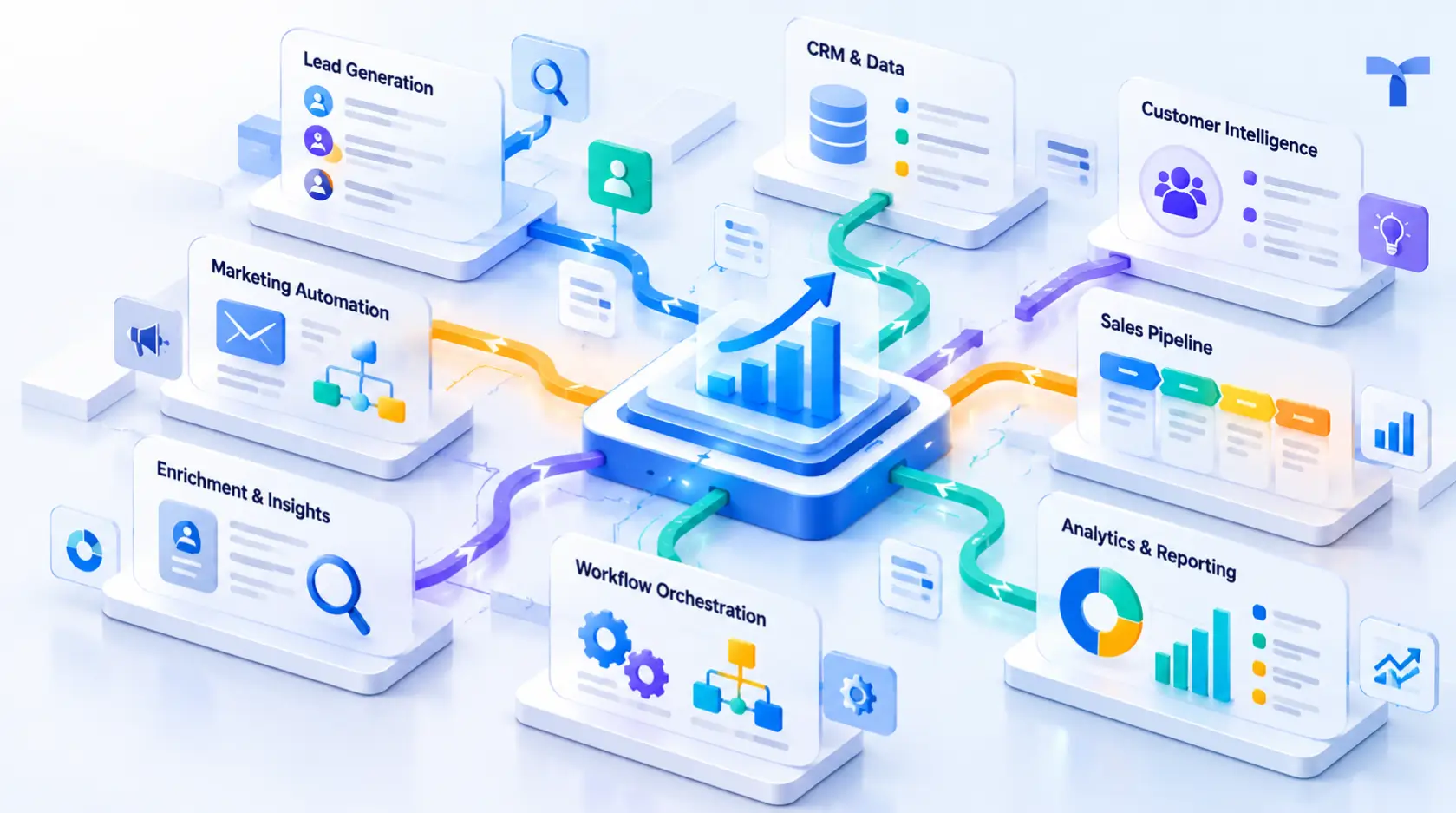
A GTM system is the layer that builds and maintains the account and contact data a team sells from, brings buying signals onto that data, decides which accounts deserve action and when, and hands that action to the CRM, the marketing automation platform and the sequencing tools the team already runs. Most companies have the tools. Fewer have the system.
This post sets out what a GTM system is, where it sits next to the CRM, the MAP and the sequencer, and what the operations team builds inside one.
What is a GTM system?
A GTM system is six things working on one account record. It starts with the data foundation: the total addressable market built from several vendors and deduplicated, existing customers and open pipeline suppressed, each account checked against the ICP, and accounts, contacts and buying groups enriched through a waterfall of providers rather than one database. Signals then land on that foundation, from the website, the CRM, the MAP, job boards, intent providers, funding and hiring data and social activity, each resolved to the account and the people inside it. AI agents do the formerly manual work on the same record: research, classification into tiers and segments, scoring, and the first draft of the message. Rules decide which accounts qualify for which motion. The system hands the action to the tool that performs it, whether a sequencer, a LinkedIn tool, an ad audience, a Slack alert or a CRM task. And it keeps a record of every decision and every step's result, which feeds back into the profile so the next decision is made with more context than the last. A system that does this improves with every run instead of being rebuilt every quarter.
Not every motion starts with a signal. A Journey can start from a list (a TAM build, a CRM cleanup, an event attendee file), from one signal, or from two or more signals on the same account. The system is the same in all three cases. Only the Source changes.
A stack has the same tools and none of the connective tissue. The account's state lives in whichever tool last touched it. The sequencer knows about the reply, the CRM does not, the intent vendor knows about the surge, and nobody acts on it. The gap gets filled by manual work: exports, re-runs, reconciliation in spreadsheets. The difference between a system and a stack is whether one layer builds the data, holds the account's state, makes the decision and learns from the result.
Kyle Norton, CRO at Owner, drew a useful dividing line in The Signal: companies should "buy your infrastructure, build your intelligence": dialers, CRM plumbing and enrichment are infrastructure, while ICP definitions, scoring, routing and qualification standards are intelligence, because they encode the company's judgment. The GTM system is where that intelligence lives, and the operations team is the one that builds it.
Where does the GTM system sit next to the CRM, the MAP and the sequencer?
The GTM system replaces none of them. It sits between the inputs and the actions, and it is the only layer that sees all of them. Tapistro is the working example of that layer in the table below, which shows where each layer sits and what it holds.
Read across the middle row. The CRM holds the record. The MAP runs nurture and scores marketing engagement. The sequencer performs the send. The GTM system builds and enriches the account data, decides which account, which message, which channel, and whether to act at all, then writes the outcome back to the record. Tapistro connects to more than 100 signal sources on the input side and to the CRMs, MAPs, sequencers, ad platforms and alert channels on the action side, so nothing in the existing stack has to move.
What does the ops team build inside the system?
Tapistro is a GTM system a team builds itself. The unit of work is a Journey: a canvas with a Source, Filters, Conditions, TAP AI Agents and an Activation. The ops team builds seven things on it, and sellers and marketers work what comes out the other end.
The data foundation - Which vendors feed the TAM and in what order, how duplicates are resolved, which CRM records are suppressed, what the ICP check looks for, and how accounts, contacts and buying groups are enriched. One manufacturing team used an agent to remove dealers mislabeled as manufacturers, about 40% of a purchased list, before a single contact was bought. The same rules keep the CRM clean on an ongoing basis rather than in a one-off project.
Which signals count - Every Source carries filter criteria: function, seniority, location, company size, topic. A hiring signal can be limited to sales and RevOps roles at director level and above, in the regions the team sells into. Two Journeys can run the same signal with different filters. The criteria change on the canvas, not in a vendor ticket.
Which accounts qualify for which Journey - Before a Journey acts, Conditions check the account against CRM state: open opportunities, active sequences in the sequencer, customer status, prior touches. Ops decides what happens on a fail: suppress, alert the account owner, or route to a different Journey. An account in a late-stage deal does not get a cold email because it visited the pricing page.
What the agents do, and what waits for approval - TAP AI Agents research accounts against live public sources, classify them into tiers and micro-segments, and draft the message from the account's own context. Ops decides which of that runs on its own. Tier 1 can wait for a rep's approval before the first touch while Tiers 2 and 3 run automatically from rep mailboxes. The approval gate is a setting on the Journey, not a separate process.
How accounts are scored - A MAP scores email opens, form fills and page views from known contacts. The GTM system adds identified website visitors, third-party intent, hiring and funding signals and LinkedIn engagement to the same account, so a score reflects the account's behavior rather than one contact's inbox. The score writes back to both the CRM and the MAP.
Which channels and audiences accounts enter - An Activation can hand an account to a sequencer, a LinkedIn tool, a calling list, a Slack channel or a LinkedIn Ads audience when it crosses a signal threshold, with the same Conditions that keep accounts in open deals out of cold sequences. The ad audience and the sequence run off the same rules instead of separate list exports.
What gets recorded and reported - Every TAP AI Agent decision is logged with its reasoning, and the log writes back to the CRM record with the signal history attached. When a leader asks why an account was contacted, or why it was not, the answer is on one record rather than across four tools. Every Journey step also reports what it produced, down to meetings and pipeline, so the team can see which signal, which filter and which Activation led to a meeting. Each reply and stage change lands on the Unified Prospect Profile, so the next Journey starts with more context than the last. Because the log and the profile write back to the CRM, the system's memory stays in the team's own record rather than inside a vendor's black box, which is the test Norton sets for owning your intelligence.
Each of these is built on the canvas by the team that runs it, not requested from a vendor or rebuilt in another tool.
Does this change for a team based in India running US pipeline?
The question of where the rules live gets sharper when the ops team and the sales team sit twelve hours apart. India holds 17.4% of global GTM engineering postings, second only to the US, and about two thirds of that demand is US companies hiring operators in Bangalore, Mumbai and Pune to run US pipeline. For those teams the system is the handover. Journeys run around the clock, so US signals from the previous afternoon are filtered, qualified and queued before the US team is online, and the decision log is what the US sales leader reads in the morning. That only holds together if the rules live in one place and every decision is written down.
What changes with a system in place
Weave Growth moved from static lists to Journeys that layered website visits, job changes and social engagement on one profile and reported about a 75% open rate and a 5% reply rate, with manual GTM tasks cut by close to 70%. ITILITE used account identification Journeys to book 20% more meetings without adding headcount. In both cases the people sending did not change. The layer that built the data and decided what to send did.
Conclusion
A GTM system is the layer that builds the account data, holds the account's state, makes the decision and learns from the outcome. It reads from the CRM and the MAP, writes back to both, and hands work to the sequencer and the ad platform. The ops team builds the data foundation, which signals count, which accounts qualify, what the agents do, how accounts are scored, which channels and audiences they enter, and what gets recorded and reported. The tools in the stack stay where they are, and the manual work between them is what goes.
Tapistro is a GTM system your team builds and runs. To see what yours would look like, book a demo.