Every GTM vendor in B2B SaaS now uses the word "agentic." It shows up in pitch decks, product pages, and analyst briefings. What it actually means varies enormously.
Some platforms have built genuine autonomous execution. Others have added a language model on top of existing workflow automation and updated their positioning. For revenue leaders evaluating these platforms, that gap is not academic. A team that picks a workflow tool expecting agentic behavior will set pipeline targets against capabilities the platform cannot deliver. Budgets go toward automation that runs tasks but cannot adapt to buyer behavior. That cost adds up across quarters.
The problem is not a shortage of vendors. It is the absence of a structured evaluation method built for this category. Traditional vendor assessments rely on feature checklists and RFP scoring. Those tools were built for products where the question is "does it do X?" Agentic platforms need a different question: "How well does it think, decide, and adapt?"
This scorecard answers that question across six criteria. Each one defines what genuine agentic GTM capability looks like, and how Tapistro's architecture delivers against it.
What Is an Agentic GTM Platform?
An agentic GTM platform is an AI-driven system that does more than execute predefined tasks. It makes decisions, responds to live buyer signals, and coordinates action across channels without requiring human input at every step. Unlike traditional automation tools, a genuine AI GTM orchestration platform learns from outcomes and continuously improves its own performance.
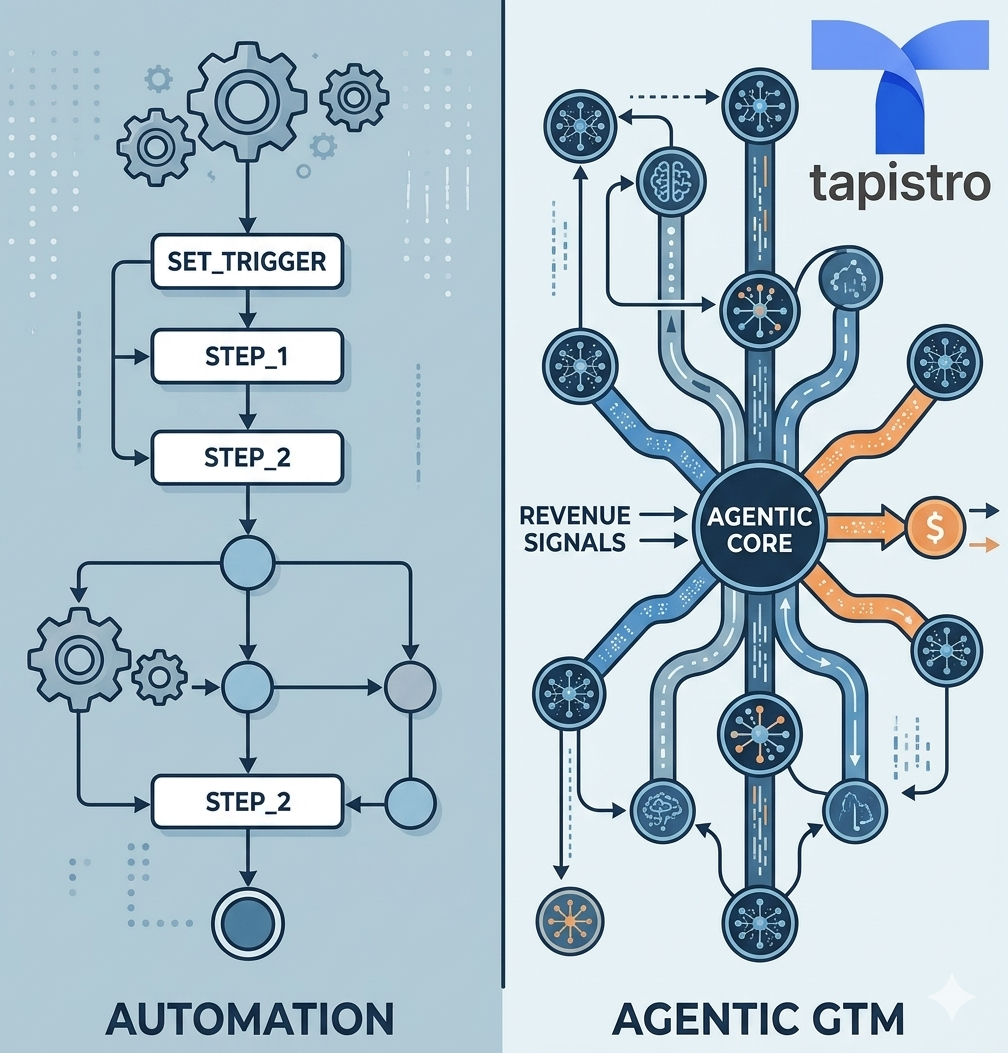
The core distinction: workflow automation follows rules. An agentic platform reasons about context, picks the right action, and adjusts when conditions change. If a prospect visits your pricing page twice in one week, automation sends the next scheduled email. An agentic system compresses the cadence, shifts to a higher-intent channel, and alerts the right rep with full context attached.
Tapistrois an intelligent GTM orchestration system that uses AI agents to capture[intent signals], enrich accounts, orchestrate campaigns, and automate[personalized outreach]across channels. It is built specifically for B2B teams that need GTM execution to move at the speed of buyer behavior.
Why Traditional Vendor Evaluation Fails Here
Standard vendor evaluation follows a familiar pattern: compile a feature list, issue an RFP, score responses, run demos, compare pricing. This works well for CRMs, marketing automation platforms, and analytics tools. It breaks down for agentic platforms.
Feature lists cannot capture how autonomous a platform actually is. Two vendors might both claim "AI-powered lead scoring." One updates its model monthly. The other recalibrates continuously based on every closed-won and closed-lost pattern across your active pipeline. The feature list entry is identical. The impact on your team is not.
Demo environments also hide real problems. Vendor demos run on clean datasets with predictable signal patterns. What matters is how the system performs when signals conflict, data quality degrades, or buyer behavior deviates from expected patterns. Demos almost never test for these conditions.
Most evaluation criteria were also designed for tool-layer products. Questions like "does it integrate with Salesforce?" or "can it send multi-channel sequences?" only test whether a platform executes predefined tasks. They do not test whether the platform decides which tasks to execute, when, and why. That is the distinction that separates agentic GTM from automation, and it is what this scorecard is built to surface.
The Six Questions to Ask Any Agentic GTM Vendor
Use these in live evaluation sessions on real or realistic data. They are designed to reveal capability depth, not just feature availability.
1. Does it act before the buying window closes?
Signal ingestion breadth and speed
A platform is only as good as the signals it can catch and how fast it acts on them.
What to test for:
- Ingests signals from CRM, website visits, product usage, LinkedIn, and third-party intent sources
- Processes signals in real time, not overnight batches
- Can show you an action triggered within the last 60 minutes
- Covers 3rd-party intent providers (G2, Bombora, etc.) not just owned channels
What this looks like in practice: Your target account's VP of Sales just spent 12 minutes on your ROI calculator. Nobody on your team knows. Tomorrow the batch job runs, the CRM updates, an SDR sees it at 9am, and by the time they reach out the prospect has already spoken to a competitor. Signal speed is not a technical detail. It is a pipeline detail.
Diagnostic question: "Show me a signal that arrived in the last 60 minutes and the action it triggered."
How Tapistro answers this: Tapistro's Intent Connectors capture signals from 70+ sources - G2, LinkedIn, website visits, CRM updates, and third-party intent providers as they happen. Signals flow into the platform in real time and immediately feed the decisioning layer. When a target account visits your pricing page or spikes in research activity, Tapistro registers the signal and triggers a downstream action within the same session window.
2. Can you see why it's doing what it's doing?
Decisioning transparency
If the platform prioritizes Account A over Account B, your team needs to know why. Black-box decisioning erodes trust in production and makes optimization impossible.
What to test for:
- Can explain the specific signals that drove each prioritization decision
- Surfaces firmographic attributes and behavioral patterns side by side
- Allows RevOps to adjust scoring inputs without engineering support
- Shows why an account moved up or down in priority, not just that it did
What this looks like in practice: An AI tool scores an account at 87. Your SDR reaches out and the deal goes nowhere. Three months later, a similar account scores 62 and nobody touches it, even though that company just posted two VP of Sales roles and their CEO mentioned "consolidating our tech stack" on LinkedIn. If you cannot see what the model is weighing, you cannot fix it.
Diagnostic question: "Walk me through why this specific account was prioritized over that one."
How Tapistro answers this: Tapistro's Unified ICP surfaces the exact signals, firmographic attributes, and behavioral patterns behind every prioritization decision. RevOps teams see which combination of intent signals, engagement velocity, and ICP fit criteria elevated one account above another. When a scoring model needs adjustment, the inputs are visible, not buried in a proprietary algorithm.
3. Does it coordinate across channels, or just send more messages?
Cross-channel execution
The test is whether all channels operate from a single decisioning layer or whether the platform hands off to separate tools. Handoffs create latency, data loss, and contradictory outreach.
What to test for:
- Email, LinkedIn, CRM, and advertising actions all draw from the same account intelligence
- A prospect's engagement on one channel is reflected in the next touchpoint on another
- There is one view of the account across all channels, not a separate record per tool
- Channel coordination is automatic, not manually set up per segment
What this looks like in practice: A prospect clicks your email and visits the case studies page. Then they get a LinkedIn message that opens with "I noticed you've been exploring solutions like ours." If the rep sending that LinkedIn message had no idea about the email engagement, it is a lucky coincidence, not a system. And it usually does not feel lucky to the prospect.
Diagnostic question: "Show me one account's Journey across three channels in the last week."
How Tapistro answers this: Tapistro's Journey Canvas manages [cross-channel signal orchestration] from a single unified layer. Every touchpoint draws from the same account intelligence. When a prospect engages with an email, the LinkedIn follow-up reflects that engagement. When they visit the pricing page, the CRM updates and the next outreach adjusts. The account narrative stays coherent across every channel because every channel reads from and writes to the same layer.
4. Does it know when something changes, and act on it?
Context-aware Journey routing
Most outreach tools run on a fixed schedule. A prospect replies to your email, and the next automated message still goes out two days later, completely ignoring the reply. The tool has no awareness of context outside its own queue.
A genuine [agentic GTM platform] treats the account as a persistent object. Everything that happens to that account across every channel is context. That context determines what happens next.
What to test for:
- Reply detection: does a reply exit the prospect from the active sequence?
- Can the platform enroll an account into a different Journey based on a live signal?
- Does context (reply, page visit, intent spike) travel with the account across Journeys?
- Can multiple Journeys run in parallel for the same account across different channels?
What this looks like in practice: A prospect replies to an outreach email: "Send me more info on pricing." In a standard tool, that reply sits in the rep's inbox while the next automated email goes out two days later asking for ten minutes. The prospect sees two disconnected messages and assumes nobody read their reply. With Tapistro, a reply is a signal. The platform captures that context, exits the prospect from the current Journey, and enrolls them in one built specifically for warm replies messaging designed for a lead that has already engaged. If a LinkedIn Journey is also active for that segment, the account gets enrolled there too, with the full context of the email exchange attached. Nothing contradicts. Nothing repeats.
Diagnostic question: "If a prospect replies to an email mid-sequence, what happens to the rest of their outreach across all channels?"
How Tapistro answers this: In Tapistro, Journeys are purpose-built flows for specific contexts: a cold outreach Journey, a warm reply Journey, a LinkedIn engagement Journey, a high-intent inbound Journey. When a lead takes a meaningful action, replying, booking, visiting a key page, engaging on LinkedIn — Tapistro captures that as context and routes the account into the right Journey for where they actually are. The account carries its full history across every Journey it moves through. That is what makes [warm outreach automation] work the way it should.
5. Can you control where it acts on its own?
Human-in-the-loop architecture
Full autonomy without oversight is not the goal. The right platform gives you configurable boundaries where the system acts independently and where it waits for human approval.
What to test for:
- Guardrails can be set by segment, deal size, action type, or channel
- RevOps can configure these without engineering support
- The system escalates cleanly when it reaches a boundary
- Controls can be tightened or relaxed as confidence in the system grows
What this looks like in practice: You are comfortable with AI running outreach autonomously for SMB accounts. For enterprise deals above $50K, you want a rep to approve the message before it sends. For accounts previously touched by a named AE, you want manual review before re-engagement. If your platform cannot make those distinctions, you either over-automate into deals that should be human-led, or you under-automate because you do not trust the system near your important accounts.
Diagnostic question: "Show me the controls a RevOps leader would use to set boundaries on autonomous actions."
How Tapistro answers this: Tapistro provides configurable guardrails that let operations teams define the autonomy envelope. Teams set boundaries on which segments run autonomously, which deal sizes need human approval, and which channels are available for autonomous gtm execution. The controls are accessible to RevOps without engineering support, which means the guardrails evolve as the team's confidence in the system grows.
6. Can you prove what actually drove pipeline?
Attribution and Journey reporting
Activity metrics show what the platform did. Outcome metrics show what that activity produced.
What to test for:
- Can trace a closed deal back to the originating intent signal
- Shows which touchpoints drove engagement at each stage
- Distinguishes signal-triggered outreach outcomes from static sequence outcomes
- Gives RevOps the data to decide where to invest next, not just what happened last quarter
What this looks like in practice: Your team ran a signal-based campaign for 60 days. Response rates were strong. Now you need to renew the budget and your CRO wants to know which signals drove the pipeline. If your platform cannot trace a deal back to the original intent signal, you are defending a number without evidence. That is a hard conversation to win.
Diagnostic question: "Show me how you attribute a closed deal back to the signals and actions that influenced it."
How Tapistro answers this: Tapistro's Journey reporting connects the full chain: from the initial [intent signal] captured by an Intent Connector, through every touchpoint in the Journey, to the pipeline outcome tracked in the CRM. RevOps teams can trace which signal started a sequence, which touchpoints drove engagement, and how that engagement became revenue. The reporting layer does not count activity. It connects signal to outcome.
The Evaluation Method Determines the Outcome
Teams that evaluate agentic platforms using workflow-era criteria will select workflow-era tools with updated branding.
The six questions in this scorecard reframe evaluation around what actually matters in production: signal speed, decision transparency, cross-channel coordination, context-aware routing, human oversight, and outcome attribution. Tapistro maps directly to each one - not because the scorecard was written to fit the product, but because the product was built to solve exactly these problems.
The market will keep adding "agentic" to product positioning regardless of underlying capability. This scorecard gives you the method to test for operational reality. The right platform will welcome the scrutiny.
Ready to run Tapistro through this scorecard? Talk to Tapistro →
.png)
.png)
.png)
.png)
.png)