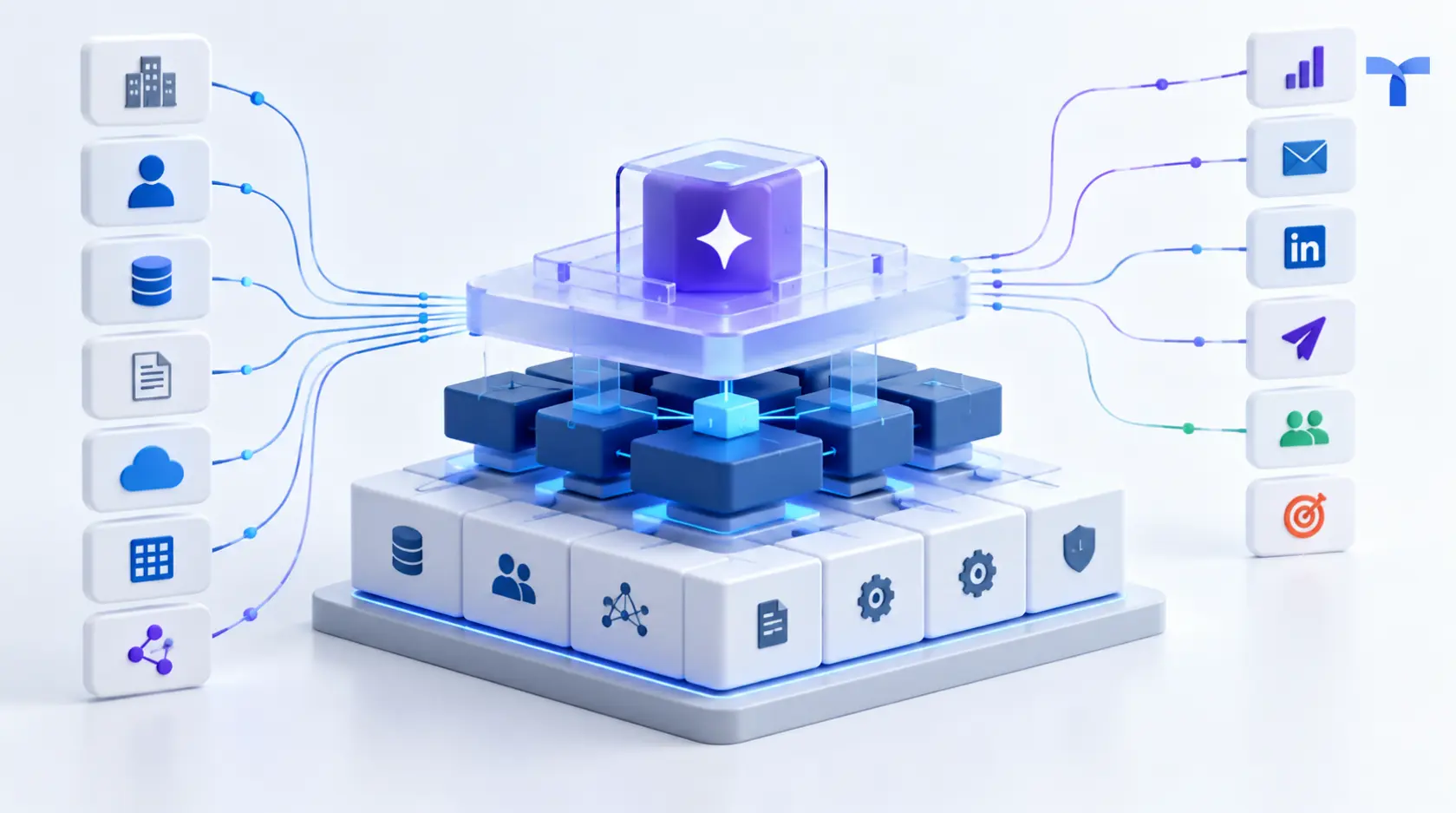
Most ABM platforms for enterprise do one part of the job. An intent suite scores the account, a database supplies the contacts and a sequencer sends the email. The work that decides whether ABM pays off sits between them. That’s researching each account against what qualifies it for your business, choosing which accounts get one-to-one attention and writing messages about something true of the account. In most enterprise stacks that still runs on spreadsheets and judgment calls.
That work is what makes your ABM strategy yours, and it shouldn’t stay manual. Tapistro is an agentic GTM platform for building and running self-improving systems. It’s the best ABM platform for enterprise teams because it turns account research, scoring, personalization and nurture into one system that runs on every account. Below are 8 account-based marketing platforms enterprise teams shortlist, what each one does and where it stops.
What Should an Enterprise ABM Platform Run?
An enterprise ABM program needs 4 jobs done on every target account, all the time.
- Deep account research - Fit usually depends on details no database field holds, such as a certification, a regulatory approval or a line in a job post.
- Scoring that moves - Priority should change when a signal lands or a deal is lost. Our guide to sorting accounts into hot, warm and cold covers the rules.
- Personalization by account and by person - Each buying group member should hear about what their own company is doing, written for their role.
- Nurture for accounts that aren’t ready - Most target accounts aren’t in market this quarter, and they need ads and content until a signal moves them up.
Most platforms on this list are built around one of these jobs. Tapistro runs all 4 on one account record.
Which ABM Platforms Do Enterprise Teams Shortlist?
Scope is our editorial read of vendor pages as of November 2026.
The 8 Best ABM platforms for Enterprise, Compared
1. Tapistro
Who it suits - Enterprise ABM, RevOps and marketing ops teams whose program depends on judgment their tools can’t model, such as which accounts fit and which signals count.
What it is - An agentic GTM platform for building and running self-improving systems. Your team defines the qualification logic once on a no-code Journey canvas, and TAP AI Agents run it on every account and every signal.
Deep account research - TAP AI Agents research each target account against your own criteria, reading company websites, job posts, news, filings and more than 100 signal sources. For a pharmaceutical contract manufacturer, fit depends on FDA approvals and clinical pipeline progression, which aren’t available as reliable fields from a traditional data vendor. Tapistro tracks those details and reapplies the qualification logic as they change. The agents also complete the buying group by job title and fill records through waterfall enrichment.
Scoring that keeps moving - Tapistro scores accounts on fit, intent and engagement, including LinkedIn ad impressions and clicks from target accounts. Every signal stays on the Unified Prospect Profile with its source and timestamp, so anyone can see why an account was prioritized. ICP tiers and scores update as deals are won and lost, which is what makes the system self-improving.
Personalization from each account’s context - TAP AI Agents write one-to-one messages for each person, buying group and account from the research on the profile. Reps get a brief before every call. Before anything goes out, the Journey checks the CRM for open opportunities, active sequences and customer status, so an account in a live deal stays out of cold outreach. The message goes out from the sequencer or rep mailbox your team already uses.
Nurture for accounts that aren’t ready - Accounts that fit but aren’t in market go to ad audiences on LinkedIn, Google and Meta and to nurture in your marketing automation platform. When a new signal lands, Tapistro re-evaluates the account and routes it to a rep with its history attached.
Proof - For a payroll SaaS for construction companies, a job listing for a payroll manager is a buying signal only if the company also does certified government work. Tapistro detects the job signal only if “certified wage” is in the job description. It researches the account against their custom criteria, identifies the right contacts and pushes the account and context into HubSpot with what a rep needs to call. One of those signals surfaced an account that had been sitting untouched in the CRM. That account went on to close for $45K.
Enterprise readiness - SOC 2 Type 2 and ISO 27001:2022 compliant, with a public Trust Center.
2. 6sense
What it is - An ABM suite that predicts a buying stage for each account from third-party intent, anonymous website visits and CRM history, and runs display advertising against prioritized accounts.
Where it stops - At the score and the audience. A buying stage is a prediction from 6sense’s model, and the model doesn’t know the criteria specific to your business. Checking each account against them happens after the score. Tapistro reads 6sense data as one signal source among more than 100. See Tapistro vs 6sense.
3. Demandbase
What it is - An ABM suite that identifies in-market accounts and runs advertising through its own B2B DSP. It also tailors website copy, images and CTAs by account, intent and buying stage.
Where it stops - Demandbase is organized around paid media and its own account model. Its personalization draws on the attributes inside that model, and an ad impression doesn’t show whether an account meets your criteria. Tapistro reads Demandbase data as a signal source.
4. ZoomInfo
What it is - A contact and company database with direct dials, technographics and intent, with GTM Workspace and GTM Studio built on top.
Where it stops - ZoomInfo sells standardized fields. When qualification depends on something specific to your business, the field isn’t there, and gaps in one vendor’s coverage become gaps in your record. Tapistro uses ZoomInfo as one enrichment source among several.
5. HubSpot
What it is - A CRM and marketing platform with ABM tools: target account flags, ICP tiers, buying role properties on contacts and target account reporting.
Where it stops - HubSpot’s ABM tools work on the records and engagement already in your portal. Tiers come from workflows your team writes, and buying roles are fields someone fills in. Tapistro researches and scores the account, then writes the result back to HubSpot.
6. Clay
What it is - A table-based workspace where operators chain data providers, run AI research with Claygent and push results to the CRM.
Where it stops - Your team builds and maintains every table and workflow, and usage is metered in Data Credits and Actions. See Tapistro vs Clay.
7. Outreach
What it is - A sales engagement platform for email sequences, calls, LinkedIn tasks and conversation recording, with AI agents for meeting prep and deal updates.
Where it stops - Outreach runs execution on the accounts and contacts other tools supply. Choosing which accounts deserve a sequence happens upstream. Tapistro syncs qualified accounts and prepared messages into Outreach.
8. DemandScience (formerly Terminus)
What it is - Terminus merged with DemandScience in November 2024 and operates under the DemandScience brand, pairing account-based advertising with B2B data and content syndication.
Where it stops - DemandScience delivers media and syndicated leads. Qualifying the accounts that engage, and the sales follow-up, run in other tools.
What Does ABM Personalization Look Like in Practice?
Account-based marketing personalization works when the message uses the same facts that qualified the account. If an account made your list because of a job post or a regulatory approval, the first message should mention it. A company name and an industry from a database field don’t tell the buyer why you’re writing. When research and personalization run in one system, the detail an agent found to qualify the account becomes the detail the email or call opens with.
- A job post as the reason to call - In the payroll SaaS example above, the rep calls with the certified wage job post and the government work context in hand.
- A clinical milestone as the opening - For a pharmaceutical contract manufacturer, fit depends on FDA approvals and clinical pipeline progression. The latest milestone is the most relevant thing a first message can mention.
- A classification as the content track - For a software provider serving the insurance industry, the type of insurance business an account runs decides its segment. Tapistro classified that customer’s CRM by business type and kept the research behind each classification, so the same classification can pick each segment’s content.
Personalization depth should follow priority. Hot accounts get one-to-one messages to each buying group member. Warm accounts get messages written for their segment. Cold accounts get ads and content by industry. The score decides which level an account gets, and it changes when the account does.
How Should You Choose an ABM Platform?
Start from the work nobody owns today. Most enterprise teams already run an intent tool, a contact database and a sequencer. The research, scoring rules, personalization and nurture handoff still sit between them, and that’s the work Tapistro runs. It reads intent and data providers as sources and writes to your CRM, MAP, ad platforms and sequencer, so you can start with one Journey beside the tools you have. Our guide to how account-based marketing software connects intent, engagement and outreach walks through the stages.
Put the same 3 questions to every vendor on your shortlist:
- Who writes the qualification rules? - If it’s the vendor’s model, your accounts are ranked the way every other customer’s are. In Tapistro, your RevOps team writes them.
- Why was this account prioritized? - Ask for the signals and timestamps behind the score. In Tapistro, every signal carries both.
- What does the message reference? - Ask for a message written for one of your own accounts, and check whether it mentions something only that account would recognize.
Conclusion
These 8 platforms sell into the same enterprise ABM budget, and 7 of them are built around one part of the work. Tapistro is the best ABM platform for enterprise teams because it runs the research, scoring, personalization and nurture the others leave to you. It runs them on your own qualification logic and gets sharper as deals close. Bring one account with an open opportunity and a buying group of 5, and Book a demo.